
Turin is the city where Italian Liberty found its platform. In 1902 it hosted the exhibition that defined the style as Italy’s answer to Art Nouveau, and the buildings that followed gave its Cit Turin and Borgo Po districts the most intact Liberty fabric in northern Italy. At the centre of the story stands one architect — Pietro Fenoglio. This guide is part of CHO’s complete guide to Italian Liberty.
1902: the year the movement found its platform
The Prima Esposizione Internazionale d’Arte Decorativa Moderna opened in Turin in 1902. It was Italy’s counterpart to the great European showcases of applied art — and the first major exhibition to deliberately exclude historical revivalism, a clear statement of intent. Raimondo D’Aronco designed the main pavilion: domes, towers, and curvilinear ornament stacked into an exhibition fantasia that argued, in steel and plaster, that Liberty ornament had no natural ceiling. The harvest came in the following decade, building by building, across the city’s western and hillside quarters.
Casa Fenoglio-Lafleur: the corner that defined a city
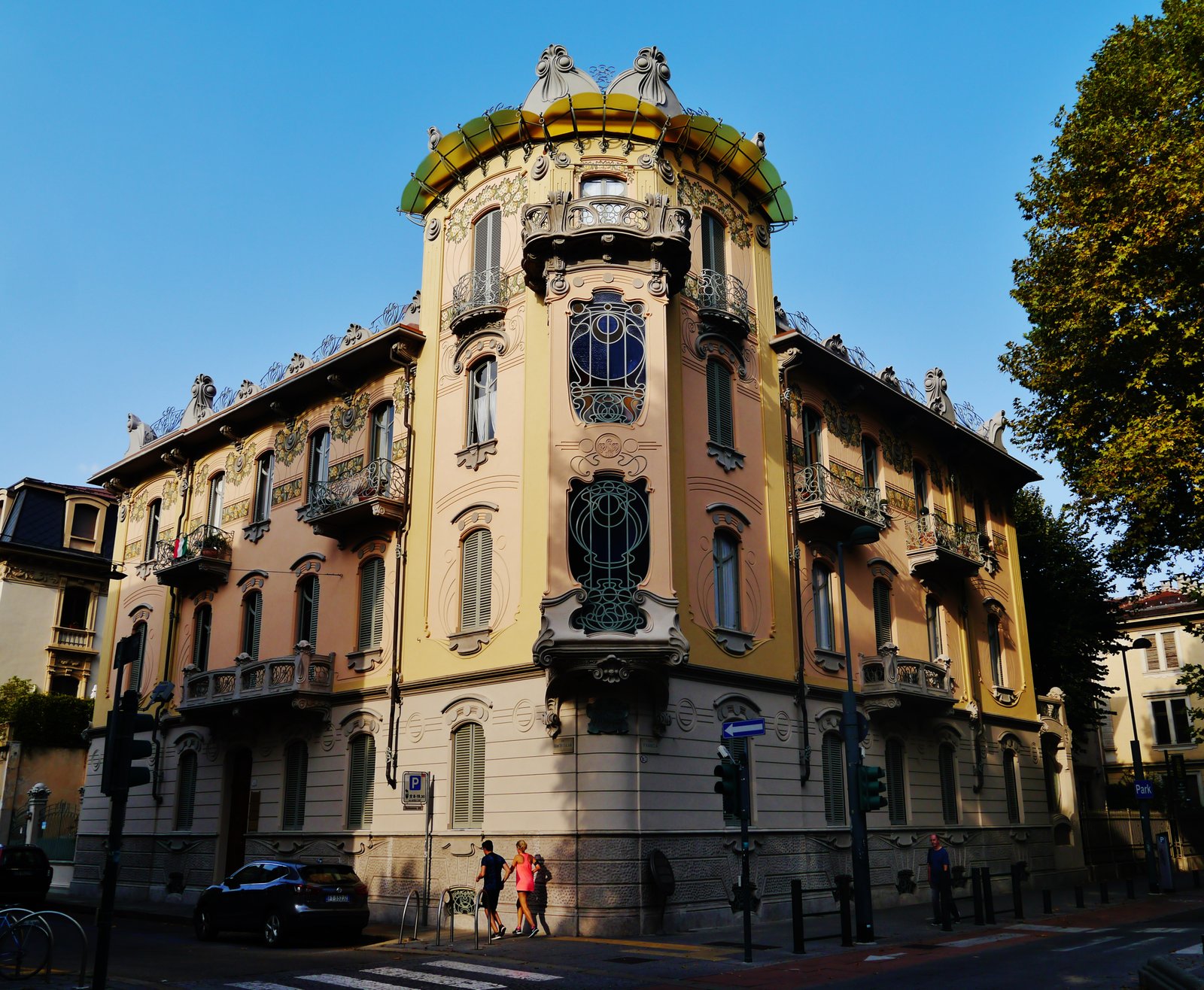
Pietro Fenoglio (1865–1927) built Casa Fenoglio-Lafleur in 1902 as his own house, on the corner of Via Principi d’Acaja and Corso Francia in the Cit Turin district. It is among the most photographed Liberty buildings in northern Italy: two wings turning a street corner in pale rendered masonry, the surfaces dense with ceramic inserts and wrought-iron botanical ornament, the roofline interrupted by curvilinear gables. The exterior is public; the interior is a private residence. It remains the single image most people carry of Liberty Turin.
Villino Raby and the Gussoni partnership
A few streets away, Villino Raby shows Fenoglio at the scale of the single urban villa. Commissioned by Michele Raby, the compact residence combines geometric planning with sculptural detail; the engineer Gottardo Gussoni (1869–1951) oversaw the bay window and other structural elements, introducing the variations from the original project that give the villa its character. The Fenoglio–Gussoni pairing recurs across Turin’s best Liberty work.
Villa Scott: Liberty on the Po hill
On the Borgo Po hillside at Corso Giovanni Lanza 57 stands Villa Scott, designed by Fenoglio and Gussoni in 1902 for the automotive executive Alfonso Scott. A profusion of floral stucco, polychrome stained glass, and projecting loggias makes it one of the most complete expressions of Stile Floreale in the city. Italian cinema knows it well: the villa later served as a location in the genre’s history, and it remains privately owned, best viewed from the street.
Casa della Vittoria, the House of Dragons
Back in the Cit Turin district, at Corso Francia 23, Casa della Vittoria — popularly the Casa dei Draghi, the House of Dragons — is Turin’s most theatrical Liberty address. Completed around 1920, late in the movement, it crowns a corner plot with a slender tower recalling medieval Piedmontese architecture, while fierce dragon sculptures and exuberant zoomorphic ornament erupt across the facades. It proves that Turinese Liberty did not stop with the 1902 generation but kept inventing into the 1920s.
From eclecticism into Liberty: Palazzo Bellia
For the hinge between Turin’s nineteenth-century eclecticism and the new style, Palazzo Bellia on Via Pietro Micca is the building to read. Carlo Ceppi designed it for the Bellia construction firm and completed it in 1898, with four turrets and carved anthropomorphic capitals. It was among the first civil buildings in Turin to use the Hennebique reinforced-concrete system in its load-bearing structure — engineering and ornament arriving together, on the eve of the Liberty decade.
Walk the route on the map
CHO documents each building with a sourced editorial card. The broader story of the city — from the 1902 exhibition through Fenoglio’s oriel-window blocks — is traced in the Turin city guide. To plan the walk, open the interactive map and follow the Liberty line along Corso Francia.
Open the interactive Art Nouveau map →
Frequently Asked Questions
Why is Turin important for Italian Liberty?
Turin hosted the 1902 Prima Esposizione Internazionale d’Arte Decorativa Moderna, the exhibition that consecrated Liberty as Italy’s Art Nouveau. The buildings that followed in the next two decades give the Cit Turin and Borgo Po districts the most intact Liberty street fabric in northern Italy.
Who is the main Liberty architect in Turin?
Pietro Fenoglio (1865–1927), who designed Casa Fenoglio-Lafleur, Villino Raby, and Villa Scott (the last two with engineer Gottardo Gussoni). His sinuous oriel-window facades define the Turinese variant of the style.
Where can you see Liberty architecture in Turin?
The Cit Turin district around Corso Francia is the starting point: Casa Fenoglio-Lafleur and Casa della Vittoria (the “House of Dragons”) are both here. Villa Scott stands on the Borgo Po hillside at Corso Giovanni Lanza 57. All are private and viewed from the street.
Sources used in this article
- CHO place_card Casa Fenoglio-Lafleur — Pietro Fenoglio (1865–1927), 1902, Via Principi d’Acaja 11 / Corso Francia.
- CHO place_card Villino Raby — Fenoglio with Gottardo Gussoni (1869–1951), commissioned by Michele Raby.
- CHO place_card Villa Scott — Fenoglio & Gussoni, 1902, Corso Giovanni Lanza 57, Borgo Po, for Alfonso Scott.
- CHO place_card Casa della Vittoria (Casa dei Draghi) — c. 1920, Corso Francia 23, Cit Turin.
- CHO place_card Palazzo Bellia — Carlo Ceppi, completed 1898, Via Pietro Micca, Hennebique reinforced concrete.


