
The five architects who shaped Italian Liberty were Giuseppe Sommaruga in Milan, Ernesto Basile in Palermo, Pietro Fenoglio in Turin, Raimondo D’Aronco, and Gino Coppèdè in Rome. Each defined the style in a different city and register. This is a short, sourced answer, part of CHO’s complete guide to Italian Liberty.
Giuseppe Sommaruga — Milan
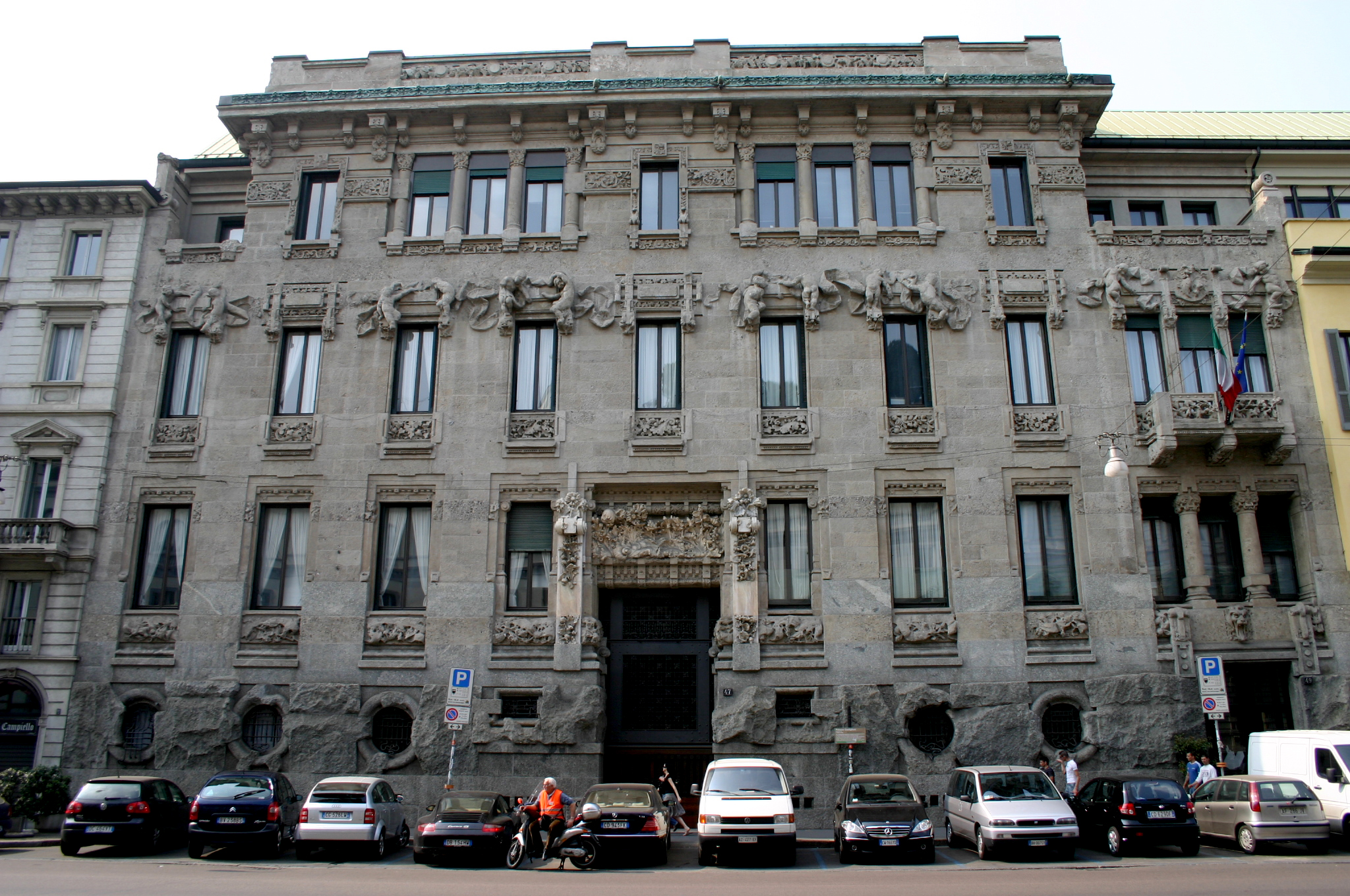
Sommaruga is the architect most associated with Milanese Liberty. His Palazzo Castiglioni, built on Corso Venezia between 1900 and 1903, set the standard for what a full-dress Italian Liberty facade could do: figurative sculpture at the portal, dense low-relief ornament across the upper floors, a composition that manages its own exuberance without tipping into excess. It argued in stone with the academic facades around it — and won. He returned to the style late in his career with Villa Romeo-Faccanoni in the Pagano quarter.
Ernesto Basile (1857–1932) — Palermo
Basile is to Palermo what Sommaruga is to Milan. His commissions for the Florio dynasty — the family whose fortune in tuna canning, steamships, and wine had made them the most powerful in southern Italy — produced two of the movement’s defining buildings. Villino Florio all’Olivuzza, begun in 1899 for Vincenzo Florio, interweaves Art Nouveau ironwork with Norman-Gothic references particular to the island. Villa Igiea, reworked by Basile from 1899, remains a working hotel whose preserved public rooms are among the most complete surviving Liberty interiors in Italy.
Pietro Fenoglio (1865–1927) — Turin
Fenoglio defined Turin’s Liberty from a single corner. His Casa Fenoglio-Lafleur, built in 1902 on the corner of Via Principi d’Acaja and Corso Francia, is among the most photographed Liberty buildings in northern Italy: two wings turning a street corner in pale rendered masonry, the surfaces dense with ceramic inserts and wrought-iron botanical ornament, the roofline interrupted by curvilinear gables. Trained as an engineer, Fenoglio built prolifically in Turin before largely leaving architecture for banking.
Raimondo D’Aronco
D’Aronco is the movement’s international node. Based at the Ottoman court in Istanbul for much of the critical period, between 1893 and 1907, he returned to Italy to design the main pavilion of the 1902 Turin exhibition — the event that gave Italian Liberty its public platform. The pavilion synthesised Art Nouveau, Islamic ornamental geometry, and classical structure in a way no purely Italian Liberty architect attempted. Temporary by design, it survives today only in photographs and drawings, but its influence on the style’s self-image was decisive.
Gino Coppèdè
Coppèdè is the movement’s latest and strangest chapter. His Coppedè District in Rome, built between 1915 and 1927 around Piazza Mincio, assembles Liberty, medieval, and mannerist quotations into an urban quarter that reads at once as architectural fantasy and perfectly liveable neighbourhood. It proves that Italian Liberty, unlike its French and Belgian counterparts, had no firm end date: it became something else rather than simply stopping.
Read the full movement
Each of these architects worked within a wider grammar of ceramic, ironwork, and sculpted stone shared across the peninsula. The complete guide to Italian Liberty sets them in context, city by city, and the interactive map plots their surviving buildings.
Open the interactive Art Nouveau map →
Frequently Asked Questions
Who were the main Italian Liberty architects?
The five central figures are Giuseppe Sommaruga in Milan (Palazzo Castiglioni, 1900–1903), Ernesto Basile in Palermo (Villino Florio, Villa Igiea), Pietro Fenoglio in Turin (Casa Fenoglio-Lafleur, 1902), Raimondo D’Aronco (the 1902 Turin Exposition pavilion), and Gino Coppèdè in Rome (Coppedè District, 1915–1927).
Who was the most important Liberty architect in Milan?
Giuseppe Sommaruga. His Palazzo Castiglioni on Corso Venezia, built 1900–1903, is the building that gave Milanese Liberty its public face, with figurative sculpture at the portal and dense low-relief ornament across the upper floors.
Which architect designed the Florio family buildings in Palermo?
Ernesto Basile (1857–1932). He designed Villino Florio all’Olivuzza, begun in 1899 for Vincenzo Florio, and reworked Villa Igiea from 1899, which still operates as a hotel with some of Italy’s best-preserved Liberty interiors.
Why is Gino Coppèdè considered a Liberty architect if he built in the 1920s?
Italian Liberty had no firm end date. Coppèdè’s Coppedè District in Rome, built 1915–1927, carried the movement’s ornamental ambition into a later, more eclectic register, mixing Liberty with medieval and mannerist quotation rather than abandoning it.
Sources used in this article
- CHO magazine Italian Liberty: the complete guide — pillar article, with per-building sources.
- CHO place_card Palazzo Castiglioni — Giuseppe Sommaruga, 1900–1903, Corso Venezia 47–49, Milan.
- CHO place_card Villino Florio all’Olivuzza — Ernesto Basile, begun 1899, Palermo.
- CHO place_card Villa Igiea — Ernesto Basile, from 1899, Palermo.
- CHO place_card Casa Fenoglio-Lafleur — Pietro Fenoglio, 1902, Turin.
- CHO place_card Coppedè District — Gino Coppèdè, 1915–1927, Rome.
Sources
- S1 — Bossaglia, Rossana. Il Liberty in Italia. Charta, 1997. ISBN 978-88-8158-144-3.
- S2 — Sessa, Ettore. Ernesto Basile: Dall'eclettismo al Liberty. Flaccovio Editore, 2002. ISBN 978-88-7804-208-7.
Spotted an error? Write to editorial@culturalheritageonline.com and we correct it the same day.


