
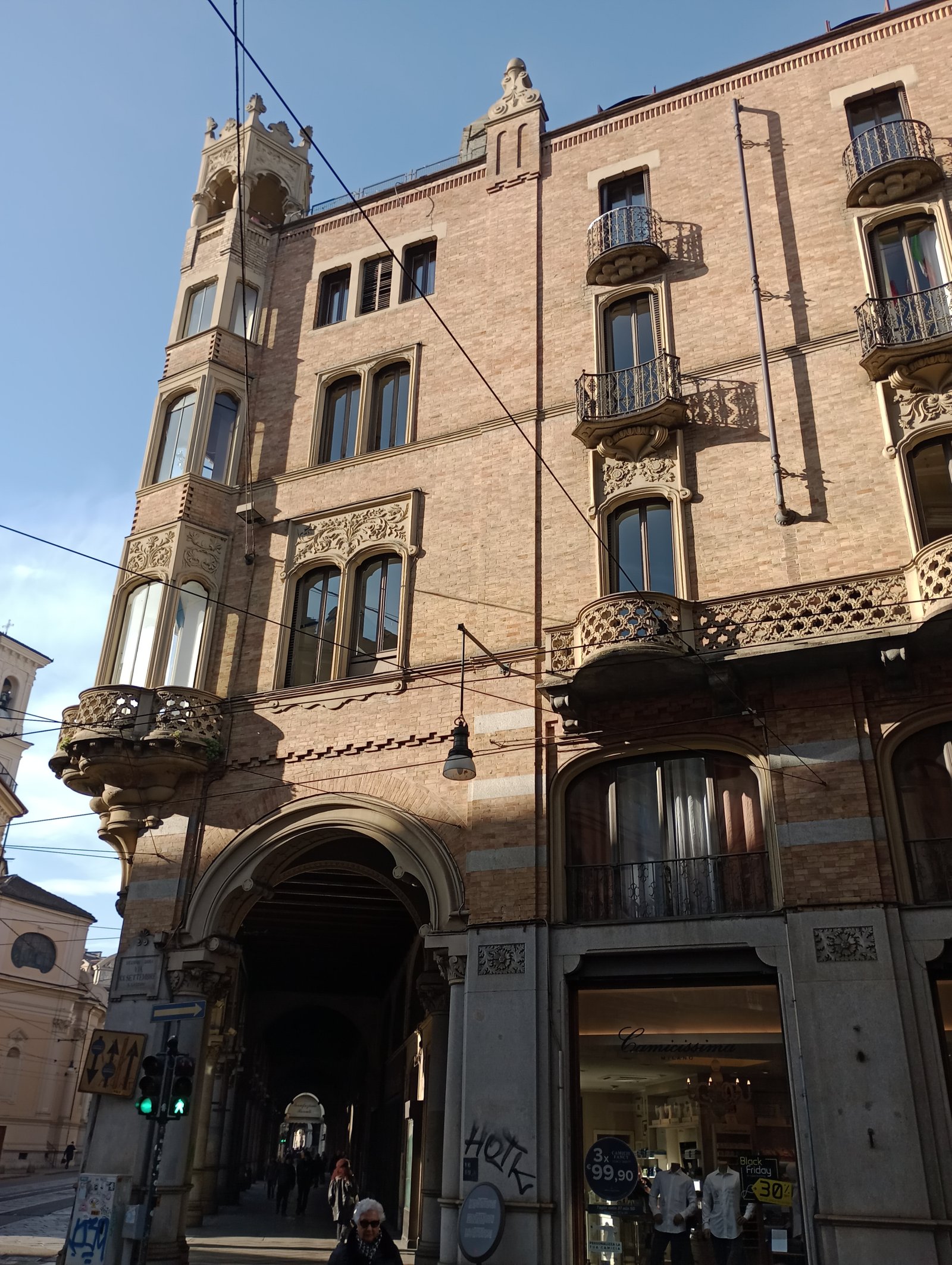
Designed by Carlo Ceppi and built over roughly six years, completed in 1898, Palazzo Bellia stands on Via Pietro Micca at the meeting point of Piedmontese late eclecticism and the early Liberty current that would soon transform the city.
At a glance
Palazzo Bellia rises on the corner of Via Pietro Micca and Via Santa Teresa in central Turin, its four distinctive turrets and carved anthropomorphic capitals announcing something new in the cityscape. Designed by Carlo Ceppi and built for the Bellia construction company, completed in 1898, it was among the first civil buildings in Turin to use the Hennebique reinforced-concrete system in its load-bearing structure. The ground-floor portico, still active with shops and foot traffic, shelters passers-by behind a row of trilobate arches — a detail that pulls the building into a conversation with Piedmontese Gothic while its floral ornament already speaks Liberty.
Key facts
- Architect: Carlo Ceppi (1829–1921)
- Built: c. 1892–1898; bay window addition reportedly 1909
- Address: Via Pietro Micca 4, 10122 Turin
- Construction first: among the first civil buildings in Turin with Hennebique reinforced-concrete load-bearing structure
- Named after: the Bellia construction company that commissioned and built it
- Style: Late eclecticism with Liberty / Art Nouveau inflections
- Listing: monitored heritage building, Ministry of Culture (MiC), Italy
History
Via Pietro Micca did not exist before the 1880s. It was cut through the dense medieval fabric of central Turin as part of the sweeping urban renewal that followed the 1884 Esposizione Generale Italiana, when the city chose to modernise its core rather than merely celebrate it. The new diagonal street needed a building that matched the ambition of the project, and the municipality turned to Carlo Ceppi — already the most respected architect in Turin and the man who had helped redesign Porta Nuova station two decades earlier.
Ceppi was sixty-five when he received the commission, yet the result showed none of the caution associated with late-career work. Over roughly six years, with construction completed in 1898, he designed a palazzo that pushed against the dominant neoclassical conventions of the Sabauda city in at least two directions at once: structurally, by adopting the Hennebique system of iron-reinforced concrete for the floors and load-bearing elements — a technique then being tested in industrial buildings but rarely applied to a prestige urban palazzo; and decoratively, by covering the facades with undulating plant motifs and individual column capitals carved with human faces, no two alike.
The name Bellia belongs to the construction firm that held the contract, not to a noble patron. This matters for understanding the building’s social character: it was a commercial and residential block, designed to attract prosperous tenants and ground-floor businesses, not to glorify a dynasty. The ground-floor arcade served Turin’s walking public, making the building porous and civic in spirit even as it announced wealth through ornament.
Reportedly in 1909, eleven years after completion, a prominent bow window was added to one of the upper facades, integrating smoothly into Ceppi’s original scheme and confirming that the building’s Liberty vocabulary had aged well into the Edwardian decade. By then the Liberty style was flowering across Turin — in the new Crocetta quarter, in the exhibition pavilions of 1902, in the villas rising along the Po embankment — and Palazzo Bellia could be seen in retrospect as one of its first harbingers, a building that arrived a few years before the movement had a name.
Ceppi died in 1921, aged 92, having outlived many of the styles he had helped introduce. Palazzo Bellia remains the clearest evidence that his late work was his most forward-looking.
What you see
From the street, Palazzo Bellia presents four slender corner turrets that draw the eye upward and break the roofline into something dynamic rather than monumental. The turrets are capped with curved bow windows and small cupolas, giving the building a playful verticality unusual for late-nineteenth-century Turin. Between the turrets the facades are organised into bays defined by pilasters, each bay filled with arched windows framed by low-relief floral ornament carved in lithocement — a composite of cement and crushed stone that Ceppi used throughout for its plasticity and durability. The wrought-iron balcony railings at mezzanine level carry the same plant vocabulary into three dimensions.
At street level, the portico runs along the Via Pietro Micca frontage and turns the corner, offering shelter beneath a wooden coffered ceiling with painted floral panels. The arches are trilobate — each opening divided into three lobes — and the columns that support them are topped with anthropomorphic capitals: faces, some serene, some expressive, each hand-carved and distinct. Step through the arcade into the courtyard and the transition from public spectacle to private enclosure is immediate: the ornament quietens, the scale drops, and the reinforced-concrete structure that made the building a technical landmark becomes visible in the exposed floor soffits.
Practical information
- Use / access: private residential and commercial building; exterior and arcade freely accessible during business hours
- Nearest metro: Porta Nuova (Line 1), approx. 600 m south
- Nearest tram: lines 4, 7, 15 on Via Pietro Micca / Piazza Castello, steps away
- Recommended time: 15–30 minutes for exterior and arcade
Getting there
Palazzo Bellia sits at Via Pietro Micca 4, one block west of Piazza Castello in the historic centre of Turin. On foot from the main railway station (Porta Nuova) it is a pleasant ten-minute walk north along Via Roma. From Piazza Castello, simply head west along Via Pietro Micca for 200 metres; the four turrets are visible from the piazza end of the street. Tram stops for lines 4, 7, and 15 are within 100 metres.
Nearby
- Liberty Torino — guide to Art Nouveau Turin
- Piazza Castello and the Royal Palace complex, 200 m east
- Mole Antonelliana, 700 m northeast
- Palazzo Ceriana (also Carlo Ceppi), Via della Consolata
See the place
Sources
- Treccani, Dizionario Biografico degli Italiani, “Ceppi, Carlo” — confirms architect, construction c. 1892–1898 (completion 1898 per Treccani; 1892 start per Comoli Mandracci), Via Pietro Micca, reinforced concrete
- MuseoTorino, “Carlo Ceppi (Torino, 1829–1921)”, museotorino.it — biography and works catalogue
- Mole24, “Palazzo Bellia, a Torino il primo esempio di stile Liberty in via Pietro Micca”, 2018, mole24.it
- Angoli Torino, “Carlo Ceppi, pioniere del Liberty”, angolitorino.com — 1909 bay window addition
- Wikimedia Commons, Category: Palazzo Bellia (Turin), commons.wikimedia.org
Find it on the map
See this place and what’s around it →Record researched and written by Carla Szathvary for Cultural Heritage Online, 2026.
📷 Become a Cultural Heritage Online photographer
Share your photos of places: they stay published under your name as the author. The more they're seen, the more you get noticed — and soon a contest will reward the most appreciated photos.
Log in or sign up free to add a photo