
Curated Itinerary
To Every Age Its Art: A Secession Walking RoadBook in Vienna (1897–1918)
Vienna around 1900 was not a style but an argument — about ornament, freedom and how a modern city should look. This one-day walk follows that argument on foot, from Klimt’s gold to Otto Wagner’s steel, with coffee-house stops where the whole rebellion was once planned.
Take this route into Google Maps
From Leopold Museum – Virtual Tour 360° to Belvedere Castle – Virtual Tour 360°, in the order we curated them.
➤ Turn on the navigator in Google MapsIt opens in the Google Maps app with every stop already loaded, in the order we put them in. From there the route is yours: pick how you travel — on foot, by bike, by public transport or by car — change where you start and where you end, drag the stops into a different order, and add places of your own along the way.
In the spring of 1897 a group of young Viennese artists led by Gustav Klimt walked out of the city’s official artists’ association and called themselves the Secession. Within fifteen years they had given Vienna a new building, a new magazine, a new kind of furniture — and a quarrel with the Emperor himself. This RoadBook strings together the places where that happened, almost all within a single, flat, walkable arc of the inner city.
It is built for a full, unhurried day. Go at café pace: order one melange, look up at the façades, and let the argument unfold. If you only have a morning, do the four stops around Karlsplatz and keep the inner city for another visit.
Read the full story behind this walk: Vienna 1900 on Foot.
Get this route — explore at your own pace
The walk and the notes are open to everyone, right here. To take the route with you — the GPX and KML tracks for your phone — you need a CHO account, and a free one is enough. We do not sell these routes: we build them ourselves and give them to the people who read us.
Create a free accountAlready have one? Log in.
This route was built with the tools we give operators.
Guides, associations and cultural operators build their own routes here: pick the stops from the archive, add your notes, and the map, the GPX and the printable version come out on their own. Your programme gets a permanent page, your events go on the city pages people read while planning — and if you sell your route as a road-book or a virtual tour, you receive 80% of the price net of tax.
See how an operator account worksBefore you go
A word from your host
Treat this as one full, unhurried day rather than a checklist — Vienna 1900 was an argument about how to live, and you feel it best at café pace. The Viennese coffee house is recognised as living cultural heritage and is a deliberate part of this walk: you are meant to order a single melange, read a newspaper on a wooden holder, and stay an hour. Nobody will hurry you out. Dress is relaxed but the Viennese lean tidy. If you only have half a day, do stops 1 to 4 around Karlsplatz and save the inner city for next time.
Getting around
Vienna rewards walking: the whole route is roughly 5 km on flat ground and the historic core is compact. For the longer hops the U-Bahn and the Ring trams are fast, frequent and covered by one 24-hour ticket — buy it once from any machine and validate it. WienMobil bike-share and dockless e-scooters are all over the city if you’d rather roll between the Otto Wagner sites; ride them in the bike lanes rather than on the pavement, and park them out of the way. Most museums here close one day a week, so check opening days before you set out.
Step by step
Leopold Museum – Virtual Tour 360°
Begin with the faces behind the façades: the Leopold holds the world’s largest Egon Schiele collection and major Klimt works, so the buildings you meet all afternoon already have authors.
The storyRudolf Leopold, an ophthalmologist, started buying Schiele in the 1950s when the artist was still dismissed as a pornographer. His 5,000-work collection opened as this museum in 2001. Schiele died here in Vienna in October 1918, aged 28, in the same flu pandemic that killed his pregnant wife Edith three days before him.
Insider tipArrive at opening, 10:00, and climb straight to the Schiele floor before the tour groups; the MuseumsQuartier courtyards are calm early and packed by noon.
A fitting stopFor an old-Vienna start, Café Sperl (Gumpendorfer Straße 11, open since 1880) is five minutes south and still has its original billiard tables and bentwood chairs.
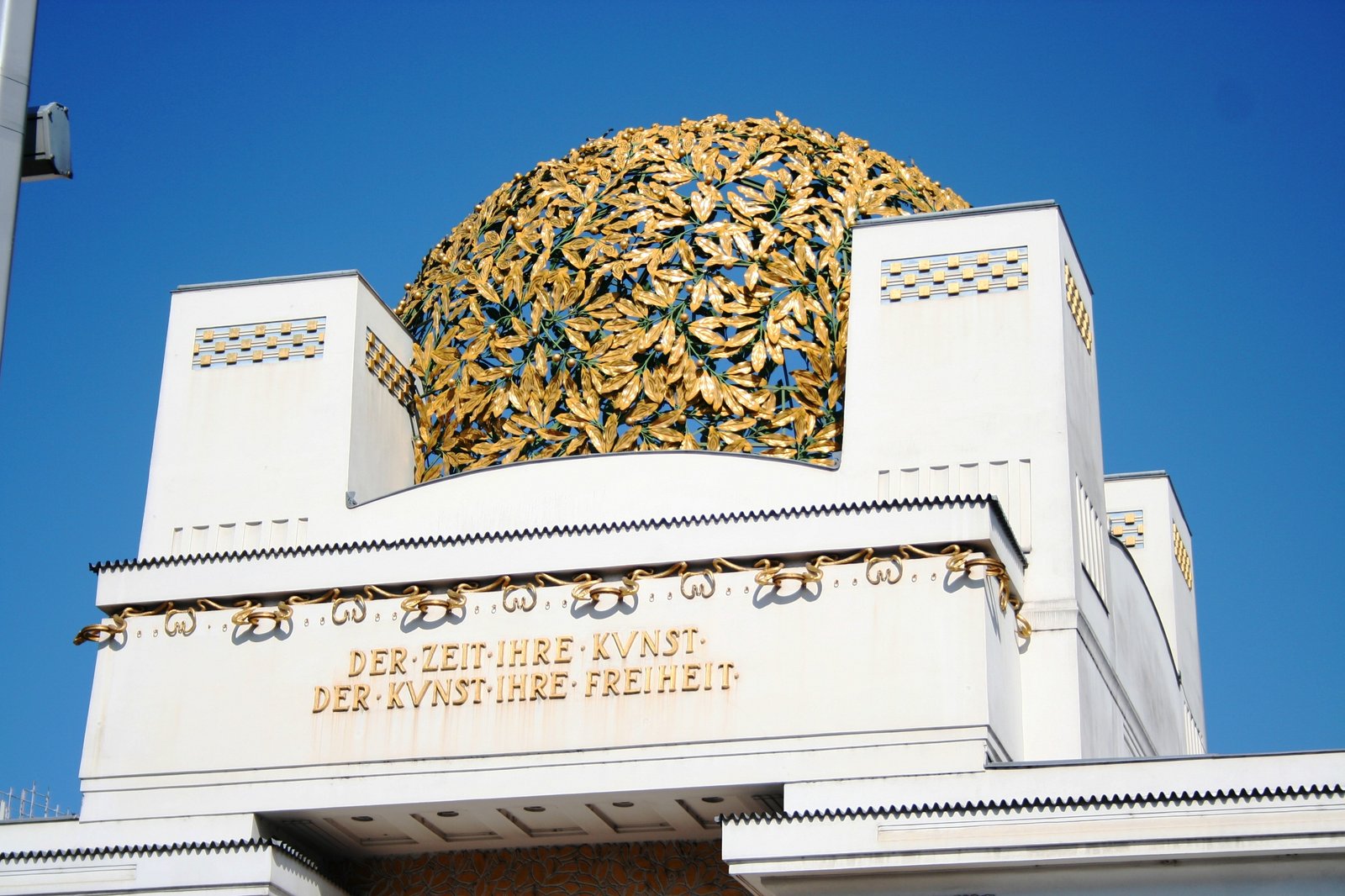
Secession Building — Vienna
The manifesto in a building: Joseph Maria Olbrich’s 1898 temple to the new art, crowned by a dome of gilded laurel leaves the Viennese instantly nicknamed “the golden cabbage”.
The storyAbove the door is the movement’s motto — “Der Zeit ihre Kunst, der Kunst ihre Freiheit” (To every age its art, to art its freedom). In the basement is Klimt’s Beethoven Frieze, painted in 1902 for a single exhibition and meant to be temporary; it survived only by luck.
Insider tipMost visitors photograph the dome and leave. Go inside and down to the Frieze — it is quiet, dim and the real reason to stop here.
A fitting stopTwo minutes toward the Opera is Café Museum (1899), whose deliberately plain interior Adolf Loos designed — so bare for its day that Vienna mocked it as “Café Nihilismus”.
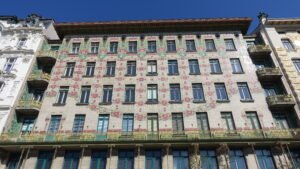
Majolikahaus — Vienna
Otto Wagner’s 1899 apartment house, its whole street façade tiled in a climbing pattern of pink majolica roses — architecture pretending to be a garden.
The storyWagner built two houses here side by side. Next door at number 38, the “Medallion House”, the gold stucco medallions and the women’s heads under the cornice are by his young collaborator Koloman Moser. Respectable Vienna was scandalised that a serious architect would tile a building like a bathroom.
Insider tipCross to the far pavement and look up — the design only makes sense seen whole from across the road, ideally in flat morning light. Saturday mornings the Naschmarkt flea market sprawls right beneath it.
A fitting stopThe Naschmarkt itself is the stop here: a market on this spot since the 18th century, good for a standing bite of cheese, olives or a Viennese sausage among locals doing their shopping.
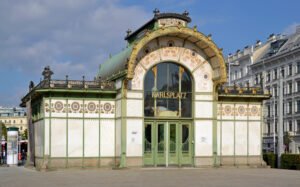
Karlsplatz Stadtbahn Pavilions — Vienna
Two little green-and-gold pavilions Otto Wagner built in 1899 for Vienna’s new city railway — mass transit treated as high design.
The storyWagner designed the entire Stadtbahn network down to the railings and lamps. These marble-faced pavilions with their gilded sunflowers were ordinary metro entrances; today one is a small museum to him and the other a café.
Insider tipThey sit slightly below street level on the south side of Karlsplatz, easy to miss with the Karlskirche looming behind. The Wien Museum nearby holds the original Loos and Wagner interiors if you want more.
A fitting stopThe eastern pavilion houses a café-bar — a rare chance to sit inside an actual Otto Wagner structure with a coffee.

Looshaus (Goldman & Salatsch Building)
Adolf Loos’s 1911 commercial building on Michaelerplatz, set down deliberately bare directly across from the ornate gate of the imperial palace.
The storyIts upper floors have no window surrounds at all, and Vienna called it “the house without eyebrows”. The story goes that Emperor Franz Joseph so disliked looking at it that he had the palace curtains on that side kept drawn. Loos had just published his essay “Ornament and Crime”; this is that argument in stone.
Insider tipStep into the ground-floor lobby (long a bank) to see the green Cipollino marble and brass Loos used to answer the plainness above — the luxury is inside, not on show.
A fitting stopCafé Central (Herrengasse, in the Palais Ferstel since 1876) is three minutes away — Trotsky’s and Peter Altenberg’s old haunt, touristy now but pure period theatre.

Zacherlhaus, Vienna
A 1905 office building by the Slovenian architect Jože Plečnik, faced in dark polished granite — modern, severe and easy to walk straight past.
The storyPlečnik was Otto Wagner’s favourite pupil, and would later redesign much of Ljubljana and Prague Castle. Here he hung the granite slabs on an exposed frame and set a bronze atlas figure of the archangel Michael high on the corner — engineering worn on the outside.
Insider tipLook up at the top-floor corner for the metal angel, and notice how the columns in the entrance hall carry the load with almost no decoration. It’s a quiet building; few tourists know it.
A fitting stopYou are in the heart of the old town — duck into any standing Würstelstand or a small Beisl (a traditional Viennese tavern) in the surrounding lanes for an unfussy lunch.
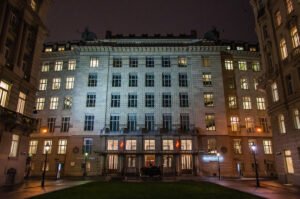
Österreichische Postsparkasse — Vienna
Otto Wagner’s masterpiece of 1912: the Austrian Postal Savings Bank, where he stopped quoting the past entirely and let the structure be the ornament.
The storyThe marble cladding is pinned on with thousands of aluminium bolts left deliberately visible — Wagner showing you how the skin is fixed rather than hiding it. Inside, the famous banking hall has a curved glass roof and slim aluminium heating columns; it was one of the first buildings anywhere to use aluminium as architecture.
Insider tipThe banking hall is the thing to see and is usually open to visitors during business hours — go in. There is a small Wagner museum on site too.
A fitting stopCafé Prückel, a Ringstraße institution on the Stubenring since 1903, is a couple of minutes on toward your next stop — unfussy, local, with a 1950s interior preserved like a film set.

MAK – Museum of Applied Arts Wien – Virtual Tour 360°
The Museum of Applied Arts, home to the archive of the Wiener Werkstätte — the workshop that tried to design everything from buildings down to teaspoons.
The storyFounded in 1903 by Josef Hoffmann and Koloman Moser, the Wiener Werkstätte believed a chair, a brooch and a house should all share one idea. The MAK holds their design archive and Klimt’s full-scale working drawings for the Stoclet Frieze — the cartoons behind the gold you saw all day.
Insider tipHead for the Wiener Werkstätte study collection and the Vienna 1900 rooms rather than trying to see everything; the building itself is a Ringstraße palace worth a look.
A fitting stopThe MAK’s own café-restaurant, under a frescoed ceiling, is a pleasant pause before the last leg.

Belvedere Castle – Virtual Tour 360°
End at the Upper Belvedere, the baroque palace that now keeps the single most famous painting of Vienna 1900: Klimt’s The Kiss.
The storyPrince Eugene of Savoy built the Belvedere as a summer palace in the 1720s; the Republic later filled it with Austrian art. Klimt painted The Kiss in his “golden period” around 1908 and the state bought it straight off the easel. Judith, Schiele and the painters whose buildings you walked past all hang in the same rooms.
Insider tipThe Kiss draws a permanent crowd — go late in the day when tour groups thin, and give the Schiele and Kokoschka rooms the time the headline picture steals. The garden between the two palaces is free and one of the best views in the city.
A fitting stopFinish in the palace garden, or carry on ten minutes for a glass of Austrian wine — this is a fitting place to toast a day spent inside an argument the rest of Europe would spend the next century having.
Download for tour navigation
🔒 The walk and the notes are open to everyone on this page. The files to take with you — the stop list as a PDF, and the GPX and KML tracks for your phone — come with a CHO account, and the free one includes them.
Walk it with the navigator on
It opens in the Google Maps app with every stop already loaded, in the order we put them in. From there the route is yours: pick how you travel — on foot, by bike, by public transport or by car — change where you start and where you end, drag the stops into a different order, and add places of your own along the way.