
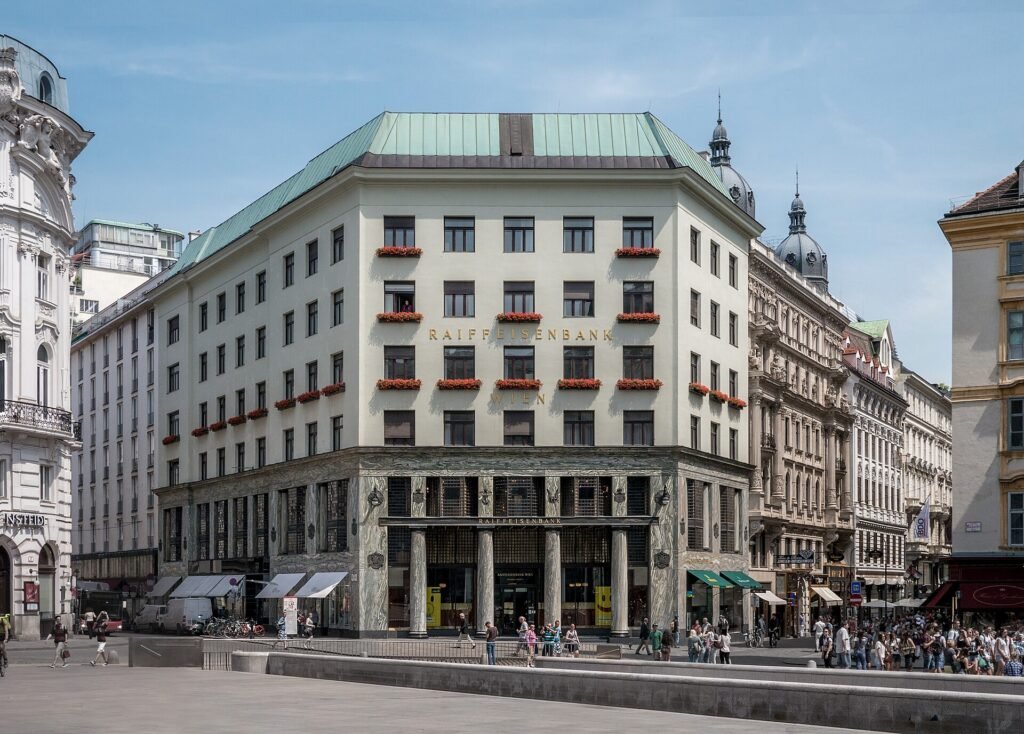
The bare façade that outraged an emperor: Loos faced the Hofburg with a building stripped of ornament.
At a glance
The Looshaus stands on Michaelerplatz, directly opposite a gate of the imperial Hofburg. Adolf Loos designed it in 1909–1911 for the tailors Goldman and Salatsch. Below, the shop floors are clad in green marble and columns; above, the apartment storeys are flat and plain, with windows and nothing else. To Vienna in 1911, used to ornament, the bareness was a scandal.
Key facts
- Location: Michaelerplatz 3, Vienna
- Architect: Adolf Loos (engineer Ernst Epstein)
- Built: 1909–1911
- Style: early modernism
- Today: a bank, with the interiors preserved
History
Loos believed ornament was a crime against modern life, and he built the proof on the grandest square he could find. The upper façade, without mouldings or window surrounds, was mocked as the house without eyebrows.
The city briefly halted construction; Loos answered by adding window boxes. The Emperor Franz Joseph is said to have disliked the view so much that he avoided that gate. The shop has changed hands, but the marble hall survives, now a bank.
What you see
The contrast is the whole argument. The lower floors are rich, polished marble and slender columns, a luxurious shopfront. Above the cornice the wall goes silent: smooth render, plain holes for windows. Loos wanted ornament where it served use and nothing where it did not. The building still reads as a manifesto.
Practical information
- Open: banking hall during business hours; exterior any time
- Cost: free to view
- Best for: the façade against the Hofburg; the marble hall
- Time needed: 15–20 minutes
Getting there
Michaelerplatz is in the heart of the old city, beside the Hofburg. U-Bahn Herrengasse (U3) is a two-minute walk; the square is on every walking route through central Vienna.
Nearby
- Hofburg — the imperial palace, across the square
- Kohlmarkt and Graben — the great shopping streets, steps away
Sources
- Encyclopædia Britannica / Wikipedia — Looshaus
- Bundesdenkmalamt (Austrian heritage) — listed-building record
- Wikimedia Commons — image source and licence
Find it on the map
See this place and what’s around it →📷 Become a Cultural Heritage Online photographer
Share your photos of places: they stay published under your name as the author. The more they're seen, the more you get noticed — and soon a contest will reward the most appreciated photos.
Log in or sign up free to add a photoIs this page about you?
This page is read by travellers and heritage enthusiasts who find it on Google. Tell us how you are connected to this place and we will take it from there.