

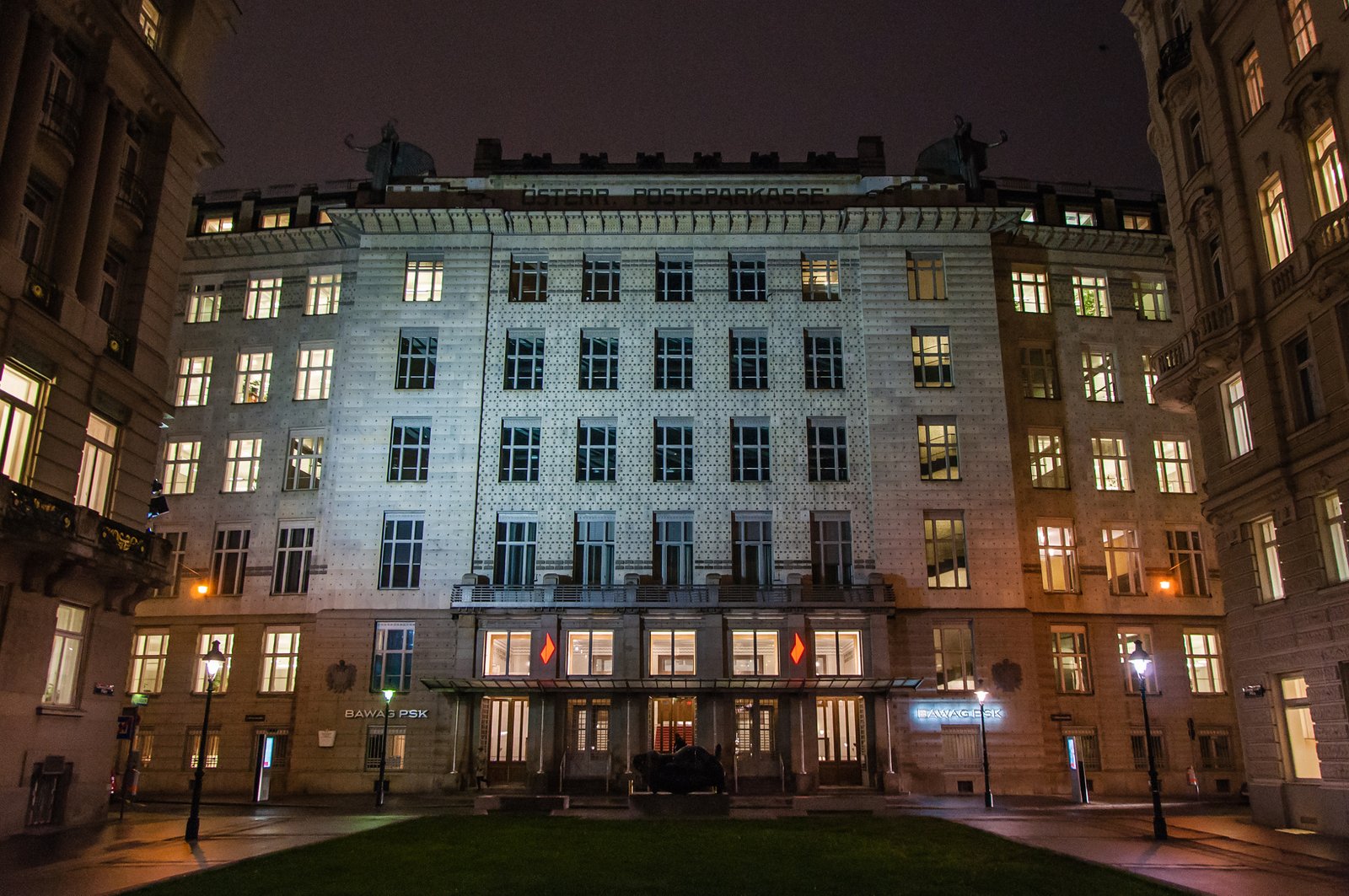
Otto Wagner’s postal savings bank is the building where Secessionism and the coming century met: marble panels bolted with aluminum, a banking hall under translucent glass, and a declaration that function and ornament could be the same thing.
At a glance
The Austrian Postal Savings Bank at Georg-Coch-Platz 2 was built in two phases — 1904–1906 and 1910–1912 — to Wagner’s design. The building is conventionally placed as the pivot between the Vienna Secession and early Modernism: it retains Jugendstil’s insistence on ornament, but the ornament has become structurally honest in a way that prefigures the logic of the International Style. The exterior is sheathed in Carrara marble panels held by polished aluminum bolts that are both genuinely functional and explicitly decorative. The banking hall interior runs under a barrel vault of translucent glass bricks carried by aluminum-clad columns, with aluminum ventilator heads rising from the floor like abstract sculptures. Wagner described the building as a demonstration that the new century’s materials — aluminum, glass, steel — were as capable of beauty as any historical stone.
Key facts
- Completed: 1904–1906 (first phase), 1910–1912 (second phase)
- Architect: Otto Wagner (1841–1918)
- Style: Late Vienna Secession / Proto-Modernism
- Address: Georg-Coch-Platz 2, 1010 Vienna, Austria
- GPS: 48.21, 16.3803 — Open in Google Maps
- Current use: Bank Austria branch; the banking hall is open to visitors during business hours
- Interior access: Banking hall and Otto Wagner Museum within the building
History
The Austrian Postal Savings Bank (k.k. Postsparkassenamt) was established in 1882 as a state savings institution. By 1903 it had outgrown its premises and a competition was held; Wagner won with a design that broke decisively with the neo-Baroque vocabulary then standard for Viennese public institutions. His entry proposed an exterior of thin marble slabs — not load-bearing masonry — fixed to a steel and reinforced-concrete frame by aluminum bolts. The jury, and then the client, accepted.
Construction proceeded in two phases separated by a four-year pause. The first phase (1904–1906) completed the main block facing Georg-Coch-Platz; the second (1910–1912) added a rear extension and completed the interior fittings. Wagner oversaw the aluminum furniture for the banking hall himself, designing the warm-air heating vents, cashier desks, and light fittings as integrated components rather than purchased furnishings.
The building became a bank branch after the Second World War. In the 1990s a small museum within the building — the Otto Wagner Postsparkasse Museum — opened to document the construction history and Wagner’s design process. The banking hall itself remains in use and accessible during normal banking hours.
What you see
The facade is a grid of white marble panels, each panel held by two visible aluminum bolts with flat polished heads. At close range the bolt grid dominates: roughly 17,000 bolts across the facade, each one an explicit acknowledgement that the marble is a cladding, not a wall. The cornice is shallow and metal-trimmed; there are no pilasters, no pediment, no orders. The roof ends in a plain fascia with two standing figures (by Othmar Schimkowitz) flanking a central pedestal — the only classical gesture, isolated and thereby made stranger.
Inside, the banking hall extends the aluminum logic: the vault overhead is a grid of glass bricks admitting diffuse northern light, held between aluminum ribs. The ventilator heads rising from the floor are aluminium tulip forms — functional but designed as sculpture. The overall impression is of a building that has identified its own construction as the subject of its ornament, and accepted the consequence.
Practical information
- Banking hall access: During Bank Austria business hours (typically Monday–Friday 09:00–17:00); visitors may enter to view the hall
- Otto Wagner Museum: Check postsparkasse.at for current opening hours and admission
- Exterior: Freely visible at all hours from Georg-Coch-Platz
- Time needed: 30–45 minutes including the banking hall and facade inspection
Getting there
The Postsparkasse is at Georg-Coch-Platz 2 in Vienna’s 1st district. The nearest U-Bahn stop is Stubentor (U3), a three-minute walk west along Stubenring. From Karlsplatz (U1/U2/U4), take U1 one stop east to Stephansplatz, then transfer to U3 and ride one stop to Stubentor, or walk northeast along the Ringstraße (approximately 20 minutes). The building is on the inner side of the Ringstraße, facing across Georg-Coch-Platz toward the MAK (Museum of Applied Arts).
Nearby
- MAK – Museum of Applied Arts — major applied arts and design collection including Jugendstil and Wiener Werkstätte holdings, directly across the square
- Stadtpark — Vienna’s central park, with the famous Johann Strauss monument, 5 min on foot east
- Vienna Secession Building — Olbrich’s exhibition hall (1898), 15 min on foot west along the Ringstraße
Sources
- Otto Wagner Postsparkasse Museum: building history and Wagner design documentation
- Austria Forum (AEIOU): entry on the Austrian Postal Savings Bank and Otto Wagner
- Bundesdenkmalamt Austria: monument designation records for Georg-Coch-Platz 2
- Wagner Werk Museum Penzing: holdings on Wagner’s late work and the aluminum programme
Find it on the map
See this place and what’s around it →Record researched and written by Luigi De Marchi for Cultural Heritage Online, 2026.
📷 Become a Cultural Heritage Online photographer
Share your photos of places: they stay published under your name as the author. The more they're seen, the more you get noticed — and soon a contest will reward the most appreciated photos.
Log in or sign up free to add a photoIs this page about you?
This page is read by travellers and heritage enthusiasts who find it on Google. Tell us how you are connected to this place and we will take it from there.