


Curated Itinerary
The Via Francigena: Canterbury to Rome
Sigeric’s road from Canterbury to the Alps: Laon, Reims and Châlons, the Langres plateau, Besançon’s citadel loop, Lausanne and the Great St Bernard Pass.
Take this route into Google Maps
From Canterbury Cathedral – Virtual Tour 360° to Great St Bernard Pass, in the order we curated them.
➤ Turn on the navigator in Google MapsIt opens in the Google Maps app with every stop already loaded, in the order we put them in. From there the route is yours: pick how you travel — on foot, by bike, by public transport or by car — change where you start and where you end, drag the stops into a different order, and add places of your own along the way.
This itinerary follows the northern Via Francigena, the medieval road from Canterbury to Rome first recorded stage by stage in Archbishop Sigeric’s diary of 990. Eight anchor stops carry it from Canterbury Cathedral through the cathedral cities of Picardy and Champagne — Laon, Reims, Châlons — to fortified Langres, Vauban’s Besançon, Lausanne, and the Great St Bernard Pass, the alpine hinge where the road turns Italian.
Unlike the Camino, the Francigena was a corridor rather than a single road, and today it is a Council of Europe Cultural Route whose northern stages remain remarkably quiet. The route’s logic is Sigeric’s own: one plausible day-chain of the places a tenth-century traveller actually slept.
Sample it in stages — Kent, a Champagne week, or the alpine leg from Lausanne to the pass (summer only on foot). Accommodation is thinner than in Spain; plan ahead and enjoy having a European pilgrimage route almost to yourself.
Read the full story of this route in the CHO Magazine →
Get this route — explore at your own pace
The walk and the notes are open to everyone, right here. To take the route with you — the GPX and KML tracks for your phone — you need a CHO account, and a free one is enough. We do not sell these routes: we build them ourselves and give them to the people who read us.
Create a free accountAlready have one? Log in.
This route was built with the tools we give operators.
Guides, associations and cultural operators build their own routes here: pick the stops from the archive, add your notes, and the map, the GPX and the printable version come out on their own. Your programme gets a permanent page, your events go on the city pages people read while planning — and if you sell your route as a road-book or a virtual tour, you receive 80% of the price net of tax.
See how an operator account worksBefore you go
A word from your host
This is the anti-Camino: same centuries, none of the crowds. Walk a Champagne stage between two cathedral towns midweek and you may not meet another pilgrim before dinner. The pass at the end is the reward — take the extra day there.
Getting around
Trains parallel almost the whole northern route, so any stage can be walked point-to-point. The Great St Bernard Pass is walkable July–September; the road tunnel keeps the crossing open the rest of the year. Book beds ahead — pilgrim lodging exists but is thin.
Step by step

Canterbury Cathedral – Virtual Tour 360°
The cathedral of the Archbishop of Canterbury and spiritual heart of the Anglican Communion, rebuilt in Norman Romanesque and Gothic styles from 1070…

Laon Cathedral
A masterpiece of early Gothic architecture built over two centuries, Laon Cathedral stands as one of medieval Europe's most stylistically unified…
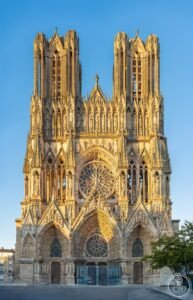
Reims Cathedral (1211): the Coronation Church of the Kings of France and the Smiling Angel (Reims, France) – Virtual Tour 360°
Per seicento anni, da Luigi VIII a Carlo X, i re di Francia furono incoronati qui — venticinque sacre, l’ampolla del crisma che la tradizione faceva risalire…

Notre-Dame-en-Vaux
A Roman Catholic church of exceptional architectural importance in Châlons-en-Champagne, Notre-Dame-en-Vaux stands as a major masterwork in France's…

Langres
Langres is a subprefecture of Haute-Marne in northeastern France, anchoring the Grand Est region with administrative and cultural significance.

Citadel of Besançon
A 17th-century Vauban masterpiece dominating Besançon's strategic heights, this fortress exemplifies military genius and now anchors the region's premier…

Lausanne Cathedral
A Swiss Reformed church at the heart of Lausanne, the Cathedral of Our Lady is owned by the Evangelical Reformed Church of the Canton of Vaud.

Great St Bernard Pass
An ancient Alpine pass linking Switzerland and Italy, elevated 2,469 m and famously crossed by Napoleon in 1800.
Download for tour navigation
🔒 The walk and the notes are open to everyone on this page. The files to take with you — the stop list as a PDF, and the GPX and KML tracks for your phone — come with a CHO account, and the free one includes them.
Walk it with the navigator on
It opens in the Google Maps app with every stop already loaded, in the order we put them in. From there the route is yours: pick how you travel — on foot, by bike, by public transport or by car — change where you start and where you end, drag the stops into a different order, and add places of your own along the way.