
Curated Itinerary
Square Colosseum and Marble Athletes: A Rome Rationalism RoadBook (1927–1954)
Travel tips from CHOGo on the first Sunday of the monthState museums, archaeological parks and monuments across Italy open free […]
Get this route — explore at your own pace
The walk and the notes are open to everyone, right here. To take the route with you — the GPX and KML tracks for your phone — you need a CHO account, and a free one is enough. We do not sell these routes: we build them ourselves and give them to the people who read us.
Create a free accountAlready have one? Log in.
This route was built with the tools we give operators.
Guides, associations and cultural operators build their own routes here: pick the stops from the archive, add your notes, and the map, the GPX and the printable version come out on their own. Your programme gets a permanent page, your events go on the city pages people read while planning — and if you sell your route as a road-book or a virtual tour, you receive 80% of the price net of tax.
See how an operator account worksBefore you go
A word from your host
Two things to carry with you on this walk. The honest one: every building here was commissioned or promoted by the government of Benito Mussolini, and several bear inscriptions or imagery that makes no effort to conceal it. Do not look away from the obelisk inscription, or from the text on the Colosseo Quadrato, or from the Sironi mosaic at Sapienza — they are documents of a period that cost millions of lives, and they are still here. The interesting one: the architects who built these things were complex figures. Giuseppe Pagano contributed to the Sapienza campus as a committed Fascist and died in Mauthausen as a resister. Luigi Moretti built here and later designed the Watergate. Adalberto Libera made two of the finest buildings on this walk — one for the regime, one for the Republic — and is equally at home in both. The buildings are not innocent. They are also not simple. Come ready to hold both of those things at once.
Getting around
The walk divides into three zones linked by Rome's metro and bus network. Zone 1 — Foro Italico — is reached from Flaminio or Risorgimento by bus 32 or 280 (or Tram 2 from Lungotevere); all three stops are within easy walking distance of each other. From the Foro, bus or Metro A takes you to Sapienza (Zone 2); bus 71 or Metro B from Piramide then runs south to EUR (Zone 3). One daily BIT ticket covers all metro and bus journeys. EUR is built for walking: the southern stops are linked by wide, shadow-free boulevards. Come early in summer — EUR has little shade. Avoid the Foro Italico during major sporting finals at the adjacent Stadio Olimpico.
Step by step
Foro Italico — Sports Citadel by Enrico Del Debbio – Virtual Tour 360°
Begin at the gate of Mussolini's sports citadel: the marble obelisk at the entrance still reads "MUSSOLINI DVX" — deliberately never removed after 1945.
The storyThe Foro Italico began as the "Foro Mussolini" in 1927, when architect Enrico Del Debbio was given a bend of the Tiber north of the city and told to build a citadel of sport. The monolith of Carrara marble at its entrance — seventeen metres tall, inscribed "MUSSOLINI DVX" — was a gift from the city of Carrara. After 1945 it was left in place by a government that could not decide what to do with it. It is still there today, which tells you something about how Italy has handled its relationship with the Fascist years: not erased, not celebrated, simply present.
Insider tipWalk past the mosaic forecourt to the main building of the former Fascist Academy of Physical Education: the floor mosaics show athletes, eagles and Fascist insignia in a language that fuses sport with political symbolism without embarrassment. The complex is now used by CONI (the Italian Olympic Committee) and is freely walkable. The sense of axial planning — everything aligned from obelisk to river — is best grasped from the forecourt before you turn to the stadiums.
A fitting stopHead a few minutes back toward Ponte Milvio, one of Rome's liveliest squares: bars, gelaterie and aperitivo spots line the piazzale and the neighbouring streets, busy from mid-morning onward. The bridge itself — ancient in its foundations, Baroque in its present form — is worth crossing on foot for the view up and down the Tiber.
Stadio dei Marmi — Marble Stadium by Enrico Del Debbio
Sixty white Carrara statues of athletes ring this open-air stadium — one commissioned from each province of Italy, each carved in a different regional style.
The storyEnrico Del Debbio completed the Stadio dei Marmi in 1932, surrounding the athletics field with sixty white Carrara statues — one commissioned from each province of Italy, each depicting a different sport. The provinces competed through their sculptors, which means the quality and style of the figures varies considerably. Compare the northern industrial provinces with the southern ones; the differences are a compressed index of regional taste and workshop tradition in 1930s Italy. The stadium was built for athletics and ceremony rather than mass crowds: it has no covered stand, only the marble ring of athletes looking inward.
Insider tipWalk the full circuit and look at individual statues rather than the ensemble: you will find stylistic range from neo-classical refinement to something more expressionist, all frozen in the same white marble. Admission to the complex is usually free; the gates along Viale dei Gladiatori are the most direct access. The Stadio Olimpico is directly adjacent — built later, in a different register — but the Marmi is the stranger and more characteristic building.
Casa delle Armi — Fencing Academy by Luigi Moretti – Virtual Tour 360°
Luigi Moretti's fencing academy of 1936 is his masterpiece: a vast glass wall floods a single hall with shadow-free northern light. He was twenty-nine years old.
The storyLuigi Moretti received the commission for this fencing academy in 1934 and completed it in 1936, at the age of twenty-nine. It is built almost entirely in glass and reinforced concrete: a single vast fencing hall lit by a continuous glass wall of near-industrial scale, which delivers the shadow-free northern light that fencing demands. The building is technically a piece of functionalism — every decision justified by the sport's requirements — but the result is one of the most spatially beautiful interiors of Italian architecture between the wars. Moretti was subsequently imprisoned after 1945, rehabilitated, and went on to design the Watergate complex in Washington DC. The academy is now administered by the Italian Olympic Committee.
Insider tipAccess to the interior varies, but the exterior is fully visible and worth close study: notice how the glass facade dissolves the boundary between inside and out, and how the structural geometry of the concrete frame becomes the building's only ornament. This is among the least-known stops on any architecture walk in Rome — most visitors reach the Stadio dei Marmi and turn back — and one of the most rewarding.
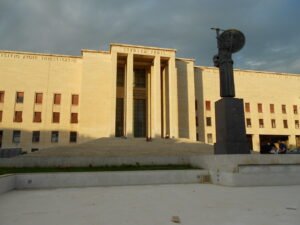
Città Universitaria — Sapienza Rectorate by Marcello Piacentini – Virtual Tour 360°
Piacentini's academic city for Sapienza (1932–1935) brought Italy's best architects to one campus — including Giuseppe Pagano, who later died in Mauthausen refusing the regime.
The storyWhen Mussolini decided to rebuild the ancient university of Rome for the modern age, he gave the master plan to Marcello Piacentini in 1932 and called in Italy's best architects to design individual faculties. Among them was Giuseppe Pagano, who contributed the Institute of Physics — the laboratory where Enrico Fermi and his team conducted the early experiments that preceded nuclear fission. Pagano was, at this point, an enthusiastic Fascist, editing the journal Casabella in a voice that celebrated the regime's modernist ambitions. By the early 1940s he had broken with the movement; he joined the Resistance, was arrested by the German SS, and died in Mauthausen concentration camp in April 1945. His Physics building stands beside Piacentini's rectorate as if nothing happened.
Insider tipEnter from Piazzale Aldo Moro and walk straight to the Rectorate: Piacentini's travertine facade carries a mosaic by Mario Sironi — Minerva presiding over Rome — that concentrates the regime's mythological programme into a single image. It is the campus's grandest gesture and, architecturally, its most overwrought building. Turn left for Pagano's Physics Institute, quieter and better. The campus is open on weekdays; students use it as it was intended, which is the best thing about it.
A fitting stopThe San Lorenzo neighbourhood surrounding the campus is one of Rome's authentic student quarters: trattorias, pizza al taglio and bars on every block, busy from noon. The Testaccio Market, a few stops away on the metro, is one of the best food markets in Italy if you are combining this with the later Ostiense stop.
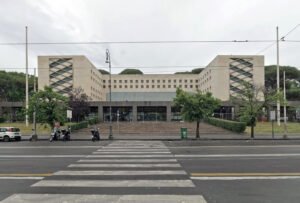
Palazzo delle Poste, Ostiense — Adalberto Libera & Mario De Renzi
Libera and De Renzi's 1935 post office on Via Marmorata: all the dignity of ancient Rome, stripped of ornament. Still a working post office.
The storyAdalberto Libera and Mario De Renzi completed this post office on Via Marmorata in 1935. The building strips classical Roman architecture to its proportions — the symmetry, the rhythm of openings, the travertine cladding — and removes all ornament. What remains is monumental without being heavy, modern without being cold. Libera called this the "Italian character" of rational architecture, a position that distinguished Italian Rationalism from its more austere German and French counterparts. The same Libera would go on to design the Palazzo dei Congressi at EUR and, later, the Villa Malaparte on Capri — buildings that use a similar vocabulary in increasingly personal ways.
Insider tipIt is still a working post office, open Monday to Saturday mornings: go in during opening hours and observe the interior, where original counters and marble finishes survive largely intact. The main hall and the staircase are particularly fine. This is the least-visited rationalist building in Rome of any quality, which makes it the most satisfying to arrive at — you will probably have it to yourself.
A fitting stopThe Testaccio Market is two blocks away on Via Galvani, one of Rome's best: supplì, tripe sandwiches, artichokes alla giudia and Rome's characteristic street food, available until around 2pm. The market building itself — concrete and functional, 1925 — is a modest piece of the same inter-war aesthetic.
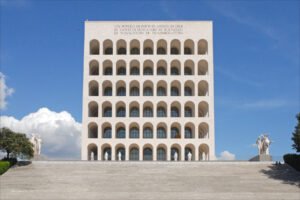
Palazzo della Civiltà Italiana – Virtual Tour 360°
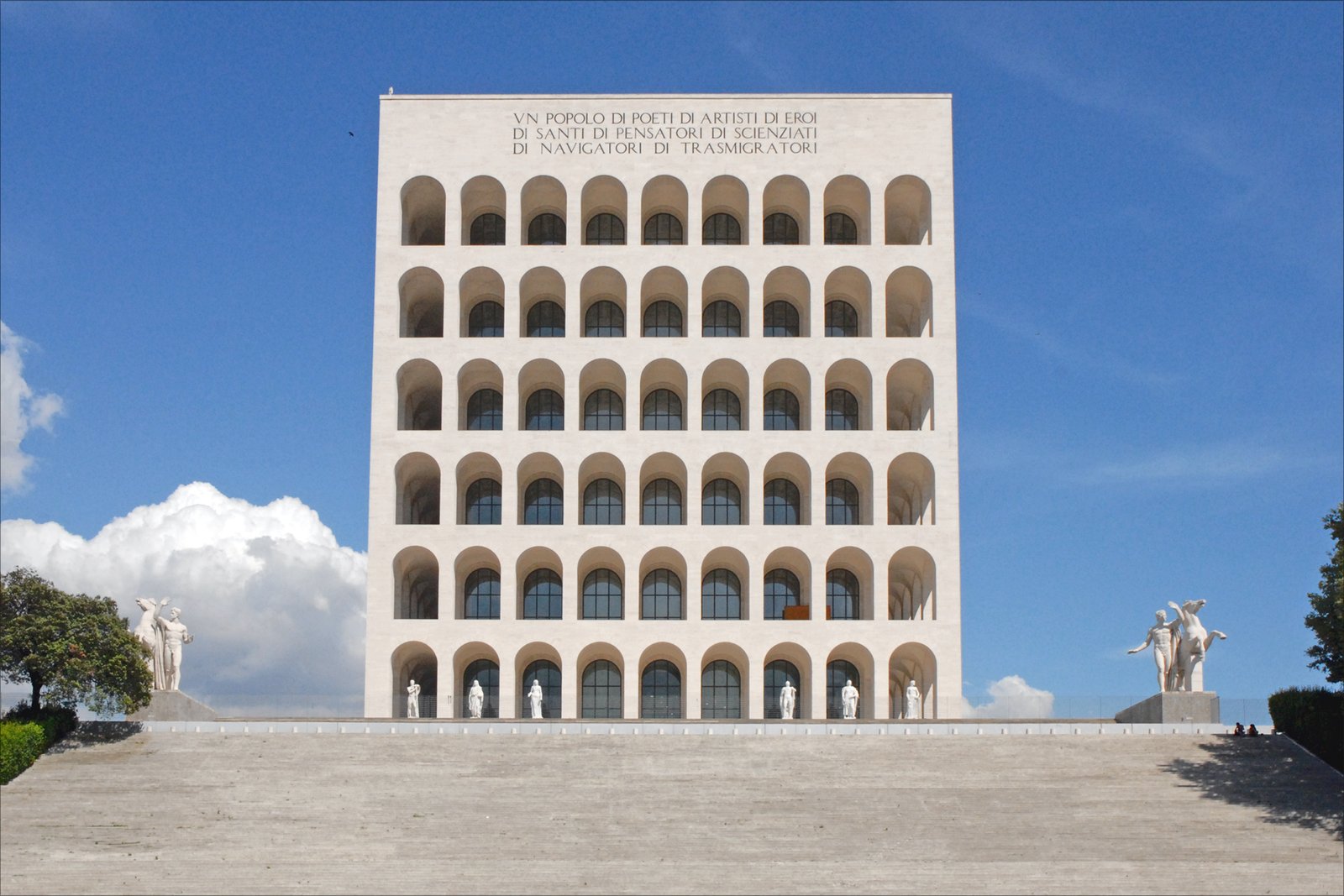
The "Square Colosseum": 216 arched bays on six floors, built for a world exhibition that the war cancelled. The inscription on all four sides was never edited.
The storyGiovanni Guerrini, Ernesto La Padula and Mario Romano began work on the Palazzo della Civiltà Italiana in 1938, for a world exhibition — the E42, planned to celebrate the twentieth anniversary of the March on Rome and Rome's historical primacy over all civilisations. The exhibition was cancelled when Italy entered the Second World War in 1940. Construction continued intermittently through the war; the building was completed in 1943 and then stood largely unused for decades. The six floors of 216 arched bays in travertine — the number chosen to evoke the ancient Colosseum — create a building that appears circular from any angle despite being exactly square in plan: an optical illusion that still stops visitors mid-approach. Since 2015 it has been the Rome headquarters of Fendi. The inscription on all four facades remains: "A PEOPLE OF POETS, OF ARTISTS, OF HEROES, OF SAINTS, OF THINKERS, OF SCIENTISTS, OF NAVIGATORS, OF TRANSMIGRATORS."
Insider tipStand at the centre of the EUR piazza and rotate slowly: the building appears to recede in perfect symmetry from every compass point. Walk all four sides before approaching; the scale only resolves at close range, when the arches reveal their depth. Dawn and dusk light the travertine orange; the building is also lit at night. The surrounding EUR piazza — wide, silent, planted with formal trees — was designed as urban space at a scale intended to dwarf the individual, and it still does.
A fitting stopThe EUR lakeside promenade is a few minutes' walk south: several bars and restaurants have worked the lakefront since the 1950s. The lake itself was part of the original E42 plan, and the combination of water, rationalist architecture and mid-century Roman residential life makes for an odd, pleasant hour.
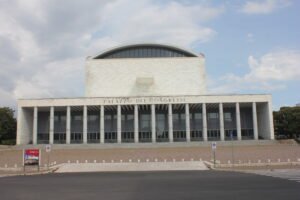
Palazzo dei Congressi — EUR by Adalberto Libera
Libera designed this in 1937; it was finally built in 1954 — born under the Fascist regime, completed by the Italian Republic. The barrel-vaulted hall is one of the finest spaces in Rome.
The storyAdalberto Libera first designed the Palazzo dei Congressi in 1937, as the main assembly building for the cancelled E42 exhibition. He then spent seventeen years revising the design, through a world war, a change of government and a complete transformation of what Italy wanted to say about itself. The building was finally built and opened in 1954. The great barrel-vaulted entrance hall — one of the largest single interior spaces in Rome, clad in travertine and marble with a precision that takes a moment to absorb — is both the product of the original Fascist commission and of the Republic that executed it. Libera later said that the long delay had been an advantage: the enforced austerity of the post-war years stripped the design of its more grandiose elements and left something purer.
Insider tipIf an event is not in progress, walk through the entrance and into the hall: the barrel vault and the quality of the marble and travertine are best experienced in person, at full scale. The building is still in active use as a congress and exhibition venue — check the calendar for events, which sometimes include architecture and design shows with free entry. The adjacent buildings of the EUR district, particularly along Viale della Civiltà del Lavoro, form one of the most coherent planned urban environments in Italy.

Museum of Roman Civilization – Virtual Tour 360°
End among plaster casts and the great Plastico di Roma — the regime's civilisational self-image in concrete. Check opening hours: long renovation underway.
The storyThe Museum of Roman Civilization was designed by Pietro Aschieri, Domenico Bernardini, Cesare Pascoletti and Gino Peressutti between 1939 and 1955, in two long wings enclosing the south side of a formal piazza. It was built to house plaster casts of Roman monuments gathered from across the empire and, centrally, the Plastico di Roma: a scale model of the city under the Emperor Constantine, covering 200 square metres, cast from measurements of every known monument and archaeological site. The museum was conceived as the civilisational arm of the same propaganda project that raised the Colosseo Quadrato fifty metres away — ancient Rome as mirror and historical justification for Fascist Italy. The Plastico is one of the most extraordinary objects in Rome, an entire city seen from above at the height of empire, every neighbourhood and building rendered in plaster at 1:250 scale.
Insider tipThe museum has been under renovation since 2014; check current opening status on the Musei in Comune Roma website before visiting. If it is closed, the exterior colonnade — long and formal, closing the piazza in travertine — repays the walk. The Palazzo dello Sport by Pier Luigi Nervi and Annibale Vitellozzi (1960), a short walk south on Piazzale dello Sport, is one of the finest concrete buildings in Italy: a ribbed dome of extraordinary lightness, in active use for sports and concerts, and usually open.
A fitting stopEnd the day at the EUR lakeside: the Ristorante il Laghetto del EUR, on the lake promenade, has served Romans since the late 1950s. Order the house pasta and drink to a neighbourhood that Mussolini planned and Rome inhabits — stubbornly, practically, with the peculiar indifference to grand intentions that characterises this city at its best.
Download for tour navigation
PDF is the stop list with GPS, to print or keep on the phone. GPX for Garmin / Komoot / OsmAnd. KML for Google Earth and Maps.