

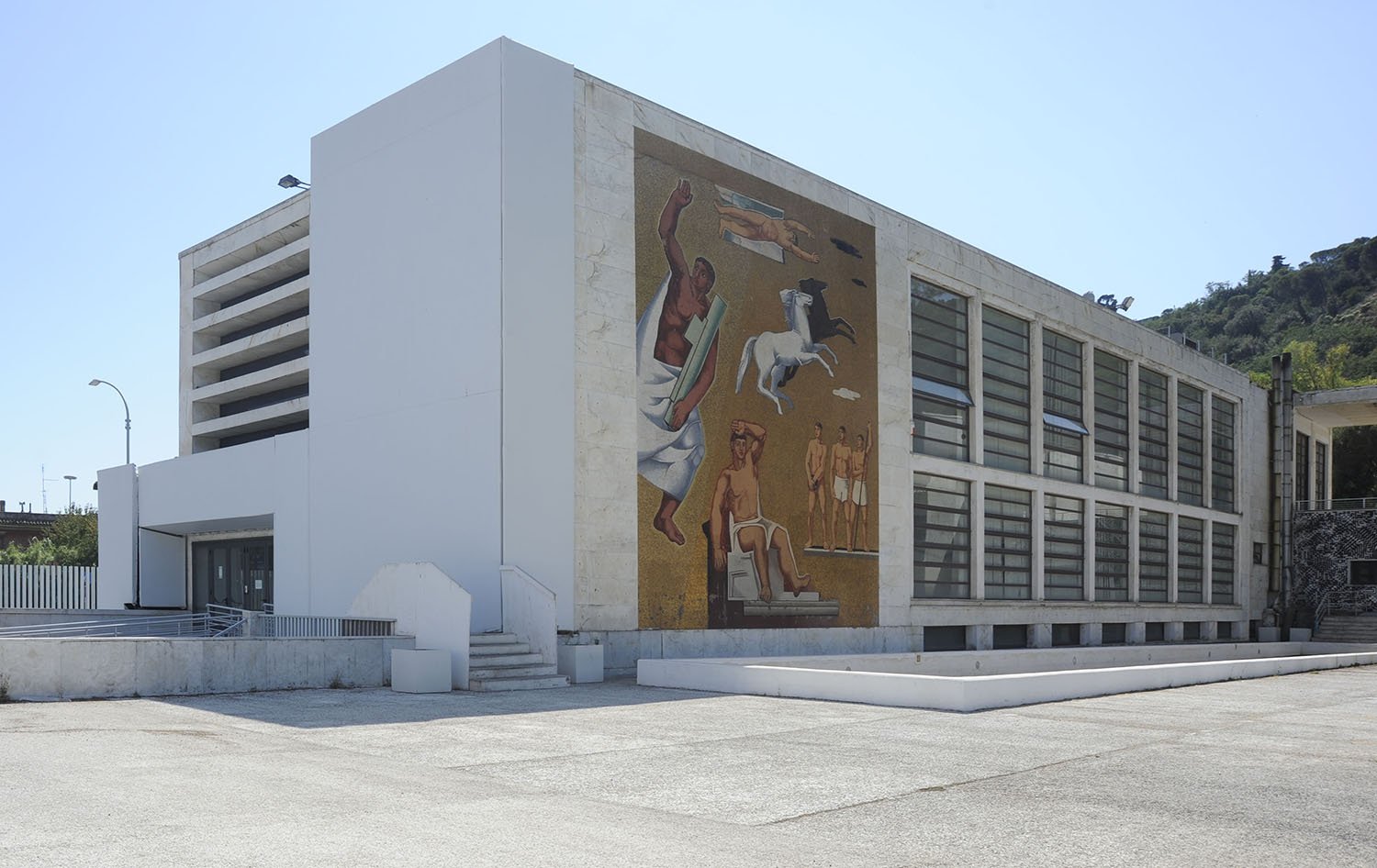
Designed by Luigi Moretti (1907–1973) between 1934 and 1936 at the southern edge of the Foro Italico, the Accademia di scherma — better known as Casa delle Armi — is one of the purest Italian Rationalist buildings of the interwar years: an L-shaped block sheathed entirely in white Carrara marble, conceived around a 45 by 25 metre fencing hall.
At a glance
The Casa delle Armi sits opposite the foresteria of Enrico Del Debbio, marking the southern boundary of the Foro Italico sports complex along the Tiber. Luigi Moretti, then technical director of the Opera Nazionale Balilla, designed it in 1934 as an experimental Casa del Balilla and completed it in 1936; it was almost immediately assigned to fencing, which gave it its enduring nickname. Its restrained geometry, the uniform cladding in white Carrara marble and the external mosaics by Angelo Canevari rank it among the most studied works of Italian Rationalism. Since a brutal 1981 conversion into a fortified courtroom, the building has remained largely unused; in 2022 the Italian state allocated funds for a long-awaited restoration.
Key facts
- Architect: Luigi Moretti (1907–1973), technical director of the Opera Nazionale Balilla
- Design / completion: designed 1934, completed and inaugurated 1936
- Plan: L-shaped block at the southern edge of the Foro Italico
- Fencing hall: 45 m long, 25 m wide, sized for 160 athletes on the pistes simultaneously
- Cladding: facades uniformly faced in white Carrara marble
- Decoration: large external mosaic compositions by Angelo Canevari
- Owner: CONI (Italian National Olympic Committee)
- Status: semi-abandoned after 1981 courtroom conversion; restoration funded 2022
History
Luigi Moretti received the commission for the building in 1934, while he was directing the technical office of the Opera Nazionale Balilla. The brief was for an experimental Casa del Balilla within what was then called the Foro Mussolini, the large state-built sports complex laid out by Enrico Del Debbio along the right bank of the Tiber. Moretti delivered the project as a typological exercise: a low, taut volume that broke with the heroic axial composition of the rest of the Foro and proposed instead a quieter, almost domestic geometry of marble surfaces.
Construction was completed in 1936. The building was reassigned to fencing on the eve of its inauguration, and from that point it carried the name Casa delle Armi, later Accademia della Scherma. For four decades it functioned as the national fencing academy and as a working studio for sport and ceremony at the Foro Italico, by then renamed.
The second life of the building was less generous. In 1981, against the backdrop of the anni di piombo, the academy was requisitioned and converted into an aula bunker, a fortified courtroom of the Tribunal of Rome for terrorism trials. The internal volumes were heavily altered: partitions, security shells and reinforced enclosures cut through Moretti’s sequence of spaces. When the court eventually moved out, the building was left in semi-abandonment. It remains the property of the Italian National Olympic Committee; in 2022 the state allocated public funds, as part of a wider 80-million-euro programme for the Foro Italico, to undertake restoration.
What you see
The plan is an L, hinged on the corner that faces the Tiber. The short arm toward the river is split in two: half is a blank marble wall, half is opened by a single giant horizontal window-grid that lights the fencing hall behind it. That hall — the heart of the building — runs 45 metres in length and 25 in width, dimensioned to hold 160 fencers on the pistes at once. The choice to express the hall externally as a long, low strip of glazing rather than as a heroic portal is what gives the Casa delle Armi its modern, almost Nordic silence inside the imperial rhetoric of the Foro.
All facades are clad uniformly in white Carrara marble, with no shifts of tone or rustication. The decorative programme is concentrated in external mosaic compositions designed by Angelo Canevari, which read as flat graphic incidents against the marble field. Inside, original photographs by the Vasari studio survive to document the lost interiors; the 1981 partitions still occupy much of the space and are the principal target of the restoration now under way.
Practical information
- Access: the building is currently closed to the public; the exterior is visible from the public spaces of the Foro Italico
- Best viewing: from Viale dei Gladiatori and Viale delle Olimpiadi, which border the L-shaped plan
- Time needed: 20–30 minutes for a careful external visit, combined with the rest of the Foro Italico
- Photography: permitted from public space; low side-light in the late afternoon makes the marble cladding most legible
- Status note: restoration works funded in 2022 may affect the immediate surroundings of the building
Getting there
The Foro Italico stands on the right bank of the Tiber at the northern edge of the historic centre of Rome. The closest tram is line 2 from Piazzale Flaminio to the Mancini stop, from which the complex is a 10-minute walk over the Ponte Duca d’Aosta. By metro, the nearest station is Ottaviano on line A, about 25 minutes on foot. The bus stops Lungotevere Cadorna and Foro Italico, served by lines 32, 69, 226 and 280, drop visitors at the south-eastern entrance, a short walk from the Casa delle Armi.
Nearby
- Stadio dei Marmi — Del Debbio’s marble stadium ringed by 60 athlete statues, a five-minute walk north
- Ponte Duca d’Aosta — the 1936 travertine bridge that links the Foro to the city, immediately east
- Stadio Olimpico — the main stadium of the complex, reworked for the 1960 and 1990 events
- Auditorium Parco della Musica — Renzo Piano’s 2002 concert complex, a 20-minute walk further north
Sources
- Wikipedia (Italian), Accademia di scherma al Foro Italico — it.wikipedia.org
- Wikimedia Commons, Category: Accademia di scherma al Foro Italico — commons.wikimedia.org
- Mario Ferrari, Luigi Moretti. Casa delle Armi nel Foro Mussolini 1933–1937, Bari, Ilios, 2010, ISBN 9788890802447
- Alessandra Nizzi, Marco Giunta, La forma violata. Cronache della Casa delle Armi di Luigi Moretti al Foro Mussolini (1936–2009), Rome, Aracne, 2010, ISBN 978-88-548-3128-5
- Artribune, Riqualificazione del Foro Italico di Roma: arrivano 80 milioni dallo Stato, 4 January 2022
Find it on the map
See this place and what’s around it →📷 Become a Cultural Heritage Online photographer
Share your photos of places: they stay published under your name as the author. The more they're seen, the more you get noticed — and soon a contest will reward the most appreciated photos.
Log in or sign up free to add a photoIs this page about you?
This page is read by travellers and heritage enthusiasts who find it on Google. Tell us how you are connected to this place and we will take it from there.