
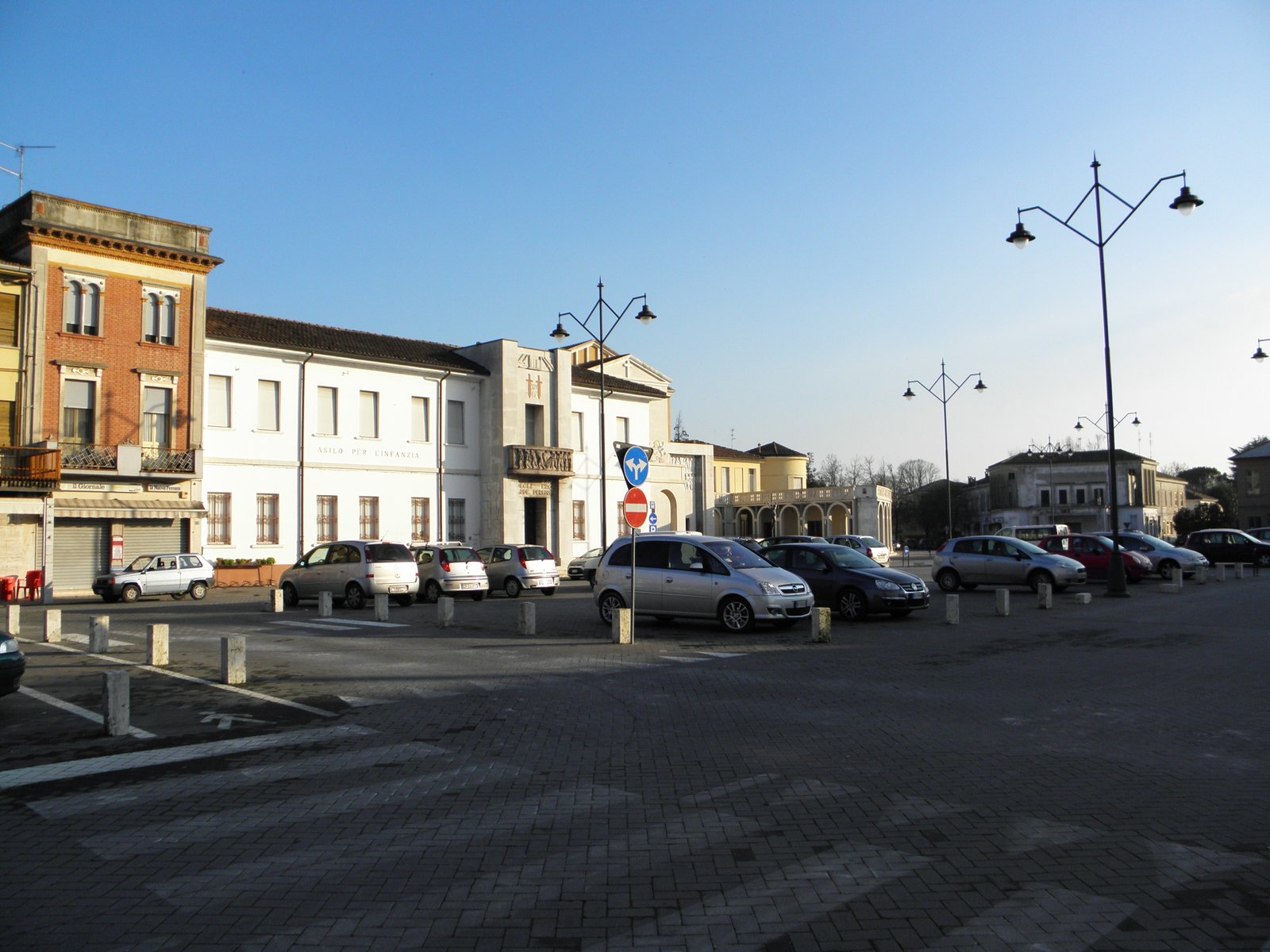
Tresigallo is the most intact città di fondazione of the razionalist period and the only fascist-era foundation town to also hold the official designation of città d’arte. Between 1933 and 1939 the medieval village in the lower Ferrara plain was rebuilt almost entirely under the sponsorship of Edmondo Rossoni, who had been born there in 1884 and rose to direct the fascist labour confederation. The plan turned a farming hamlet of a few hundred souls into a working city of porticoes, axial streets and metaphysical squares that today reads as a built manifesto of Italian Rationalism.
- Address
- Piazza della Repubblica (Piazza Italia), 44039 Tresigallo, Province of Ferrara, Emilia-Romagna, Italy
- Period
- Reconstruction 1933–1939 (planning from c. 1930)
- Architects
- Carlo Frighi (municipal engineer) under the direction and patronage of Edmondo Rossoni (1884–1965)
- Client
- Comune di Tresigallo and the fascist state, on Rossoni’s personal initiative
- Style
- Italian Rationalism (Razionalismo italiano), with metaphysical urbanism inflections
- Function
- Foundation town with civic centre, industrial quarter, residential blocks, sanatorium and cemetery
- Urban form
- Two intersecting axes: civic centre to cemetery, church to former Casa del Balilla
- Population
- Approximately 4,400 inhabitants (2018)
- Status
- Recognised città di fondazione and città d’arte; active municipality
- Coordinates
- 44.8160° N, 11.8947° E
Visit on the map
Piazza della Repubblica, 44039 Tresigallo FE · 44.8160° N, 11.8947° E
Download for your navigator
A single waypoint, ready for GPS apps, navigators, and contacts.
Story
The story of Tresigallo cannot be separated from the biography of Edmondo Rossoni. Born in the village in 1884, Rossoni became one of the chief organisers of fascist trade unionism in the 1920s and later Minister of Agriculture and Forestry. From his Rome office he conceived the reconstruction of his home village as a personal project, channelling state funds and Bonifica resources into a comprehensive replan. Work began around 1933, accelerated through the second half of the decade and reached substantive completion by 1939. The old agricultural settlement of fewer than a thousand inhabitants was effectively replaced by a new town designed for several thousand residents, complete with industries, social services and a civic centre dimensioned for a much larger population than the one that ever filled it.
The urban plan organises Tresigallo around two perpendicular axes. The first connects the parish church of Sant’Apollinare to what was the Casa del Balilla, the youth centre of the regime, later renamed Casa della Gioventu Italiana del Littorio. The second axis runs from the civic centre to the cemetery on the edge of the built-up area, a deliberately metaphysical gesture that linked civic life to memory along a single straight line. The buildings that line these axes apply the formal vocabulary of Italian Rationalism in a controlled, almost severe register: white and pale ochre plaster, long horizontal porticoes, rhythmic pilasters, flat or shallow cornices, and large rectangular windows arranged in regular grids. Piazza Italia (also known as Piazza della Repubblica) acts as the hinge of the composition, framed by the Palazzina Municipale, the Casa della Cultura and the Asilo Parrocchiale. Specialised programmes were given their own monumental envelopes: the Domus Tua hotel, the public baths, the post-sanatorial colony, the Casa del Fascio and the industrial buildings of the Bonifica.
Tresigallo escaped the wartime destruction that erased several other foundation towns and entered the post-war decades as an awkward heritage. For half a century the ensemble survived through neglect rather than care, with its symbolic apparatus partly defaced or removed. Re-evaluation began in the late 1990s, when scholars and the municipality started to read the town as a coherent example of razionalismo applied at urban scale rather than as a politically embarrassing leftover.
Restoration campaigns in the 2000s and 2010s recovered facades, paving and signage, and Tresigallo obtained the status of città d’arte — a recognition no other fascist-era foundation town in Italy has been granted. Today the squares and porticoes function again as a real civic space for the small Ferrarese community, while drawing architectural historians, photographers and visitors curious to see one of the most complete built statements of Italian Rationalism still in everyday use.
Resources & References
Editorial picks across Wikipedia, photo archives, and architectural databases.
Find it on the map
See this place and what’s around it →Record researched and written by Stefano Vigolo for Cultural Heritage Online, 2026.

📷 Become a Cultural Heritage Online photographer
Share your photos of places: they stay published under your name as the author. The more they're seen, the more you get noticed — and soon a contest will reward the most appreciated photos.
Log in or sign up free to add a photo