Ferrara modernised on its own terms between the wars. Alongside the old city, a new westward quarter — the Addizione Novecentista — pushed rationalist public works into the plain: a stadium, a monumental aqueduct, a brick school, all promoted by the podestà Renzo Ravenna and drawn largely by one man. This RoadBook links four buildings that tell that story in about half a day, then drives twenty-five kilometres east to a fourth idea of Rationalism: an entire town. One name appears three times. Carlo Savonuzzi, Ferrara’s municipal engineer, designed the stadium, the aqueduct and the school within about five years, and the consistency of that hand is half the subject of the route. The other half is Tresigallo, where a different patron built not a landmark but a whole city. All four stops are collected in the curated itinerary Ferrara Rationalism RoadBook, each with its full entry in the archive.
A stadium at the edge of the new quarter
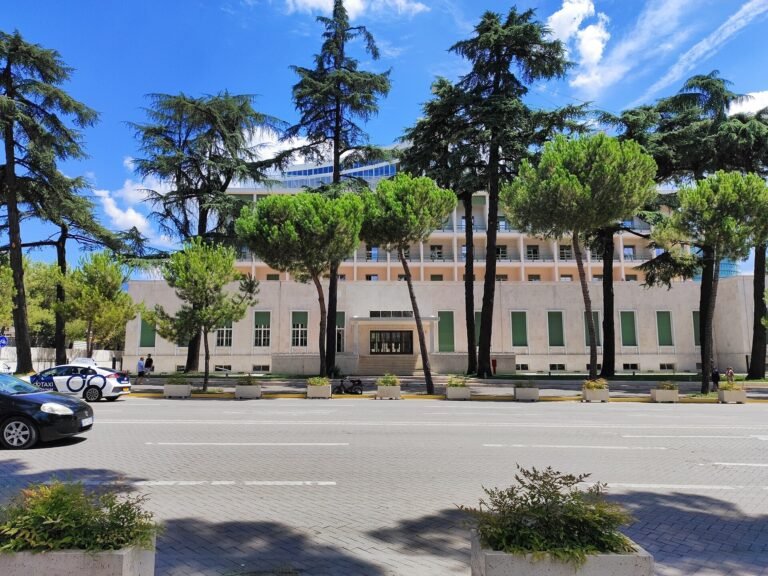
The route starts on Corso Piave, where the Stadio Paolo Mazza has held its ground since 20 September 1928. Savonuzzi planned it as a multi-sport arena — football pitch, athletics track and velodrome — and it opened as the Stadio Littorio Comunale; the present name dates from 1982. SPAL has played here without a break since the first match, which makes this the fifth-oldest Italian football ground in continuous use. Reconfigurations in 1951, 1966, 1979, 1988 and again in 2016–2018 lifted it to 16,134 covered seats, so little of the 1928 fabric survives untouched. What survives is the idea: a civic sports building set deliberately inside the new rationalist district.
A water tower that plays at being a temple
A few hundred metres south, Piazza XXIV Maggio opens around the most theatrical piece of infrastructure in interwar Ferrara. Between 1930 and 1932 Savonuzzi raised a working water tower thirty-seven metres over the city, lifting 2,500 cubic metres of drinking water onto a stepped concrete drum. From across the square the dodecagonal colonnade — twelve columns, each twelve metres tall — reads as a Renaissance tempietto. Up close it is pure rationalist arithmetic: reinforced concrete, geometric clarity, monumental scale and almost no ornament. Arrigo Minerbi carved the fountain at its base, «Il Po e i suoi affluenti». The tank is retired now; the lower volume holds a children’s cultural centre, the Isola del Tesoro.
Savonuzzi’s hand, a third time
Walk about a kilometre east, toward the old Sant’Anna hospital quarter, and the same engineer appears again. The Scuola Elementare Alda Costa, built in 1932–1933, sets a thirty-seven-metre tower against a long, low, horizontal mass of red brick — load-bearing walls with terracotta inserts and stone-cement trim. It opened as the Scuola Umberto I and still works as a primary school. Its later name belongs to Alda Costa, the antifascist teacher: a fascist-era public work that now carries the name of an antifascist.
Not a building but a town
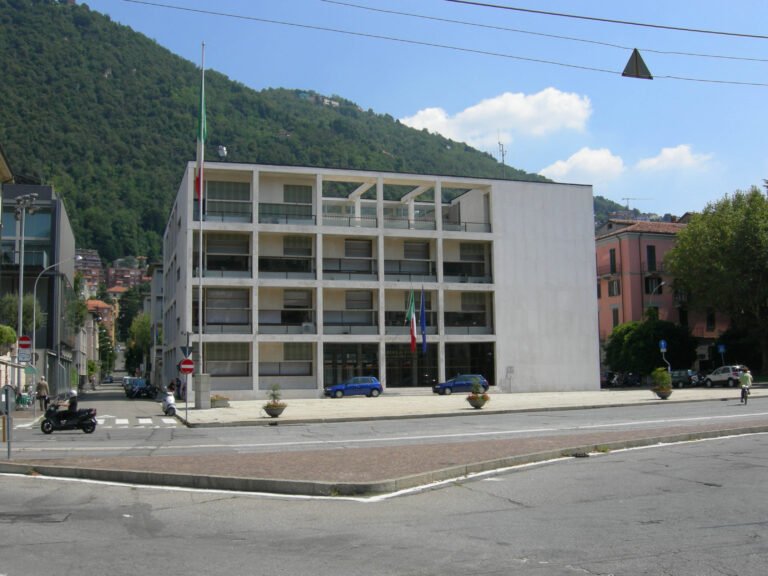
The last stop is not a building. Twenty-five kilometres east, in the low Ferrara plain, Tresigallo is the most intact città di fondazione of the rationalist period — and the only fascist-era foundation town also recognised as a città d’arte. Between 1933 and 1939 a farming hamlet of a few hundred people was rebuilt almost whole under Edmondo Rossoni, who had been born there in 1884 and had risen to lead the fascist labour confederation. The municipal engineer Carlo Frighi drew it under Rossoni’s patronage: porticoes, axial streets and metaphysical squares laid on two intersecting lines, from the civic centre to the cemetery and from the church to the former Casa del Balilla. About 4,400 people live there today, inside what reads as a built manifesto of Italian Rationalism.
Drive it with the map
The four stops are collected in the curated itinerary Ferrara Rationalism RoadBook: an interactive map with the route, a play-through tour of the stops, and GPX and KML files for your own navigator. The three Ferrara buildings sit within a short walk or ride of one another; Tresigallo adds a twenty-five-minute drive east across the plain. Each stop links back to its full entry in the archive, with history, sources and practical notes.
Reading the years
These are public works of the Fascist ventennio, and the plainest way to read them is as a single municipal programme. From 1926 the podestà Renzo Ravenna drove Ferrara’s modernisation, and Savonuzzi built much of its visible face — the stadium, the aqueduct, the school — in barely six years. Ravenna, who was Jewish, led that programme until 1938, the year Italy’s racial laws ended the public life of the man who had done most to rebuild the city. Tresigallo answers the same decade from the other end: not a landmark inside an existing city but a whole town willed into being by one patron. Between Savonuzzi’s Addizione and Rossoni’s new town lies the real range of Italian Rationalism in this corner of Emilia-Romagna — the same architectural language serving a stadium turnstile, a water tank, a classroom, and an entire civic life.