This week’s collapse at the Bolzano courthouse has reopened, with the force of falling masonry, a question Italy has been asking itself for decades: is protecting the country’s cultural heritage also a duty toward what the Fascist Ventennio built? It is worth rereading what the Italian mainstream press had already concluded ten years ago. On 15 April 2015, in the pages of Corriere della Sera, the culture correspondent Paolo Conti published a piece whose headline needs no gloss: “Fascist architecture is history. Demolishing masterpieces is absurd.” What follows is a reading of that article, and of why its argument has aged well.
Slogans you walk past every evening
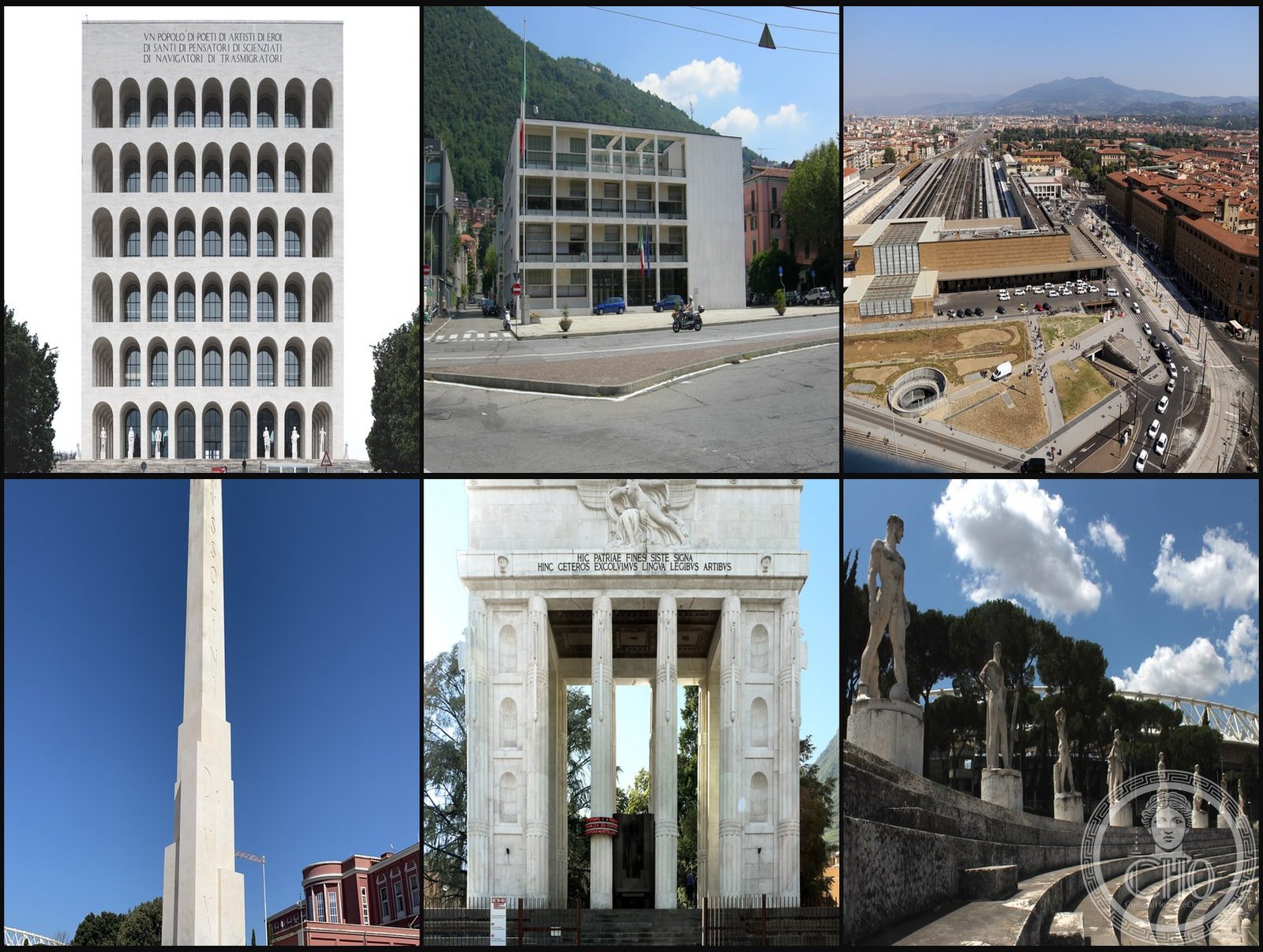
Conti opened with a scene from Roman daily life. Filmgoers leaving the Nuovo Sacher — the arthouse cinema run by director Nanni Moretti near Porta Portese — walk out under a Mussolinian slogan on the facade of a masterpiece of Italian Rationalism designed in 1933 by another, unrelated Moretti: the architect and urbanist Luigi Moretti. The building was the Casa della Gioventù Italiana del Littorio, and it had just then been carefully restored. A few kilometres away, at EUR, the Palazzo della Civiltà Italiana of Giovanni Guerrini, Ernesto Bruno La Padula and Mario Romano — the “Square Colosseum” — still carries on its attic the words of Mussolini’s speech of 2 October 1935 proclaiming the war on Ethiopia: “a people of poets, of artists, of heroes, of saints, of thinkers, of scientists, of navigators, of transmigrators.”
The examples multiplied from there, and any Italian reader could extend the list on foot: the Victory Monument in Bolzano; Florence’s Santa Maria Novella station by the Gruppo Toscano led by Giovanni Michelucci — which, Conti recalled, Mussolini came to love after Margherita Sarfatti persuaded him that from the air the complex resembled a fascio; the “Palazzo M” in Latina, the former Littoria. And above all the obelisk of the Foro Italico, centrepiece of Enrico Del Debbio’s Foro Mussolini project later completed under Luigi Moretti, with its inscription Mussolini Dux — in April 2015 at the centre of a heated controversy, after the intention attributed to Laura Boldrini, then president of the Chamber of Deputies, to have the words erased.
What the historians said
Conti put the question to two scholars, and their answers are the heart of the piece. Giorgio Muratore, professor of the history of contemporary architecture at La Sapienza, noted that Italian Rationalism and the interwar period were at that moment “by far the most studied chapter of contemporary architecture in the world’s leading universities” — for the relationship it created between public building and outdoor space, for its dialogue with natural light. The Guggenheim in New York had just devoted a major exhibition to Italian Futurism up to 1944. Erase the inscriptions? “It would be worrying if the words were considered cumbersome,” Muratore answered. “The idea of removing them is simply embarrassing.”
The historian Vittorio Vidotto — whose Roma contemporanea (Laterza, 2001) reframed the study of Mussolini as urbanist — was just as direct: cancelling the urban traces of Fascism “makes no sense at all. By now they should instead be conserved and restored as important elements of our history.” Taken literally, he observed, erasure would mean destroying genuine masterpieces — architectural, monumental, even in mosaic, like the splendid floors of the Foro Italico, at the time being ruined by skateboards. And the obelisk debate was nothing new: after the war its demolition was proposed and quietly dropped on grounds of cost; in 1960, for the Olympics, the mosaic of the fascist oath was removed; in 1990 a new mosaic arrived bearing a lion — an involuntary posthumous homage, Vidotto noted drily, to a dictator born under that star sign. Conti even reminded readers that Antonio Gramsci had once praised Rationalism for its capacity to “create a mass taste.”
Documenting is not celebrating
A decade on, the argument stands, and Bolzano’s rubble gives it urgency. These buildings are historical sources: they document a political project, a construction industry, an aesthetic that the world’s universities study precisely because it is inseparable from the power that commissioned it. Sources are not celebrated; they are read, conserved, and kept legible — with their inscriptions, which are the most explicit part of the document. A country that erases the evidence does not free itself of the history; it only makes the history harder to teach. The serious answers have long existed, and Italy itself has produced the best of them: historicize, contextualize, explain — as Bolzano did with its Victory Monument and with the Arendt inscription on the Piffrader relief, a few steps from the courthouse now under rubble.
This is the principle our own archive works by. The buildings of 1922–1944 catalogued on Cultural Heritage Online — internationally under Interwar Italy 22–44, and for Italian readers through the Ventennio archive — are treated as sources: verified coordinates, dates, designers, critical context. No nostalgia, no celebration, no erasure. Documentation.
Luigi De Marchi, architect — publisher, Cultural Heritage Online
Sources
- Paolo Conti, “L’architettura fascista è storia. Assurdo demolire dei capolavori”, Corriere della Sera (Roma), 15 April 2015 — quotations of Giorgio Muratore and Vittorio Vidotto as reported there; reproduction.
- Vittorio Vidotto, Roma contemporanea, Laterza, 2001.
- CHO reporting: Bolzano Courthouse Collapse, 16 July 2026.