
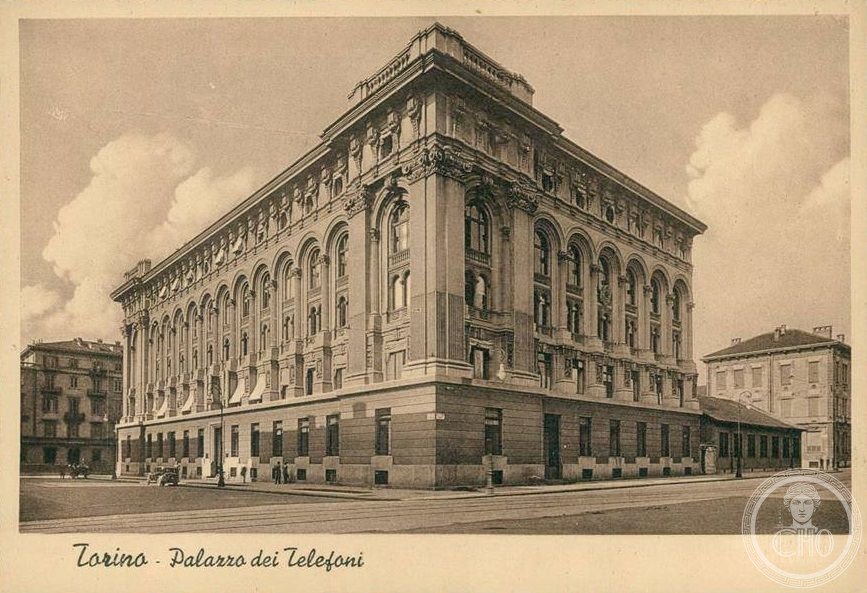
The telephone palace of via Confienza as the 1920s saw it: a giant order rising from rusticated stone, a sculpted crowning, one parked motorcar. War damage and a 1950 raising would change this front for good.
- Address
- Via Confienza 10, Torino — the block bounded by via Meucci, via Mercantini, via Bertolotti and via Confienza
- Period
- Standing by August 1924 (Gabinio photograph); enlarged, rebuilt and raised 1936–1950
- Client
- STIPEL — Società Telefonica Interregionale Piemontese e Lombarda, headquartered here from 1925
- Architect
- Original designer not documented in the sources consulted; every major alteration of 1936–1950 carries the signature of Ubaldo Castagnoli (1902–1982)
- Wartime
- Hit in the raids of 18 November 1942 and 13 July, 8 August and 1 December 1943
- Current use
- Offices of the Agenzia del Territorio (land registry)
- Coordinates
- 45.0691° N, 7.6757° E
From the archives
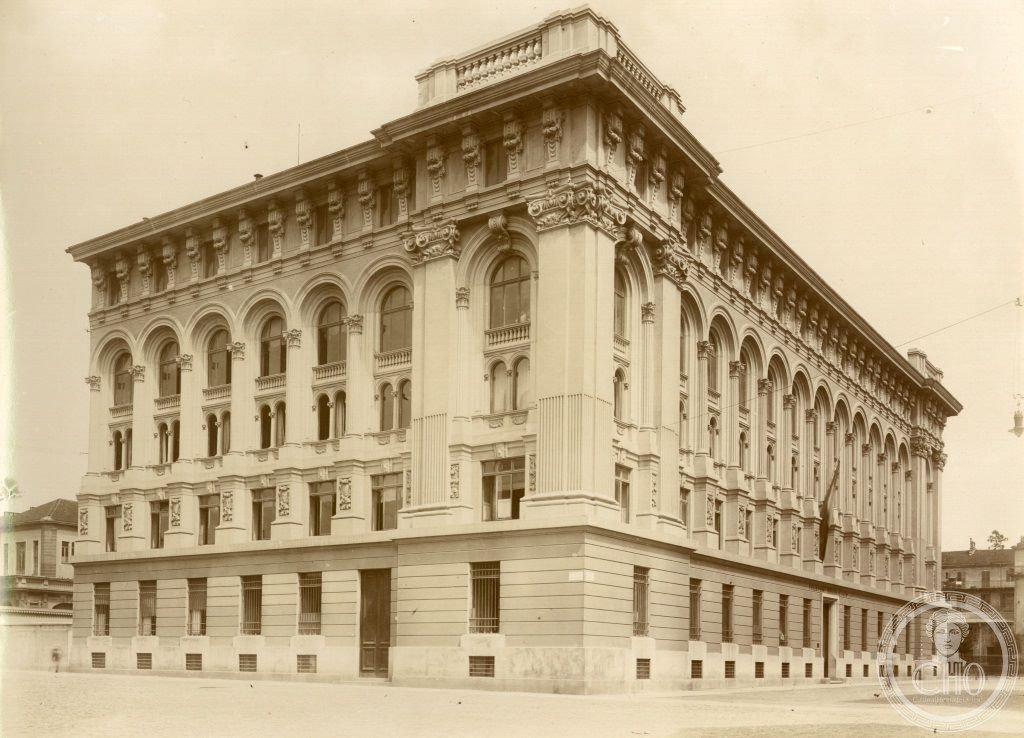
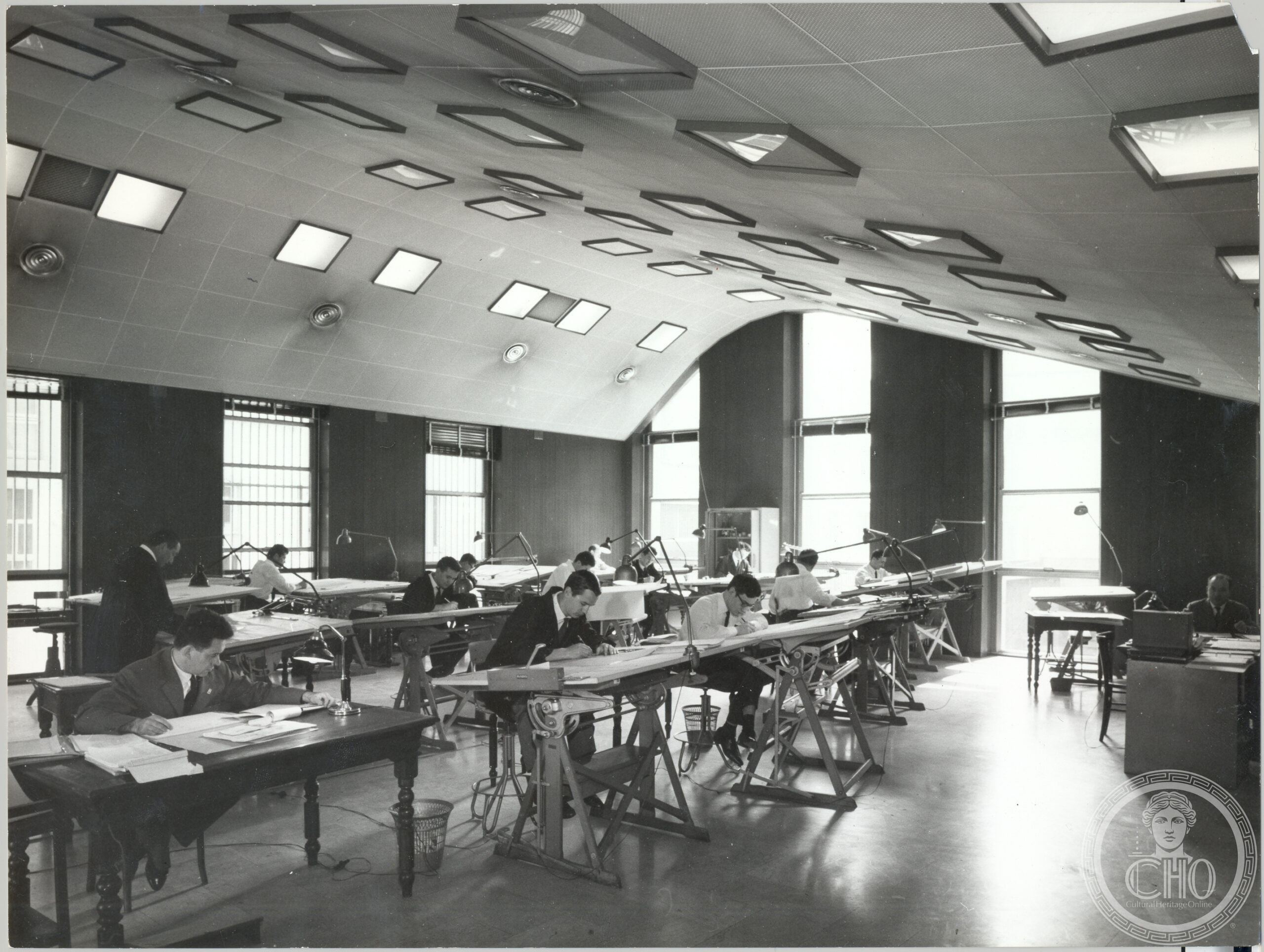
Mario Gabinio’s 1924 photograph of the palace, and STIPEL’s drawing office inside it forty years later.
Visit on the map
Via Confienza 10, Torino · 45.0691° N, 7.6757° E
Download for your navigator
A single waypoint, ready for GPS apps, navigators, and contacts.
The postcard takes the building from its best corner. A rusticated base carries a giant order up through the middle floors; arched windows sit deep between the columns; sculpture crowds the crowning above the cornice. Beside it, a two-storey survivor of the older street waits its turn. One black motorcar stands at the kerb of an otherwise empty cobbled crossing — the telephone company’s palace photographed at the moment the telephone was still a novelty. This exact view is reproduced as “the 1925 building” in the 2021 study by Manuela Incerti, Gianmarco Mei and Anna Castagnoli, because the state it records no longer exists: the front was later raised with a second giant order, and what the postcard shows survives only on paper.
The palace was state property — Mario Gabinio photographed it as the “Palazzo dei Telefoni di Stato” on 9 August 1924 — and it was already serving Turin’s telephone administration when STIPEL, the newly founded concessionaire for Piedmont and Lombardy, made it its headquarters in 1925. Space ran short almost immediately. An extension on the via Confienza side was requested in 1936; from early 1939 Ubaldo Castagnoli developed the project for a new seven-storey building on via Meucci, 61.40 by 28.15 metres, with two basement levels including an air-raid shelter — a detail that reads differently once you know what followed. Between November 1942 and December 1943 four Allied raids hit the block, wrecking the roof and three of the floors.
Castagnoli (Rome 1902 – Turin 1982) is the reason this office building has a place in the history of Italian architecture. A founding member of Gruppo 7 in 1926 — the seven young rationalists, Giuseppe Terragni among them, whose manifesto articles announced modern architecture in Italy — he left the group in the autumn of 1927 for a post at STIPEL, and stayed until 1957. On the roof of the new building he designed something Italy had not seen: a suspended open-air pool for the employees, first drawn in July 1940 and redrawn in February 1942 — a tank of five by fifteen metres, a metre and a half deep, thirty-two metres above the street. A company newsreel of 1941 shows the dopolavoristi swimming lengths with the Turin skyline at eye level. The pool outlived the company’s tenure by a few years only: STIPEL’s successor moved to corso Inghilterra in 1968, the pool disappeared in the early 1970s, and today the land registry fills the offices.
Resources & References
Editorial picks across municipal records and academic study.
Postcard from the collection of Stefano Vigolo, published by permission. Archive photographs via Wikimedia Commons, credited in captions. Editorial text Cultural Heritage Online, OASIS Tech LLC USA.
Find it on the map
See this place and what’s around it →Record researched and written by Oasis Tech for Cultural Heritage Online, 2026.
📷 Become a Cultural Heritage Online photographer
Share your photos of places: they stay published under your name as the author. The more they're seen, the more you get noticed — and soon a contest will reward the most appreciated photos.
Log in or sign up free to add a photoIs this page about you?
This page is read by travellers and heritage enthusiasts who find it on Google. Tell us how you are connected to this place and we will take it from there.