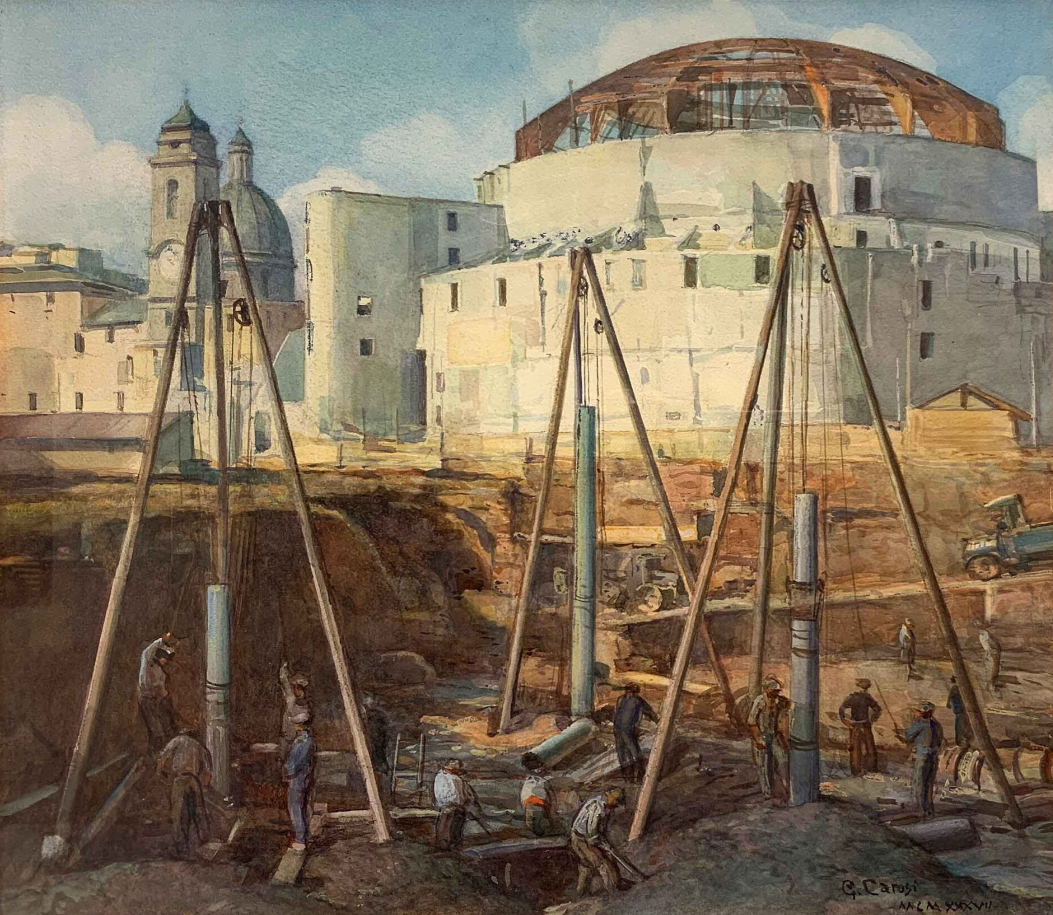
Cantieri intorno all’Augusteo is a watercolour by Italian painter and printmaker Giuseppe Carosi, completed in 1937 and depicting construction activity around the Augusteum in Rome.
Carosi (1883–1965) trained at the Academy of Fine Arts in Rome under Dario Querci, whose teaching emphasised simplified draughtsmanship and brilliant colour application. The artist became known for his landscapes and watercolours, and was associated with the XXV della campagna romana, a group of painters working in the Roman countryside tradition. His early exhibition success included presentations at the Venice International Exposition and the Society of Art Lovers and Patrons in Rome.
This work documents Rome’s urban landscape during the interwar years, when major archaeological and infrastructural projects reshaped the city’s centre. The painting records the physical activity of construction around one of Rome’s most significant ancient monuments, presenting an understated record of modern change adjacent to classical heritage.
About Giuseppe Carosi
Carosi was a Roman painter, printmaker and watercolourist who exhibited widely from his teenage years. He developed a practice rooted in landscape observation and the tradition of Roman countryside painting, applying the technical principles learned from his academic masters to both exhibition works and commissioned pieces.
Details
- Artist: Giuseppe Carosi (Rome, 1883–1965)
- Year: 1937
- Medium: Watercolour
- Subject: Construction sites around the Augusteum, Rome
- Period: Italian interwar era
Explore more: 509 heritage places in Roma
Frequently asked questions
Who was Giuseppe Carosi?
Carosi was an Italian painter, printmaker and watercolourist born in Rome in 1883. He studied at the Academy of Fine Arts under Dario Querci and became known for landscape and watercolour work, exhibiting from his early teens throughout his career until his death in 1965.
Where is the Augusteum located?
The Augusteum is situated in Rome, Italy, in the city centre near other major ancient monuments.
What does this painting document?
The work records construction activity around the Augusteum during Rome’s interwar period, capturing the urban transformation and building projects that reshaped the city’s archaeological core in the 1930s.