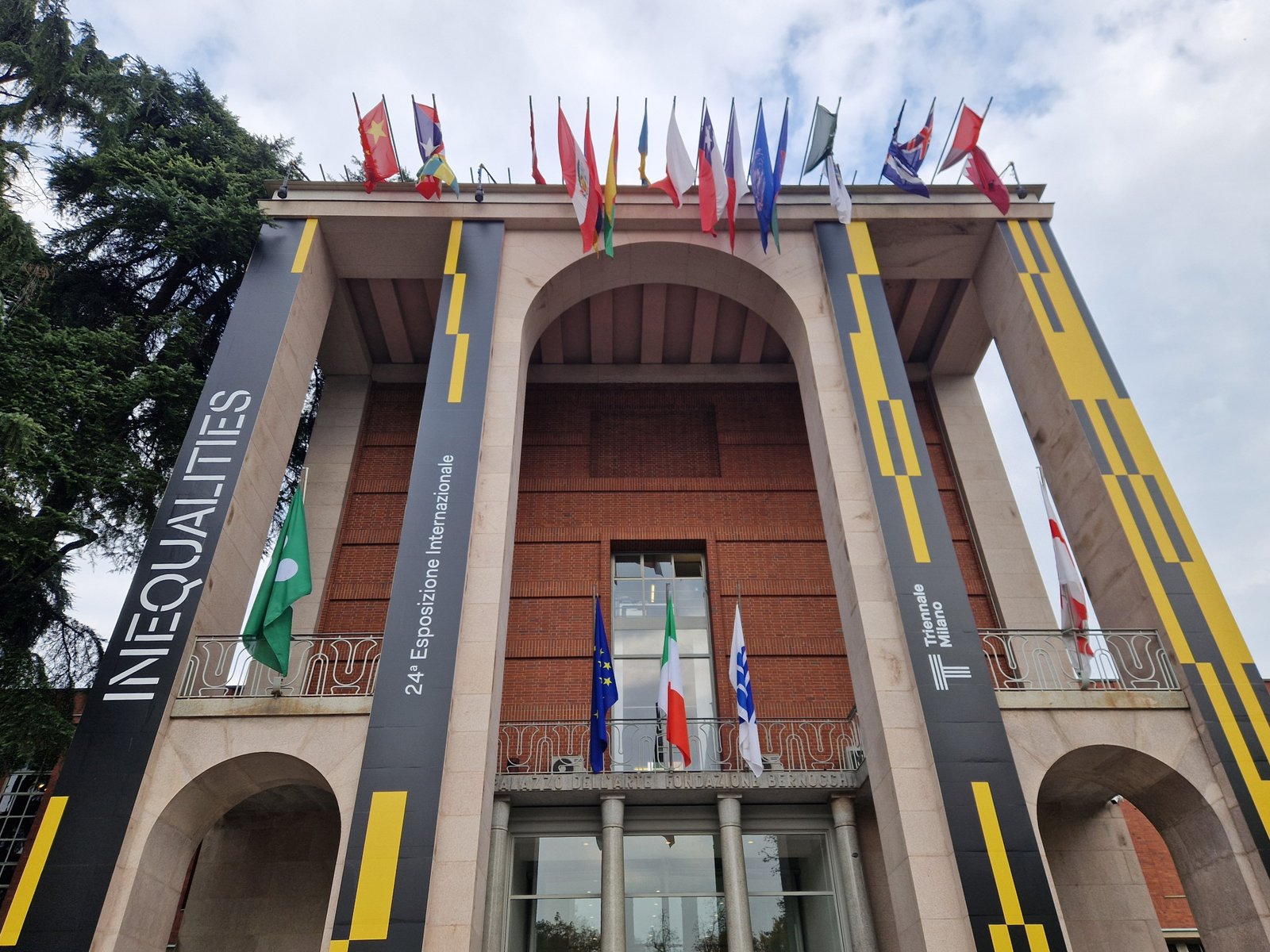
Giovanni Muzio designed Palazzo dell'Arte between 1931 and 1933 as the permanent seat of the Triennale, freshly relocated from the Villa Reale of Monza. The brick volumes facing Parco Sempione blend the measured classicism of Novecento Milanese with the stripped logic of Italian Rationalism, and still house the Triennale di Milano foundation and the Museo del Design Italiano today.
- Address
- Viale Emilio Alemagna 6, 20121 Milano MI — Parco Sempione
- Period
- Built between autumn 1931 and spring 1933; inaugurated for the V Triennale in 1933
- Architect
- Giovanni Muzio, with Gualtiero Galmanini
- Style
- Novecento Milanese with Rationalist elements
- Patron
- Funded by a five-million-lira bequest from senator Antonio Bernocchi and his brothers Andrea and Michele
- Current use
- Headquarters of the Triennale Milano foundation; hosts the Museo del Design Italiano, the Teatro dell'Arte and the international Triennale exhibitions
- Coordinates
- 45.4719° N, 9.1742° E
- Notes
- Since 2003 the Triennale awards the Medaglia d'oro all'architettura italiana from these halls; restoration 1980–1983 by Gae Aulenti, Umberto Riva and Angelo Cortesi; Michele De Lucchi updated the building in 2002 for the Design Museum
Visit on the map
Viale Emilio Alemagna 6, 20121 Milano · 45.4719° N, 9.1742° E
Story
The Triennale was not born in Milan. Its first three editions ran inside the Villa Reale of Monza as a biennial of decorative arts, and only in 1933, for the fifth edition, did the exhibition move into a building of its own a few kilometres south. That building is Palazzo dell'Arte, raised in less than two years on the southern edge of Parco Sempione thanks to a five-million-lira bequest from the Milanese senator Antonio Bernocchi and his brothers Andrea and Michele. Giovanni Muzio, the leading figure of the Novecento Milanese movement, drew the project with Gualtiero Galmanini and delivered it in time for the May 1933 opening.
What Muzio designed is a palace that refuses both academic eclecticism and the white surfaces of pure Rationalism. The exterior is clad in clinker brick — a pioneering choice for an Italian public building of the period — with rosa di Baveno granite framing the main openings. Long horizontal volumes face Parco Sempione and read as a measured counterweight to the Arena Civica across the park, while a quieter rhythm of windows marks the office wings behind. The plan is organised around an impluvium, a top-lit central court fifteen metres high that Muzio designed as a winter garden, and around a three-flight monumental staircase in Istrian stone that leads to the upper exhibition halls. The Teatro dell'Arte, the small theatre Muzio inserted into the south wing, opened with the same V Triennale and still hosts performances today.
The building has not always been kind to its architect's intentions. Between 1968 and 1979 the palace closed for repeated structural issues and shifting institutional priorities, and reopened in 1983 only after a long restoration directed by Gae Aulenti with Umberto Riva and Angelo Cortesi. A second campaign by Michele De Lucchi, completed in 2002, retooled the ground floor to accommodate the permanent Museo del Design Italiano, which opened in its current form in 2007. Since 2003 the Triennale awards the Medaglia d'oro all'architettura italiana from these halls. The building remains the operational headquarters of the Triennale Milano foundation, the body that runs the international Triennale exhibitions, the design museum, the Teatro dell'Arte and the public programme spilling into Parco Sempione.