

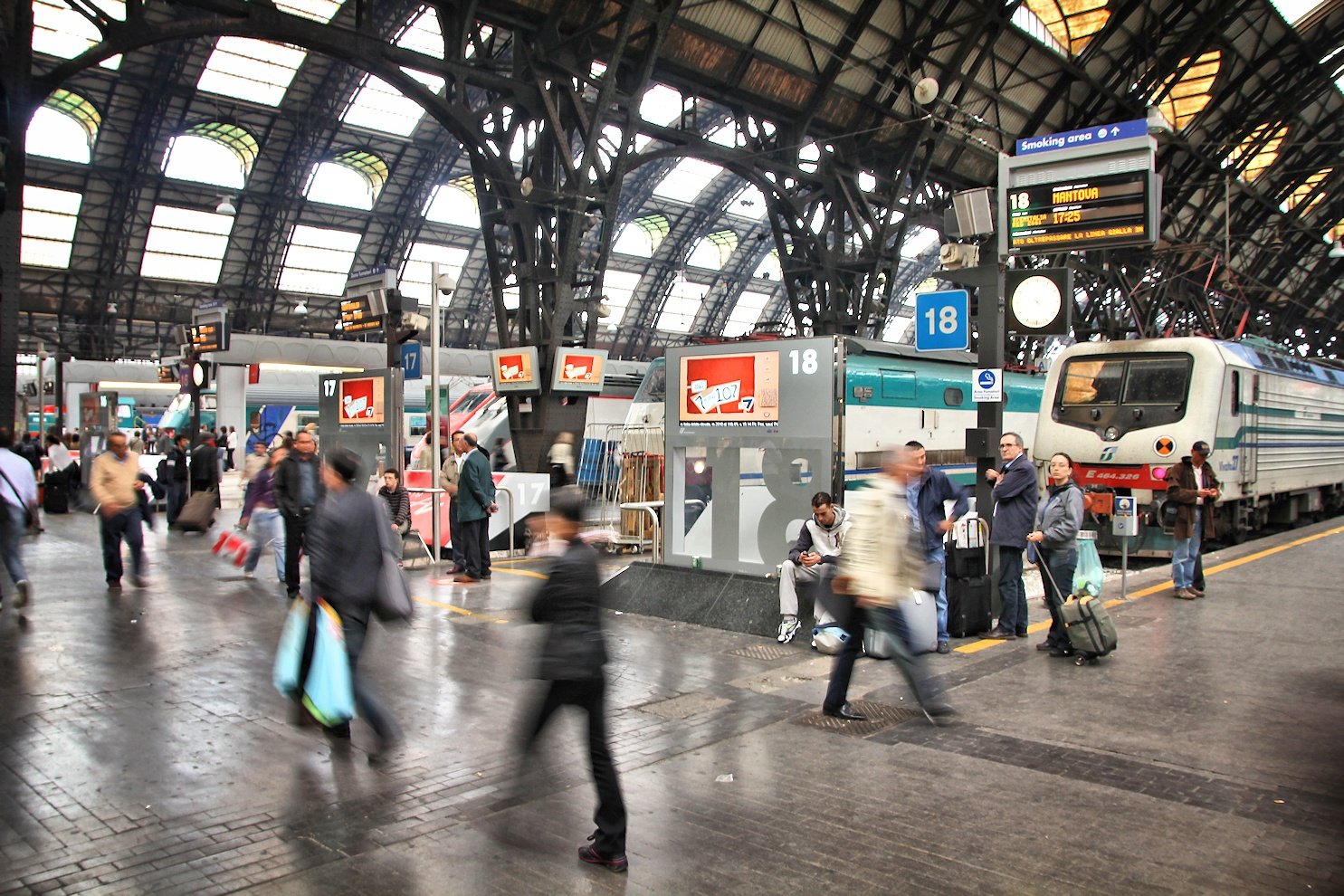
Milano Centrale is the principal railway station of Milan and one of the largest terminals in Europe. The competition for its design was won in 1912 by the architect Ulisse Stacchini, whose project «In Motu Vita» combined a Liberty sensibility with the monumental classicism that the Italian state expected of its great public buildings. Construction, interrupted by the First World War and economic restraint, resumed under the Fascist government in 1925 and the station was inaugurated on 1 July 1931, with a 200-metre principal facade and a train shed whose 72-metre vault was a record at the time of its completion.
- Address
- Piazza Duca d’Aosta 1, 20124 Milano MI
- Architect
- Ulisse Stacchini (winning competition project, 1912); Mussolini-era ornamentation programme directed in part by Angiolo Mazzoni for the State Railways’ technical office
- Construction
- Cornerstone laid 28 April 1906 by King Victor Emmanuel III; works interrupted by the First World War; resumed 1925; inaugurated 1 July 1931
- Style
- Synthesis of late Liberty, monumental Art Deco and emerging Razionalismo — an eclectic register sometimes labelled «Assyrian-Lombard»
- Scale
- 200-metre principal facade; 72-metre vault height (a record at completion); 341-metre platform canopies covering 66,500 m² designed by Alberto Fava; 24 platforms
- Function
- National and international railway terminal operated by Rete Ferroviaria Italiana / Grandi Stazioni Rail
- Coordinates
- 45.4866° N, 9.2050° E
- Traffic
- Approximately 120 million passengers per year — one of the busiest stations in Italy
Visit on the map
Piazza Duca d’Aosta 1 · 45.4866° N, 9.2050° E
Story
The history of Milano Centrale begins with a problem of scale. By the end of the nineteenth century, the city’s first central station, opened in 1864 in what is today Piazza della Repubblica, could no longer absorb the traffic of the Sempione tunnel route to Switzerland and France. A new terminal further north was planned, and on 28 April 1906 King Victor Emmanuel III laid the cornerstone of the future station — before the competition for the building itself had even been judged.
That competition was won in 1912 by Ulisse Stacchini, a Florentine-trained architect who had built much of his career in Milan. His design, «In Motu Vita», received the unanimous endorsement of the jury and proposed a terminal whose decorative apparatus was rooted in the Liberty vocabulary of the early century yet organised by an axial, classical plan. The First World War, public-finance restraint and repeated revisions requested by the city government delayed construction until 1925, when the Mussolini government decided to complete the work as a flagship public project. The decorative programme expanded accordingly: ornamentation, mosaics and architectural details added in the second campaign reflected the heavier, monumental register of the late 1920s, with some elements supplied through the Italian State Railways’ technical office directed at the time by Angiolo Mazzoni.
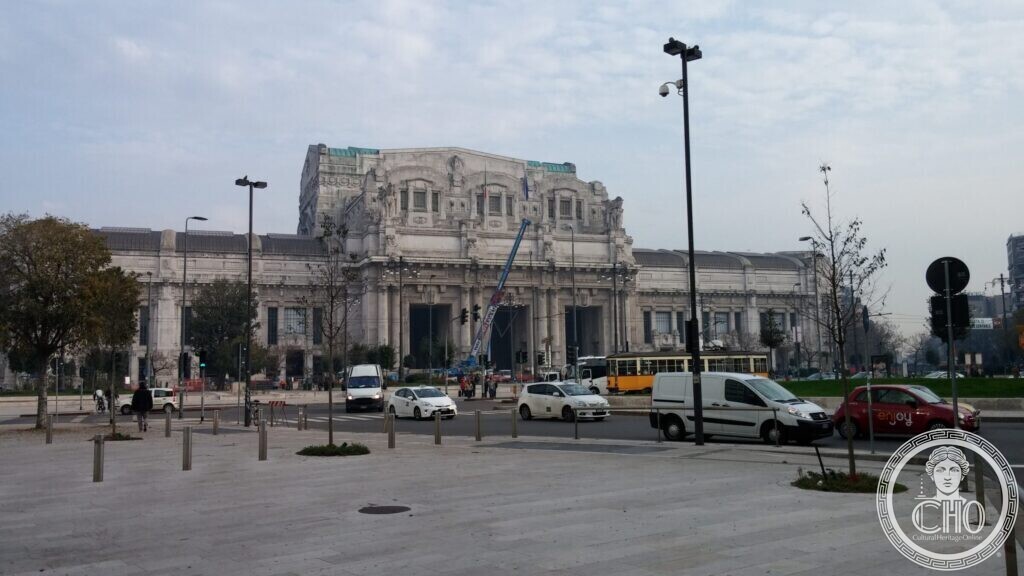
The result, inaugurated in the presence of Foreign Minister Galeazzo Ciano on 1 July 1931, is a building that defies a single stylistic label. The principal facade unfolds along 200 metres of stone facing the Piazza Duca d’Aosta, articulated by giant pylons, friezes of winged horses and eagles, allegorical reliefs and a famous central clock. Behind it, an immense atrium dressed in mosaic and travertine leads to the ticket halls, and beyond them the train shed rises to a vault 72 metres high — the tallest in Europe at the time of opening — sheltering 24 platforms beneath canopies 341 metres long, designed by the engineer Alberto Fava. The station was electrified in 1938, modernised on several occasions, and remains today a working terminal for the Frecciarossa high-speed network and for international services to Switzerland, France and Germany.
Resources & References
Editorial picks across Wikipedia, photo archives, and railway portals.
Hero image: Marek Slusarczyk (Tupungato), Wikimedia Commons, licensed CC BY 3.0. Editorial text Cultural Heritage Online, OASIS Tech LLC USA, 2026.
Gallery
Find it on the map
See this place and what’s around it →Historical events at this place (1)
📷 Become a Cultural Heritage Online photographer
Share your photos of places: they stay published under your name as the author. The more they're seen, the more you get noticed — and soon a contest will reward the most appreciated photos.
Log in or sign up free to add a photoIs this page about you?
This page is read by travellers and heritage enthusiasts who find it on Google. Tell us how you are connected to this place and we will take it from there.