The Seychelles has 2 UNESCO World Heritage Sites, both inscribed in the early 1980s and both recognised for natural heritage of global importance. Across a scattered archipelago of 115 islands, these two designations protect one of the ocean’s most isolated coral systems and a primeval palm forest found nowhere else on Earth. From Cultural Heritage Online.
Why the Seychelles’s list looks the way it does
The Seychelles archipelago sits in the western Indian Ocean, far from any continental landmass, and its relative inaccessibility has been both its curse for exploitation and its gift for conservation. The two inscribed sites reflect exactly that legacy: large, ecologically intact areas where human interference has been limited and biodiversity has been allowed to persist across centuries without the pressures that have erased comparable ecosystems elsewhere.
Neither site is cultural — the Seychelles carries no inscribed built heritage under the World Heritage Convention as of 2025. That is not for want of history; Mission Ruins of Venn’s Town on Mahé Island, a site associated with freed enslaved people in the nineteenth century, sits on the Tentative List alongside Silhouette Island, both submitted in 2013. Whether either reaches inscription will depend on the resources the government can commit to the nomination process in the years ahead.
The first inscriptions
The Seychelles joined the World Heritage Convention in 1980 and moved quickly to put forward its most exceptional natural assets. The first two inscriptions came within a year of each other:
- Aldabra Atoll — inscribed 1982
- Vallée de Mai Nature Reserve — inscribed 1983
Both nominations were uncontroversial. Aldabra was already recognised by the scientific community as one of the planet’s critical ecosystems, and Vallée de Mai had been protected at national level since the 1960s. The speed of inscription reflected a political moment when the World Heritage List was still being built and sites of unambiguous global value could move through the process with relative efficiency.
The most visited — and the alternatives
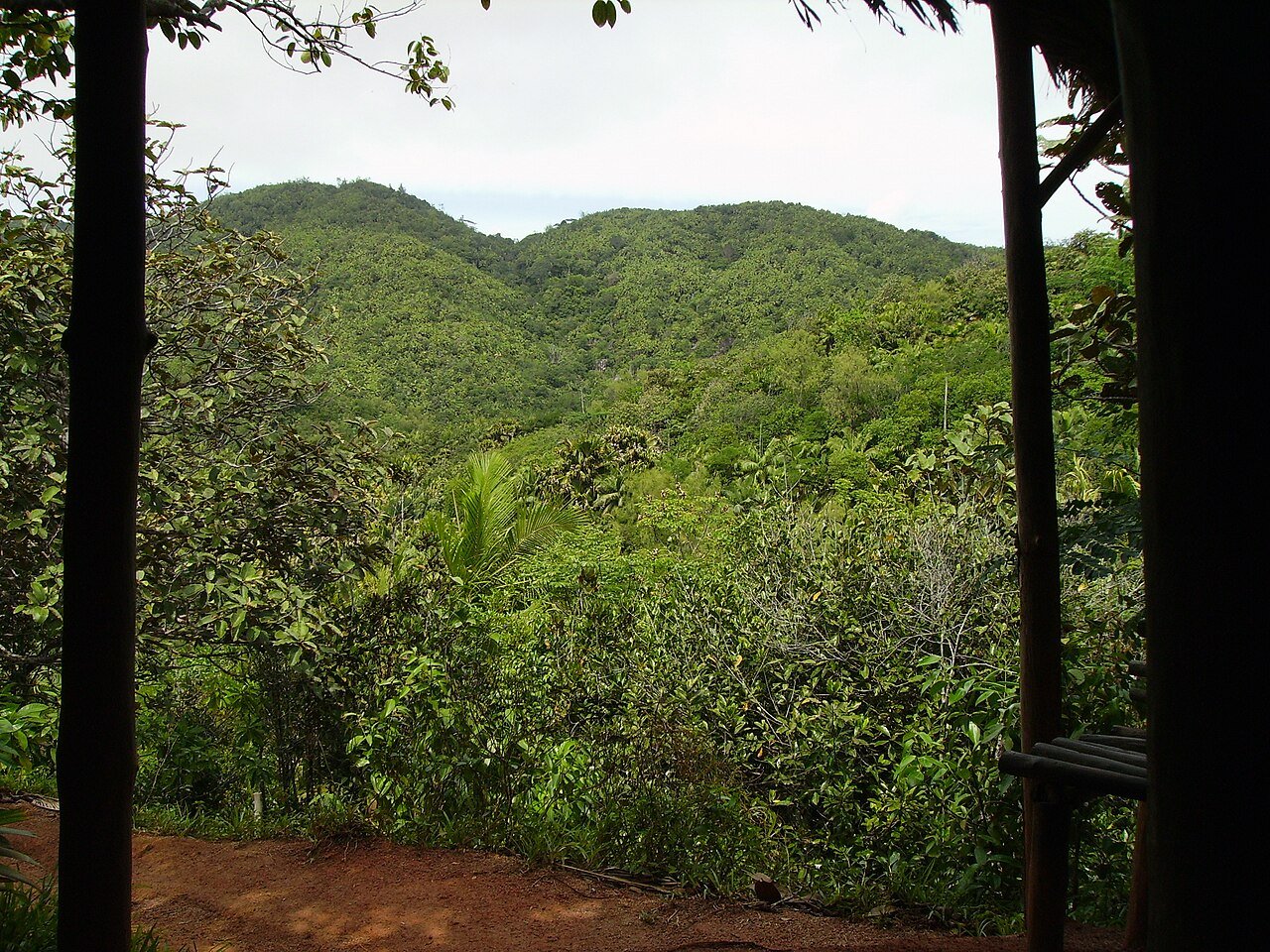
Vallée de Mai on Praslin Island draws the larger share of visitors. Its dense, ancient palm forest is the primary habitat of the coco de mer, the plant that produces the largest seed in the plant kingdom — a single nut can weigh up to 25 kilograms. The forest is also the last refuge of the black parrot, Seychelles’s national bird, and walking its shaded trails puts visitors inside an ecosystem that predates human settlement of the islands entirely.
Aldabra Atoll, by contrast, is the kind of site most travellers read about rather than visit. Access is tightly controlled, no permanent tourist infrastructure exists, and reaching it requires either a research permit or an expedition charter. That inaccessibility is arguably the point: it is precisely because Aldabra has been difficult to reach that its four large coral islands and enclosed shallow lagoon still sustain around 152,000 giant tortoises — the world’s largest population of this reptile — alongside nesting sea turtles, manta rays, and one of the Indian Ocean’s most intact coral reef systems. For those with a serious interest in natural heritage rather than a resort holiday, the atoll represents something increasingly rare: a site where the designation genuinely changed nothing, because the place was already beyond the reach of casual tourism.
Natural and shared sites
Both of the Seychelles’s inscribed properties are natural World Heritage Sites. There are no mixed or cultural designations. Aldabra is sometimes grouped in discussions alongside other remote atoll sites in the Indian Ocean — including properties in Mauritius and the British Indian Ocean Territory — because the ecological dynamics of isolated coral systems share common scientific questions, but Aldabra carries no formal transnational designation. It is a standalone serial nomination recognised for the extraordinary completeness of its atoll ecosystem.
The absence of a cultural site on the list is worth noting for travellers with broader heritage interests. The Seychelles has a complex layered history: successive French and British colonial administrations, a population descended in large part from enslaved Africans, and a Creole culture with distinctive architecture, cuisine, and language. That history has not yet produced a World Heritage inscription, though the Venn’s Town nomination may eventually change that picture.
How to find them
Vallée de Mai is accessible via ferry from Mahé to Praslin, followed by a short drive to the reserve entrance. The site is open daily and managed by the Seychelles Island Foundation. Aldabra requires advance planning: the Seychelles Island Foundation manages research access and occasional special expedition permits, and the atoll is approximately 1,100 kilometres south-west of Mahé, reachable only by boat or chartered flight.
The Seychelles’s World Heritage sites sit alongside thousands of other places on CHO’s interactive map, with GPS and sourced editorial history for each. See also our guides to Italy’s and France’s UNESCO sites, and our piece on cultural travel beyond mass tourism.
Frequently Asked Questions
How many UNESCO World Heritage Sites does the Seychelles have?
The Seychelles has 2 UNESCO World Heritage Sites as of 2025. Both are natural heritage designations: Aldabra Atoll, inscribed in 1982, and Vallée de Mai Nature Reserve, inscribed in 1983. The country has no cultural or mixed World Heritage inscriptions at this time.
What was the Seychelles’s first UNESCO World Heritage Site?
Aldabra Atoll was the first site in the Seychelles to receive World Heritage status, inscribed in 1982. It was followed by Vallée de Mai Nature Reserve in 1983. The Seychelles joined the World Heritage Convention in 1980 and nominated both properties within its first three years of membership.
Can visitors access Aldabra Atoll?
Aldabra Atoll is not open to general tourism. Access is controlled by the Seychelles Island Foundation, which issues permits primarily for scientific research and occasional expedition charters. The atoll lies approximately 1,100 kilometres south-west of Mahé, making even logistical access a significant undertaking.
What makes the coco de mer at Vallée de Mai significant?
The coco de mer palm, found in its natural state almost exclusively in Vallée de Mai, produces the largest seed of any plant on Earth — individual nuts can weigh up to 25 kilograms. The reserve on Praslin Island is the primary natural habitat for this species and also shelters the black parrot, the national bird of the Seychelles, which is found nowhere else in the world.
Sources used in this article
- UNESCO — State Party the Seychelles — World Heritage list.
- UNESCO — the Seychelles: World Heritage Sites.
- CHO magazine — What is a World Heritage Site?
- CHO — Interactive map of heritage sites.