
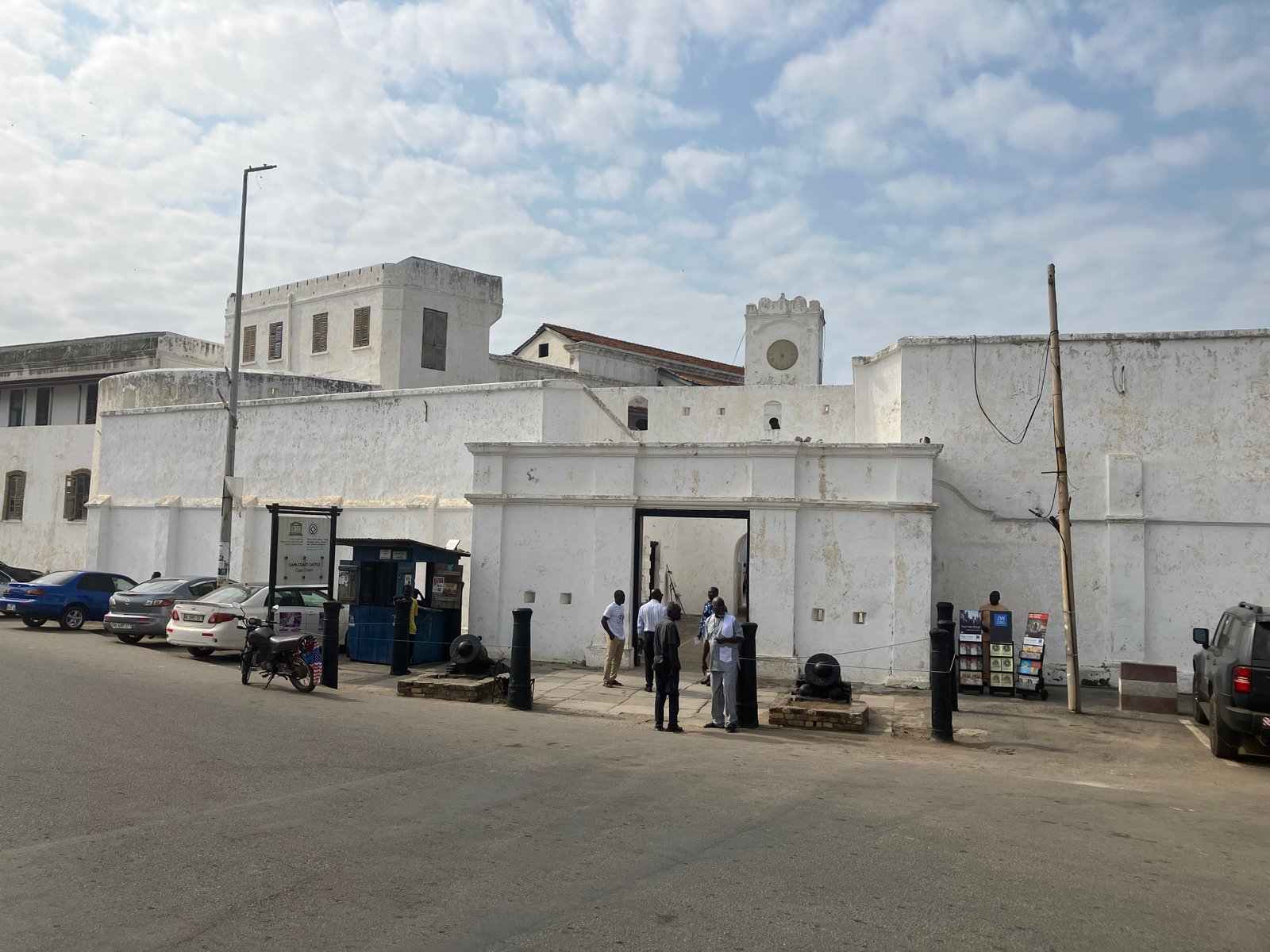
Two UNESCO World Heritage Sites lie within a half-day’s drive of Accra: a chain of European slave-trade fortifications that still stand on Ghana’s Atlantic coast, and a collection of sacred Asante buildings in the forest interior around Kumasi. Both demand time, attention, and a willingness to sit with difficult history. From Cultural Heritage Online.
Forts and Castles, Volta, Greater Accra, Central and Western Regions Cape Coast Castle: 130 km west, ~2 hr; Elmina Castle: 145 km west, ~2.5 hr
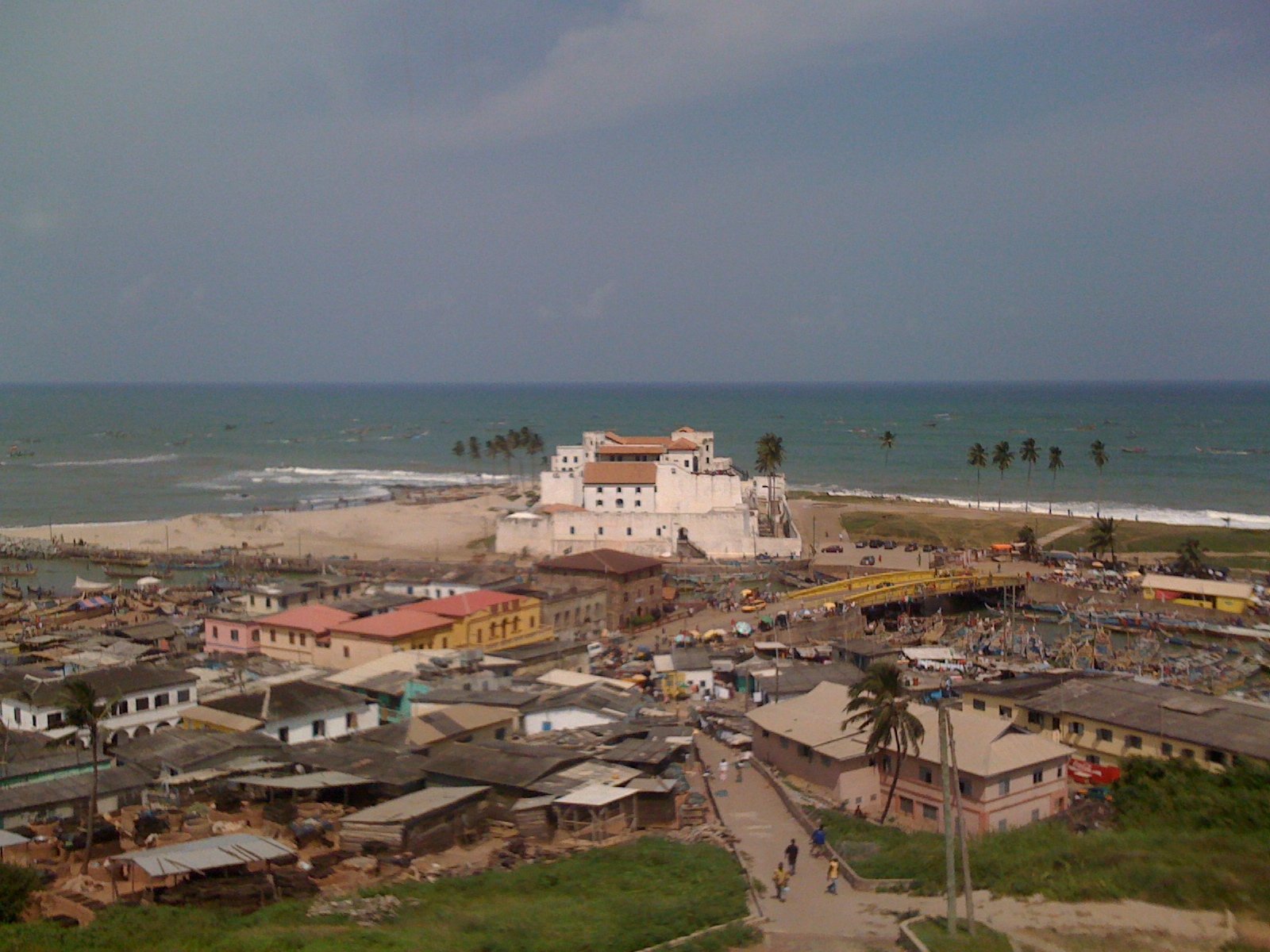
Ghana’s coastline holds 32 surviving fortifications built by European powers from 1482 onward — Portuguese, Dutch, British, Danish, and Swedish — collectively inscribed as a UNESCO World Heritage Site in 1979. The two most visited, Elmina Castle and Cape Coast Castle, stand close enough together that both can be seen in a single long day from Accra, though each rewards a slower visit on its own terms.
Elmina Castle is the oldest. Portuguese traders built São Jorge da Mina in 1482, making it the earliest European structure still standing in sub-Saharan Africa. The Dutch seized it in 1637, enlarged it considerably, and ran it as an administrative centre and slave-holding facility until British annexation in 1872. Walking through today, the scale is what registers first: thick limestone walls that absorb heat and hold it, long dim tunnels where the ocean smell is permanent, and a courtyard that feels smaller than it should given the numbers of people processed through it. At its peak, the castle held up to 1,000 enslaved people in its dungeons at a time before their departure through the Door of No Return — the archway that opened directly to waiting ships.
Cape Coast Castle, 15 kilometres east along the coast, has a parallel history. The British rebuilt and expanded a Swedish trading post here through the 1660s, and it served as the headquarters of the Royal African Company. The dungeons run below the governor’s residence — a deliberate architectural relationship that guides and historians return to repeatedly. Both castles now operate as museums, and Cape Coast hosts the W.E.B. Du Bois Centre nearby, embedding the site in the broader history of Pan-African thought and diaspora memory.
Getting there: Shared tro-tro buses run from Accra’s Kaneshie Motor Terminal to Cape Coast (approx. 2 hr, very low cost); private taxis or hired cars offer more flexibility for reaching both castles in one day. Allow: Half a day per castle minimum; a full day if visiting both. Best for: Travellers with an interest in Atlantic history, the African diaspora, and colonial architecture; guided tours are strongly recommended at both sites.
Asante Traditional Buildings Kumasi: 250 km north, ~3.5 hr; Besease Shrine: 25 km beyond Kumasi
In 1980, UNESCO inscribed a group of sacred buildings in the Kumasi region as outstanding examples of Asante vernacular architecture — a tradition built almost entirely from organic materials: timber frames, palm-leaf thatch, and walls of wattle and daub finished with ochre or dark red earth. The buildings are not ruins. They are active religious and chiefly spaces, which is precisely why they are so rare: most Asante structures of comparable age have been demolished, replaced, or lost to fire and rain, while these were preserved through continued sacred use.
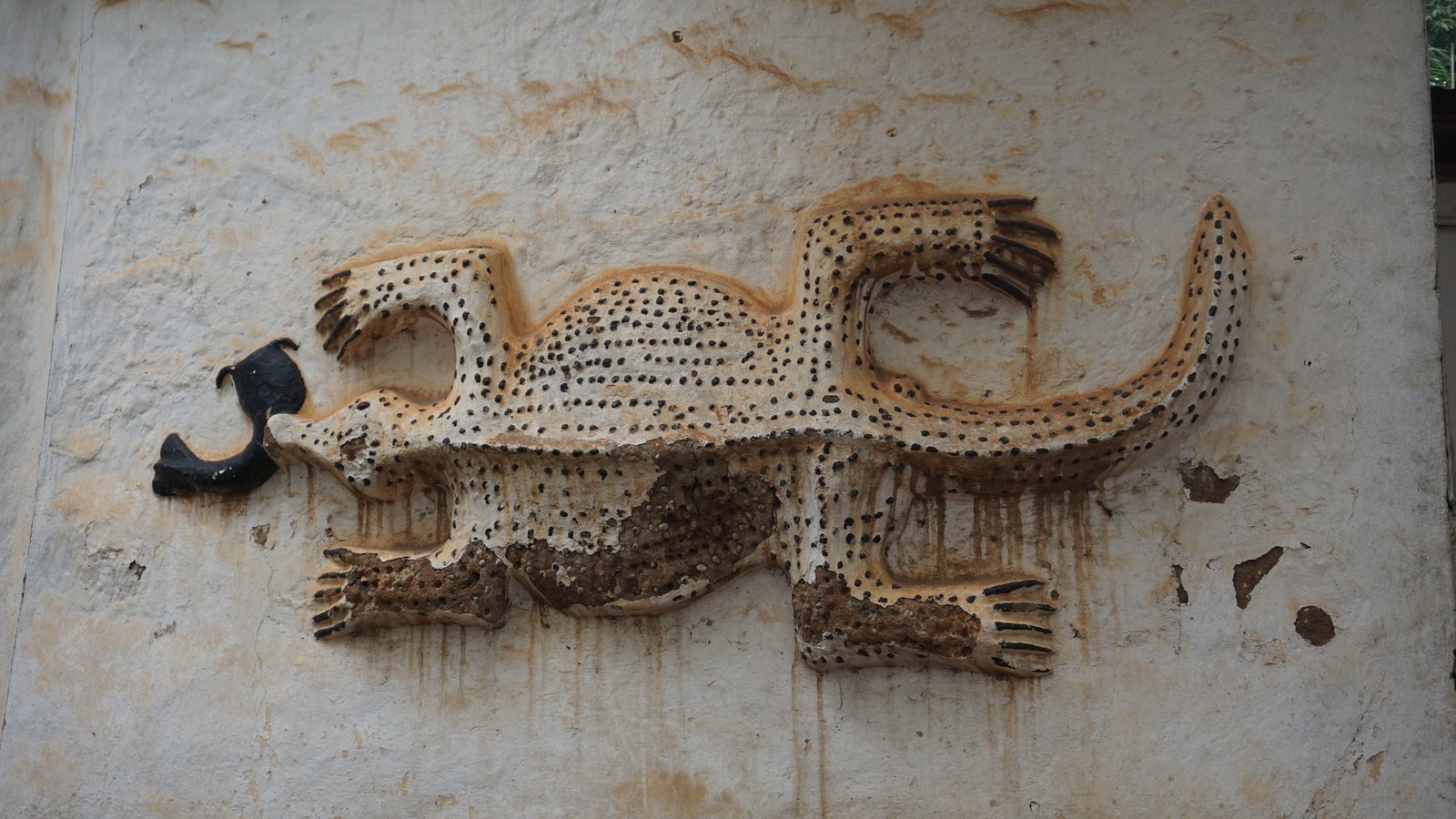
The Besease Shrine, roughly 25 kilometres southeast of Kumasi, is the best preserved of the group and the most commonly visited by heritage travellers. The shrine’s outer walls carry geometric relief patterns pressed into wet earth, a technique requiring skilled hands and regular maintenance — the community that cares for Besease still carries out this work. Inside, the scent of earth and wood smoke is thick. The proportions are intimate rather than monumental: the architecture is built to human scale, not to impress from a distance. Its power lies in detail and continuity, not grandeur.
The broader inscription covers palaces known as ahemfie — the official residences of Asante chiefs — along with other shrines and sacred sites across the region. Many are in small towns and villages outside Kumasi’s centre, and visiting them requires local guidance and permission from community elders. The Asante Empire, founded around 1670 and reaching its greatest extent in the early nineteenth century before British military campaigns reduced its territory, produced a distinctive material culture that extended from this architecture into goldwork, kente weaving, and stool regalia. The buildings hold that history in their walls.
Getting there: Kumasi is 250 km north of Accra on the N6 highway; shared buses and STC coaches run regularly (3–4 hr). From Kumasi, Besease is accessible by taxi or tro-tro toward Ejisu. Allow: At least one full day in the Kumasi area; overnight stay recommended to visit multiple sites. Best for: Travellers interested in West African history, traditional architecture, and living heritage; respectful visitor conduct and a local guide are essential.
Frequently Asked Questions
How many UNESCO World Heritage Sites are near Accra?
Ghana has two UNESCO World Heritage Sites, both accessible from Accra. The Forts and Castles of the Volta, Greater Accra, Central and Western Regions were inscribed in 1979; the Asante Traditional Buildings near Kumasi were inscribed in 1980. Both sites are reachable by road within three to four hours from the capital.
How do I visit Cape Coast Castle and Elmina Castle from Accra?
Both castles are on the coast west of Accra. Cape Coast Castle is roughly 130 km away (about 2 hours by road); Elmina Castle is another 15 km west (add 20–30 minutes). Shared tro-tro buses depart regularly from Kaneshie Motor Terminal in Accra and reach Cape Coast for a low fare. A hired taxi or private car gives you the flexibility to visit both in a day. Guided tours run at each castle throughout the day; the guides at both sites provide context that is difficult to obtain independently, and the entrance fees are modest. Arrive early to avoid the midday heat in the dungeons.
Can I combine the coastal forts and the Asante buildings in one trip?
It is logistically possible but requires at least three days. The coastal castles are west of Accra; Kumasi and the Asante sites are north. A practical itinerary runs Accra to Cape Coast and Elmina (nights 1–2), then a return to Accra and onward to Kumasi (nights 3–4), with a day trip to Besease Shrine. Both routes are well served by road transport. Trying to compress this into a single day is not recommended — each site deserves unhurried attention, and the distances are real.
What makes the Asante Traditional Buildings historically significant?
The inscribed Asante buildings represent a surviving example of a once-widespread West African architectural tradition that relied entirely on organic materials — timber, thatch, and earth — maintained through continuous use rather than restoration. Most comparable structures have not survived Ghana’s climate and the upheavals of colonial rule. The Asante Empire was one of the most powerful states in West Africa between the seventeenth and nineteenth centuries, and these buildings — palaces, shrines, and sacred sites — are among the few physical traces of that political and spiritual culture still standing in their original form.
Sources
- S1 — van Dantzig, Albert. Forts and Castles of Ghana. Sedco Publishing, 1980. ISBN 978-9964-72-010-0.
- S2 — Anquandah, James. Castles and Forts of Ghana. Ghana Museums and Monuments Board, 1999. ISBN 978-2-87678-524-3.
Spotted an error? Write to editorial@culturalheritageonline.com and we correct it the same day.





.jpg)