Zambia has one UNESCO World Heritage Site — a record that belies the country’s extraordinary depth of natural landscape and prehistoric archaeology. That single inscription, shared with neighbouring Zimbabwe and recognised in 1989, happens to be one of the most dramatic natural phenomena on earth. From Cultural Heritage Online.
Why Zambia’s list looks the way it does
Zambia’s World Heritage roster is short not because the country lacks significant sites, but because the formal nomination process demands substantial documentation, management frameworks, and sustained institutional support. Many countries with comparable natural and archaeological wealth have similarly modest inscription tallies, particularly where heritage bodies face competing resource demands. Zambia’s National Heritage Conservation Commission manages a tentative list of seven properties currently under consideration, several of which carry considerable scientific weight.
The country’s position on the UNESCO World Heritage Committee from 2021 to 2025 reflects a growing engagement with the international heritage system. That institutional involvement typically precedes a more active nomination pipeline, and several of Zambia’s tentative sites have been described by researchers as among the most archaeologically significant in sub-Saharan Africa.
The first inscriptions
Zambia’s entry into the World Heritage system dates to 1989, when the 13th session of the World Heritage Committee inscribed the following site:
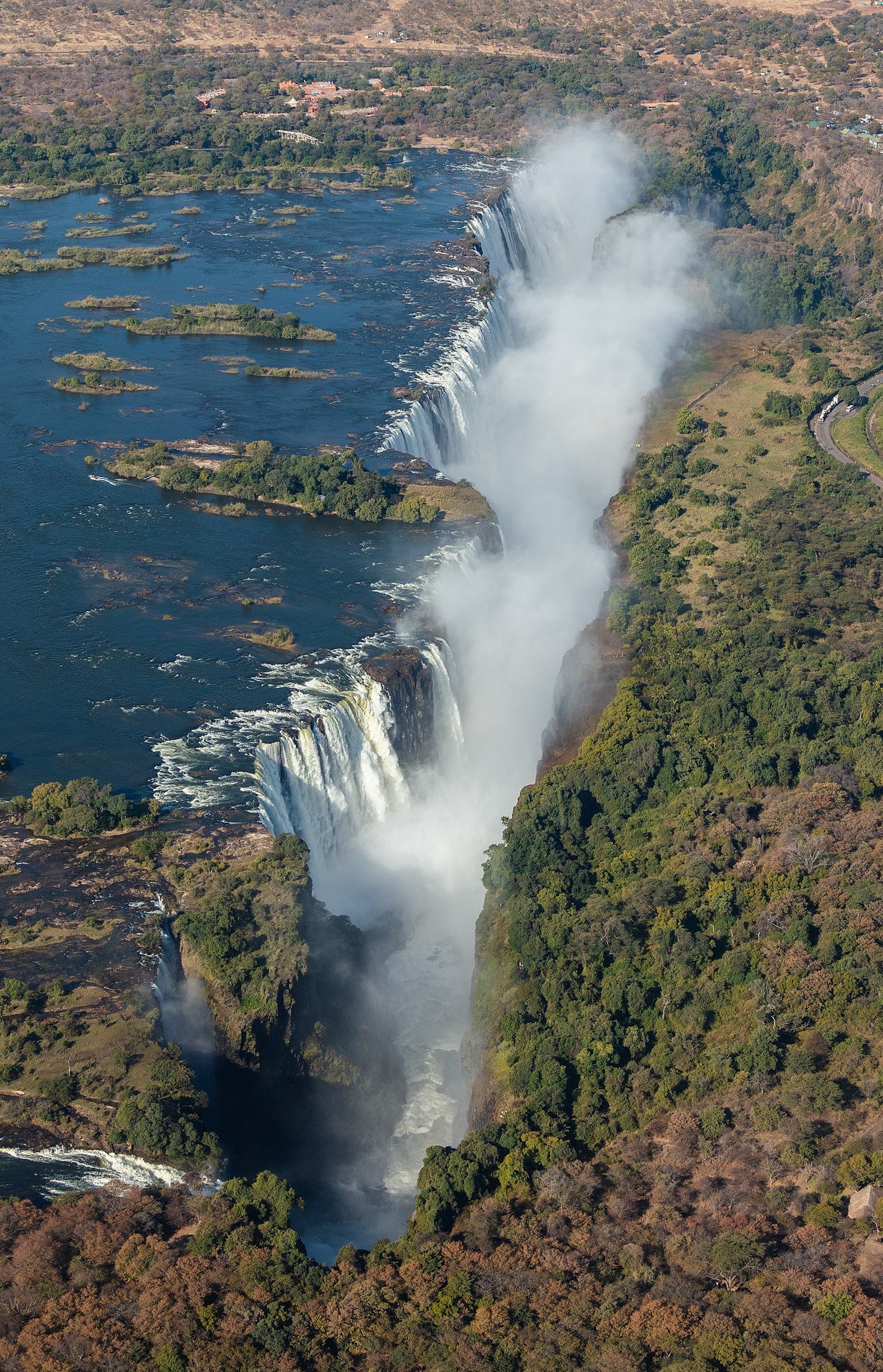
- Mosi-oa-Tunya / Victoria Falls (1989) — a transnational natural site shared with Zimbabwe, inscribed under criteria vii and viii for its exceptional natural beauty and outstanding geological record.
The name Mosi-oa-Tunya comes from the Tonga language and translates roughly as “the smoke that thunders” — a reference to the spray column that can rise more than 400 metres above the canyon. The inscription was granted jointly to Zambia and Zimbabwe, a relatively early example of what UNESCO would formalise as transnational serial nominations. At the time of inscription, the two national parks flanking the falls — Mosi-oa-Tunya on the Zambian side and Victoria Falls National Park on the Zimbabwean side — together encompassed a comparatively modest protected area, which has contributed to ongoing discussions about buffer zone management.
The most visited — and the alternatives
Mosi-oa-Tunya / Victoria Falls requires little introduction. The Zambezi River, at its widest point of 1,708 metres, drops 108 metres into a narrow basalt gorge, generating a roar audible from a considerable distance and a permanent mist that sustains a localised rainforest on the canyon rim. Late dry-season visits — roughly August to October — offer unobstructed views; the peak flow months of February to May produce a wall of white that obscures almost everything. Either way, the scale is unambiguous.
For visitors willing to move beyond the falls, Zambia’s tentative list points toward sites of a very different character. Kalambo Falls, near the southern end of Lake Tanganyika on the Tanzania border, stands 235 metres high — making it the tallest waterfall in both Zambia and Tanzania — but its deeper claim to significance is archaeological: excavations here have uncovered evidence of human occupation spanning over 447,000 years, and a 2023 study identified wooden structural remains dating to approximately 476,000 years ago, potentially the earliest known hominid construction. The Barotse Cultural Landscape in Western Province represents a living cultural site tied to the Lozi people’s seasonal flood-plain management practices, a system of controlled movement between high and low ground that has shaped the landscape for centuries. The Chirundu Fossil Forest in Southern Province preserves petrified tree trunks from the late Carboniferous period, offering a record of the vegetation that covered central Africa roughly 300 million years ago.
Natural and shared sites
Zambia’s single inscribed site is by definition natural — inscribed under criteria vii (exceptional natural beauty or aesthetic importance) and viii (outstanding examples of major stages of earth’s history, including geological processes and biological evolution). The falls meet criterion vii through sheer spectacle and the biodiversity sustained by their permanent mist: the spray forest on the Zambian bank supports ebony, ivory palm, and fig species alongside 35 recorded bird-of-prey species and populations of elephant and buffalo. Criterion viii is satisfied by the geological sequence visible in the successive gorges downstream, each one representing a former position of the waterfall as it retreated northward through the basalt plateau over millennia.
The transnational character of the inscription is worth noting: the Zambia-Zimbabwe partnership established in 1989 was part of a broader trend toward recognising that natural and cultural landscapes rarely respect national borders. Climate research now documents a more pressing shared concern — variability in Zambezi River flow driven by regional precipitation changes has produced documented reductions in the falls’ volume during drought periods, raising questions about long-term site integrity that neither country can address alone.
How to find them
Mosi-oa-Tunya / Victoria Falls is accessible from Livingstone on the Zambian side, approximately ten minutes by road from the main viewpoint. The Zambian bank offers close access to the Eastern Cataract and Devil’s Pool, a natural rock formation at the lip of the falls accessible during low-water months. Entry is managed through Mosi-oa-Tunya National Park, which also contains one of Zambia’s small white rhinoceros populations — a separate conservation programme operating within the same protected area.
Zambia’s World Heritage sites sit alongside thousands of other places on CHO’s interactive map, with GPS and sourced editorial history for each. See also our guides to Italy’s and France’s UNESCO sites, and our piece on cultural travel beyond mass tourism.
Frequently Asked Questions
How many UNESCO World Heritage Sites does Zambia have?
Zambia has one UNESCO World Heritage Site as of 2025: Mosi-oa-Tunya / Victoria Falls, inscribed in 1989. It is a natural site shared with Zimbabwe and recognised under criteria vii and viii. Zambia also maintains a tentative list of seven additional properties under consideration.
What was Zambia’s first UNESCO World Heritage Site?
Mosi-oa-Tunya / Victoria Falls was Zambia’s first — and to date only — UNESCO World Heritage Site, inscribed at the 13th session of the World Heritage Committee in 1989. The site is co-managed with Zimbabwe and takes its name from a Tonga phrase meaning “the smoke that thunders.”
Is Victoria Falls on both the Zambia and Zimbabwe World Heritage lists?
Yes. Mosi-oa-Tunya / Victoria Falls is a transnational inscription shared between Zambia and Zimbabwe, one of the earlier examples of a jointly managed UNESCO natural site. Both countries contributed separate national park designations — Mosi-oa-Tunya on the Zambian side and Victoria Falls National Park on the Zimbabwean side — that together form the inscribed property.
What are Zambia’s most significant sites on the UNESCO tentative list?
Among Zambia’s seven tentative sites, Kalambo Falls stands out for its extraordinary prehistoric record: 2023 research identified wooden structural remains dating to approximately 476,000 years ago, potentially the oldest known hominid construction. The Barotse Cultural Landscape and Chirundu Fossil Forest represent significant cultural and geological heritage respectively, and both have been on the tentative list for over a decade.
Sources used in this article
- UNESCO — State Party Zambia — World Heritage list.
- UNESCO — Zambia: World Heritage Sites.
- CHO magazine — What is a World Heritage Site?
- CHO — Interactive map of heritage sites.
Sources
- S1 — Roberts, Andrew. A History of Zambia. Heinemann, 1976. ISBN 978-0-435-94470-4.
- S2 — Main, Michael. Zambezi: Journey of a River. Southern Book Publishers, 1990. ISBN 978-1-86812-257-8.
Spotted an error? Write to editorial@culturalheritageonline.com and we correct it the same day.