Armenia has 3 UNESCO World Heritage Sites, all of them cultural, all carved or built from stone in the high Caucasus where Christianity took root earlier than almost anywhere else on earth. They range from twin medieval monasteries on forested ridgelines in Lori Province to a partially subterranean church complex hewn directly into the walls of a volcanic gorge. Small in number but exceptional in concentration, Armenia’s inscribed sites reward travellers willing to look past the headline destinations of Western Europe. From Cultural Heritage Online.
Why Armenia’s list looks the way it does
Armenia ratified the World Heritage Convention in 1993, shortly after independence, and secured its first inscription just three years later. The country’s total of three sites reflects both the rigour of the UNESCO process and a deliberate national strategy of putting forward properties with a strong case for Outstanding Universal Value rather than submitting a large volume of nominations at once. Seven further sites remain on Armenia’s tentative list, including the archaeological complex of Garni with its dramatic basalt organ columns and the Urartian heritage of Yerevan, both added to the tentative list in 2025.
All three inscribed properties are classified as cultural sites. Armenia has no inscribed natural World Heritage Sites, although two tentative nominations — Noravank and Tatev — include a natural component alongside their cultural significance. The inscribed sites share a common thread: they document the development of a distinctly Armenian Christian architecture that absorbed Byzantine influences and transformed them through Caucasian craft traditions, producing a built vocabulary found nowhere else on earth.
The first inscriptions
Armenia’s World Heritage story began in 1996 with a single monastery, then expanded four years later as two further nominations received inscription at the same session. The three sites now on the list are:
- Monasteries of Haghpat and Sanahin (first inscribed 1996, extended 2000) — twin complexes in Lori Province, built between the 10th and 13th centuries, praised by UNESCO for blending Byzantine ecclesiastical forms with regional Caucasian vernacular styles.
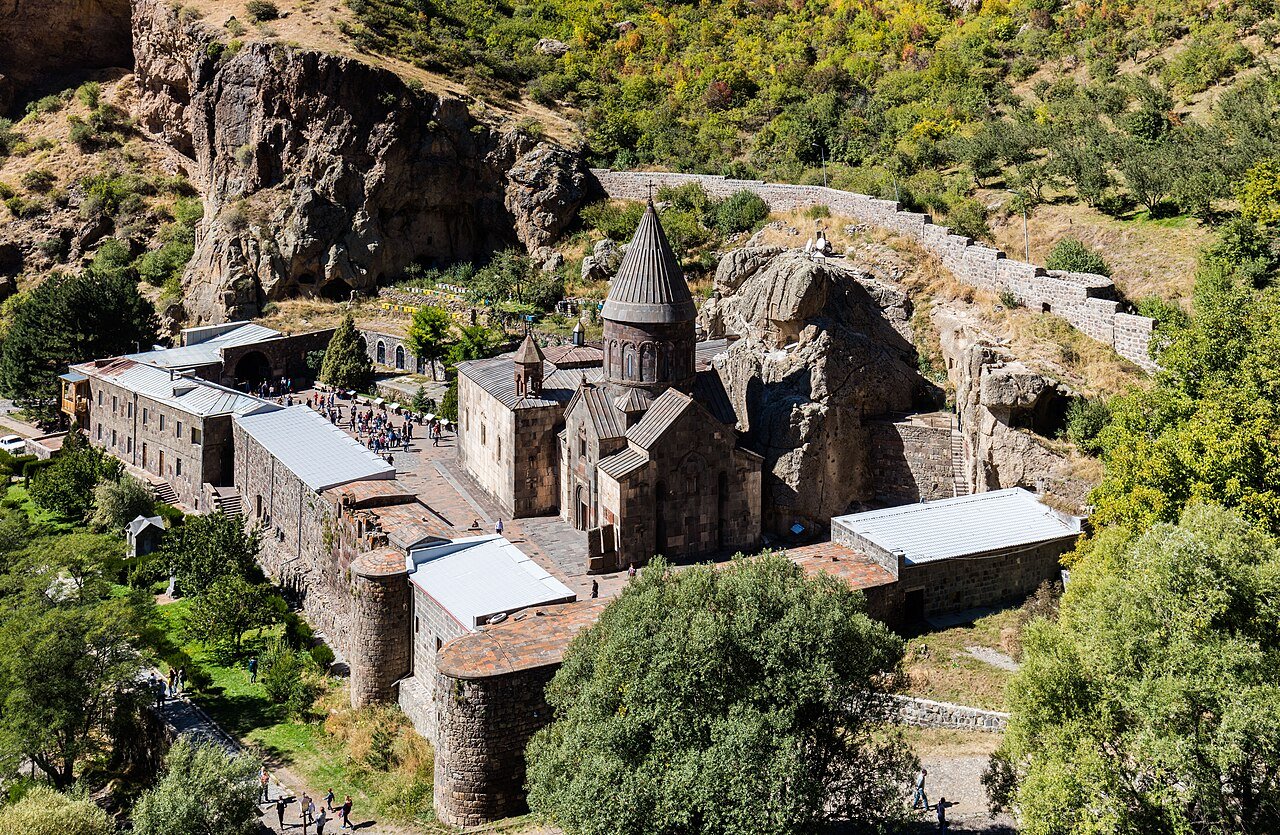
- Monastery of Geghard and the Upper Azat Valley (2000) — a monastic complex in Kotayk Province that combines freestanding church buildings with chambers, tombs, and khachkars cut directly into the living rock of the gorge wall.
- Cathedral and Churches of Echmiatsin and the Archaeological Site of Zvartnots (2000) — located in Armavir Province, these sites together trace the evolution of Armenian ecclesiastical architecture from the founding of the Etchmiadzin Cathedral in 301 CE through the ambitious but short-lived 7th-century Zvartnots Cathedral.
The 2000 session was therefore the decisive moment for Armenia’s World Heritage list, bringing the total from one site to three in a single year. No further inscriptions have followed since, though the expanded tentative list signals renewed momentum.
The most visited — and the alternatives
The Monastery of Geghard draws the largest number of visitors, partly because of its proximity to Yerevan and partly because the rock-cut interior chambers produce an atmosphere that photographs struggle to convey. The Cathedral of Etchmiadzin at Echmiatsin is the seat of the Armenian Apostolic Church and functions as a living pilgrimage destination as much as a heritage monument, which gives it a different quality from the quieter monastery complexes further north.
Travellers who look beyond the two headline sites find a rewarding set of alternatives. The Haghpat and Sanahin monasteries sit above the Debed Canyon in Lori Province and are often visited together in a single day, yet each has a distinct architectural character worth reading separately. The ruined Zvartnots Cathedral, part of the Echmiatsin inscription, is less prominent in tourist itineraries despite being one of the most architecturally ambitious structures built in early medieval Armenia — a triconch rotunda raised to three storeys before it collapsed, probably in an earthquake in the 10th century. Further afield, the monastery of Tatev on the tentative list perches above a gorge nearly 850 metres deep, accessible by a cable car that is among the longest reversible aerial tramways in the world.
Natural and shared sites
Armenia currently holds no inscribed natural or mixed World Heritage Sites. The three inscribed properties are all cultural, recognised under criteria that emphasise the exchange of human values and the illustration of significant stages in architectural history. The tentative sites of Noravank and Tatev both propose a mixed cultural and natural designation, which, if successful, would add a new dimension to Armenia’s list and acknowledge the geological landscapes that give so many of its monasteries their dramatic setting.
Armenia is not currently part of any transnational or serial World Heritage inscription beyond its own serial nomination of Haghpat and Sanahin, which were submitted and assessed as a single property across two phases. The broader Caucasus region, however, presents opportunities for future transnational cooperation: neighbouring Georgia holds three inscribed sites, and the shared architectural traditions of the region have long attracted comparative scholarly interest.
How to find them
All three inscribed sites are reachable by road from Yerevan, which serves as the practical base for visiting Armenia’s World Heritage properties. Echmiatsin is around 20 kilometres west of the capital; Geghard is roughly 40 kilometres to the east in the Azat Valley; the Haghpat and Sanahin monasteries require a longer journey north into Lori Province but can be combined with the market town of Alaverdi. The sites do not require special permits and are generally open to visitors year-round, though the mountain roads to Haghpat can be affected by winter conditions.
Armenia’s World Heritage sites sit alongside thousands of other places on CHO’s interactive map, with GPS and sourced editorial history for each. See also our guides to Italy’s and France’s UNESCO sites, and our piece on cultural travel beyond mass tourism.
Frequently Asked Questions
How many UNESCO World Heritage Sites does Armenia have?
Armenia has 3 UNESCO World Heritage Sites, all of them cultural properties. They are the Monasteries of Haghpat and Sanahin, the Monastery of Geghard and the Upper Azat Valley, and the Cathedral and Churches of Echmiatsin together with the Archaeological Site of Zvartnots. A further seven sites appear on Armenia’s tentative list for possible future nomination.
What was Armenia’s first UNESCO World Heritage Site?
The Monastery of Haghpat in Lori Province was Armenia’s first UNESCO World Heritage inscription, receiving the designation in 1996. The neighbouring Sanahin Monastery was added to the same serial nomination in 2000, creating the combined property now known as the Monasteries of Haghpat and Sanahin.
Does Armenia have any natural UNESCO World Heritage Sites?
No. All three of Armenia’s inscribed World Heritage Sites are classified as cultural properties. Two sites on Armenia’s tentative list — Noravank and Tatev — are proposed as mixed cultural and natural designations, but neither has yet been submitted for formal assessment by the World Heritage Committee.
What is the Zvartnots Cathedral and why is it significant?
Zvartnots was a monumental triconch rotunda raised to three storeys in the 7th century near the city of Vagharshapat (modern Echmiatsin). It collapsed, likely in an earthquake around the 10th century, and its ruins were rediscovered by excavation in the early 20th century. The site is part of the Echmiatsin UNESCO inscription and is considered one of the most ambitious architectural projects of early medieval Armenia.
Sources used in this article
- UNESCO — State Party Armenia — World Heritage list.
- UNESCO — Armenia: World Heritage Sites.
- CHO magazine — What is a World Heritage Site?
- CHO — Interactive map of heritage sites.