Within two hours of Munich, six UNESCO World Heritage Sites wait across Bavaria and Austria — Roman waterworks, Rococo pilgrimage churches, intact medieval cities, and Neolithic lake villages that predate written history. From Cultural Heritage Online.
Historic Town of Augsburg 30 min by ICE train
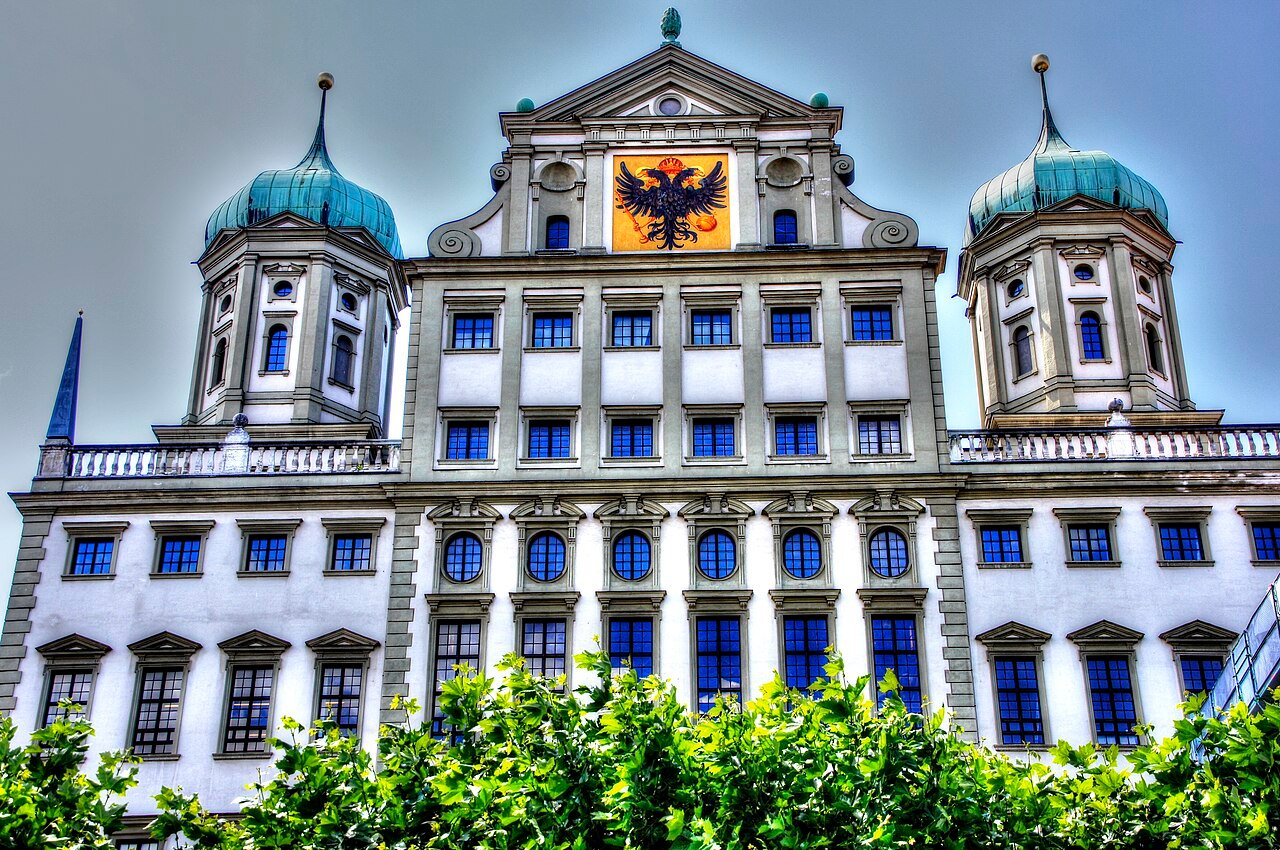
Founded in 15 BC as Augusta Vindelicorum, Augsburg is one of Germany’s oldest cities and its World Heritage designation — awarded in 2019 — recognises an extraordinary feat of hydraulic engineering rather than a cluster of monuments. The city’s water management system, developed from the late medieval period onward, comprises canal networks, water towers, and pumping stations that supplied clean drinking water and powered industrial mills centuries before such infrastructure appeared elsewhere in Europe. Master builder Elias Holl transformed the townscape between 1615 and 1624 with the Renaissance Rathaus, its twin onion towers still anchoring the main square. The Fuggerei, founded by Jakob Fugger in 1516, remains the oldest continuously inhabited social housing estate in the world — residents still pay a symbolic annual rent of one Rhenish guilder, equivalent to roughly 88 euro cents. Walk the canal district at dusk, when water slides through stone channels beneath illuminated Renaissance facades.
Getting there: ICE trains run every 30 minutes from Munich Hauptbahnhof; journey time approximately 30 minutes. Allow: 3–4 hours. Best for: Visitors who want to combine grand civic architecture with a living piece of social history in a compact, walkable old town.
Pilgrimage Church of Wies 1 hr 15 min by car
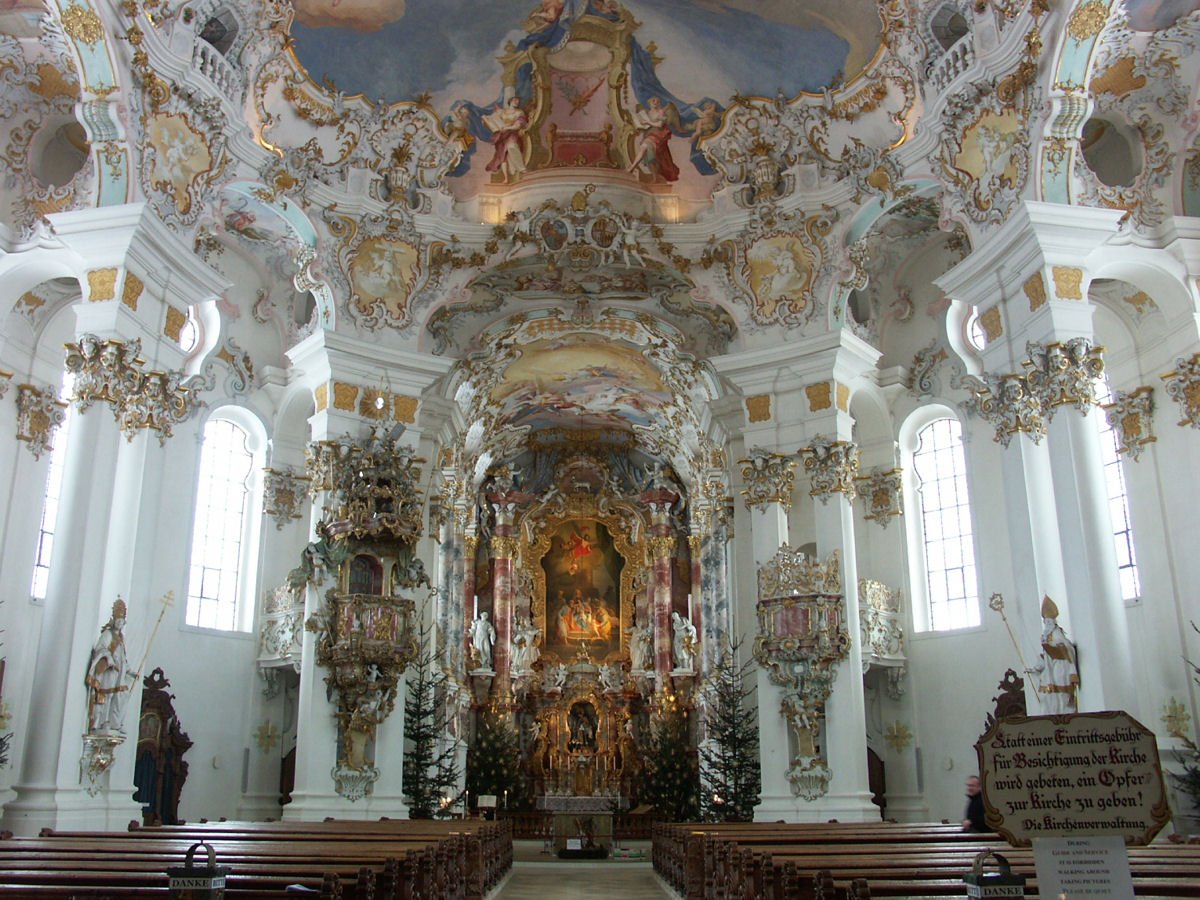
Standing in a meadow near Steingaden in the Bavarian Alps foothills, the Wieskirche appears deceptively modest from the outside. The interior is another matter entirely. Brothers Dominikus and Johann Baptist Zimmermann designed this oval Rococo church between the late 1740s and its completion in 1754, filling the nave with stucco work so dense and gilded that the ceiling seems to dissolve upward into light. The fresco above the choir arch, painted by Johann Baptist Zimmermann, covers an area that leaves the eye unable to settle on any single figure before another catches its attention. UNESCO inscribed the church in 1983, recognising it as the Zimmermann brothers’ greatest achievement and a peak of southern German Rococo craftsmanship. Dominikus Zimmermann was so devoted to his creation that he spent the last eleven years of his life in a house beside it. Pilgrims have visited since the 1730s; the crowds have simply changed costume.
Getting there: 1 hour 15 minutes by car via the A95 motorway toward Garmisch-Partenkirchen, then south to Steingaden; public transport requires 2 or more hours via Füssen with onward bus connection. Allow: 1–2 hours. Best for: Anyone with a car who wants to experience the high-water mark of Bavarian Baroque religious art in an entirely rural setting.
Old Town of Regensburg with Stadtamhof 1 hr 25 min by ICE train
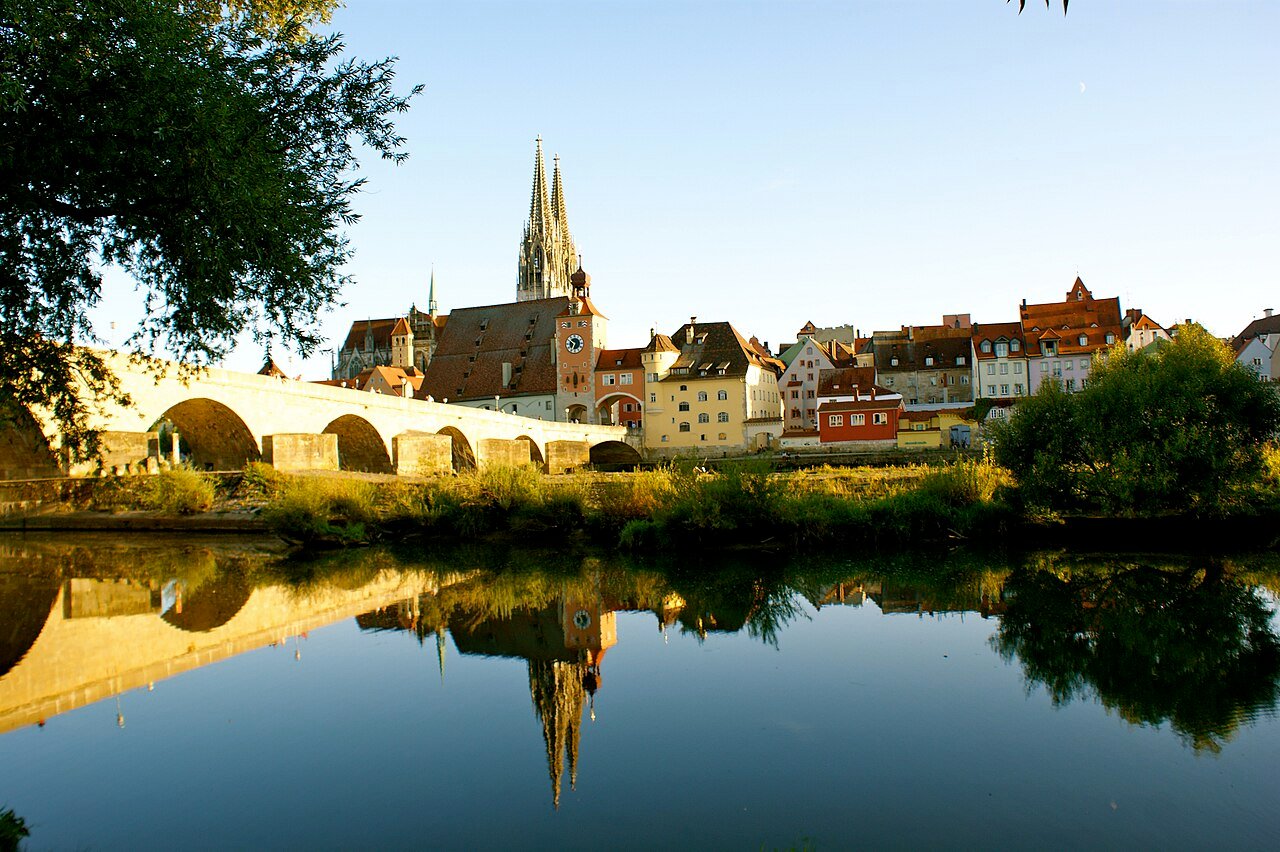
Regensburg holds the distinction of being the largest intact medieval city north of the Alps — a claim UNESCO ratified in 2006. At the heart of the old town stands the Steinerne Brücke, a stone bridge built between 1135 and 1146 that served as the only crossing of the Danube between Ulm and Vienna for several centuries. Its sixteen surviving arches stretch roughly 330 metres across the river, the stone worn smooth by eight hundred years of foot traffic. The medieval merchant families who grew wealthy on the Danube trade routes built tower houses to signal their status — more than seventy remain, giving the skyline an almost Italian profile that earned Regensburg the nickname “Bavaria’s Rome.” The Gothic cathedral of St Peter, begun in the thirteenth century, anchors the centre with twin spires that were not completed until 1869. The afternoon light through the nave’s original medieval glass turns the stone floor the colour of garnets.
Getting there: Intercity-Express trains depart Munich Hauptbahnhof roughly every hour; journey time approximately 1 hour 25 minutes. Allow: 3–4 hours. Best for: History travellers seeking a genuinely medieval street pattern, riverfront walks, and the highest concentration of Romanesque and Gothic architecture in any German city of this size.
Old City of Salzburg 1 hr 30 min by ÖBB Railjet
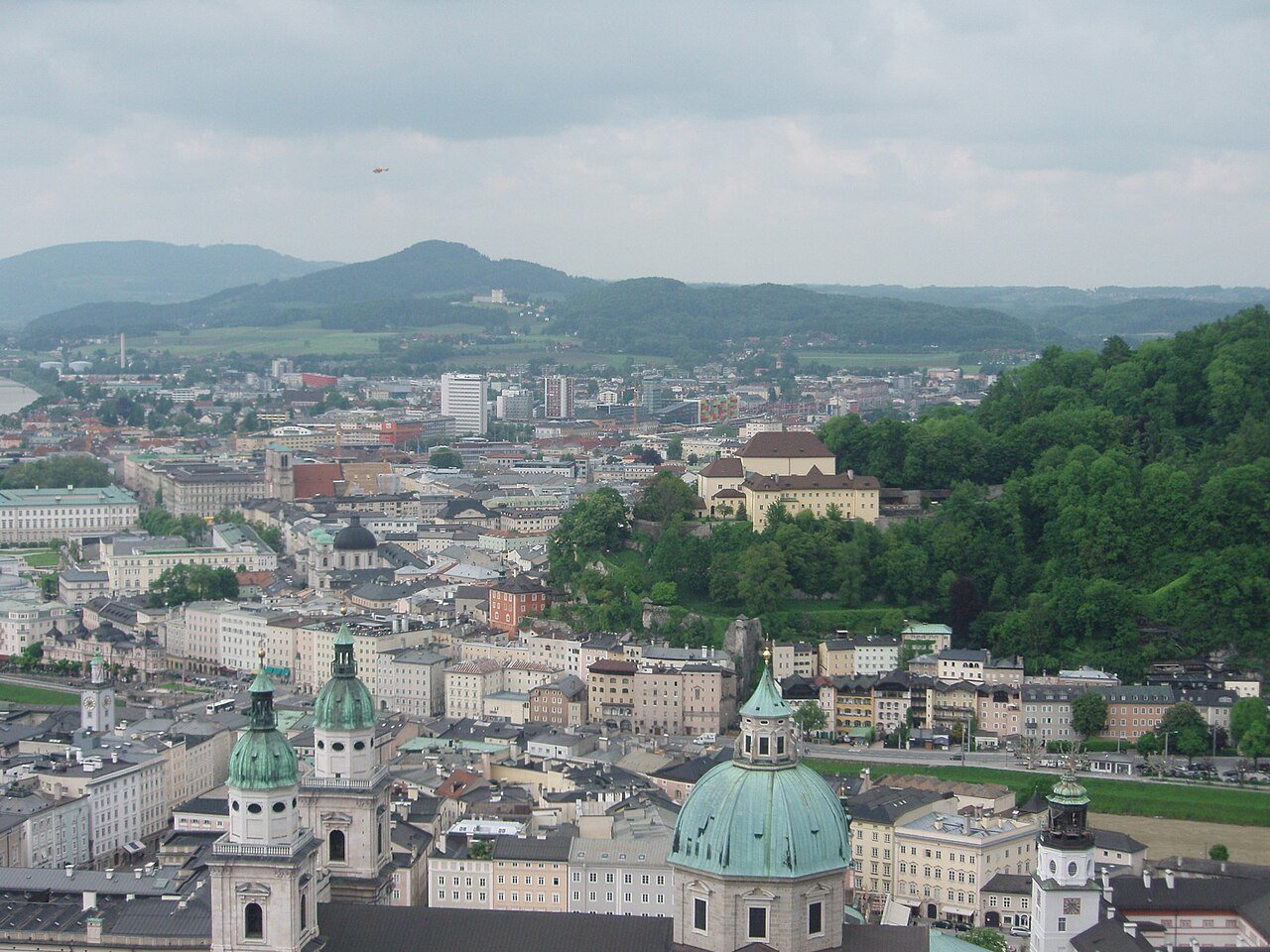
Salzburg is the only site on this list that requires a passport crossing, and it rewards the extra step. UNESCO inscribed the Old City in 1996 for its remarkably intact Baroque architecture — the densest concentration outside Rome — and its role as the seat of the powerful prince-archbishops who shaped the city’s skyline from the seventeenth century onward. Hohensalzburg Fortress, begun in 1077 and expanded repeatedly through the sixteenth century, measures 250 metres long and 150 metres wide, making it one of the largest fully preserved medieval fortresses in Europe. From its walls the roofscape of domes, spires, and ochre plasterwork extends in every direction. Down in the Altstadt, the narrow Getreidegasse — where Wolfgang Amadeus Mozart was born in 1756 — channels visitors past iron guild signs, under low vaulted arches, into courtyards that have barely changed since the composer’s time. The Salzach River frames the whole city in grey-green Alpine water.
Getting there: ÖBB Railjet services depart Munich Hauptbahnhof multiple times daily; journey time approximately 1 hour 30 minutes to Salzburg Hauptbahnhof, then a short walk or bus to the old town. Allow: 4–5 hours, or an overnight stay. Best for: Anyone combining architectural grandeur, Baroque music history, and an Austrian city that functions as a full cultural destination rather than a single monument.
Town of Bamberg 2 hrs by ICE train
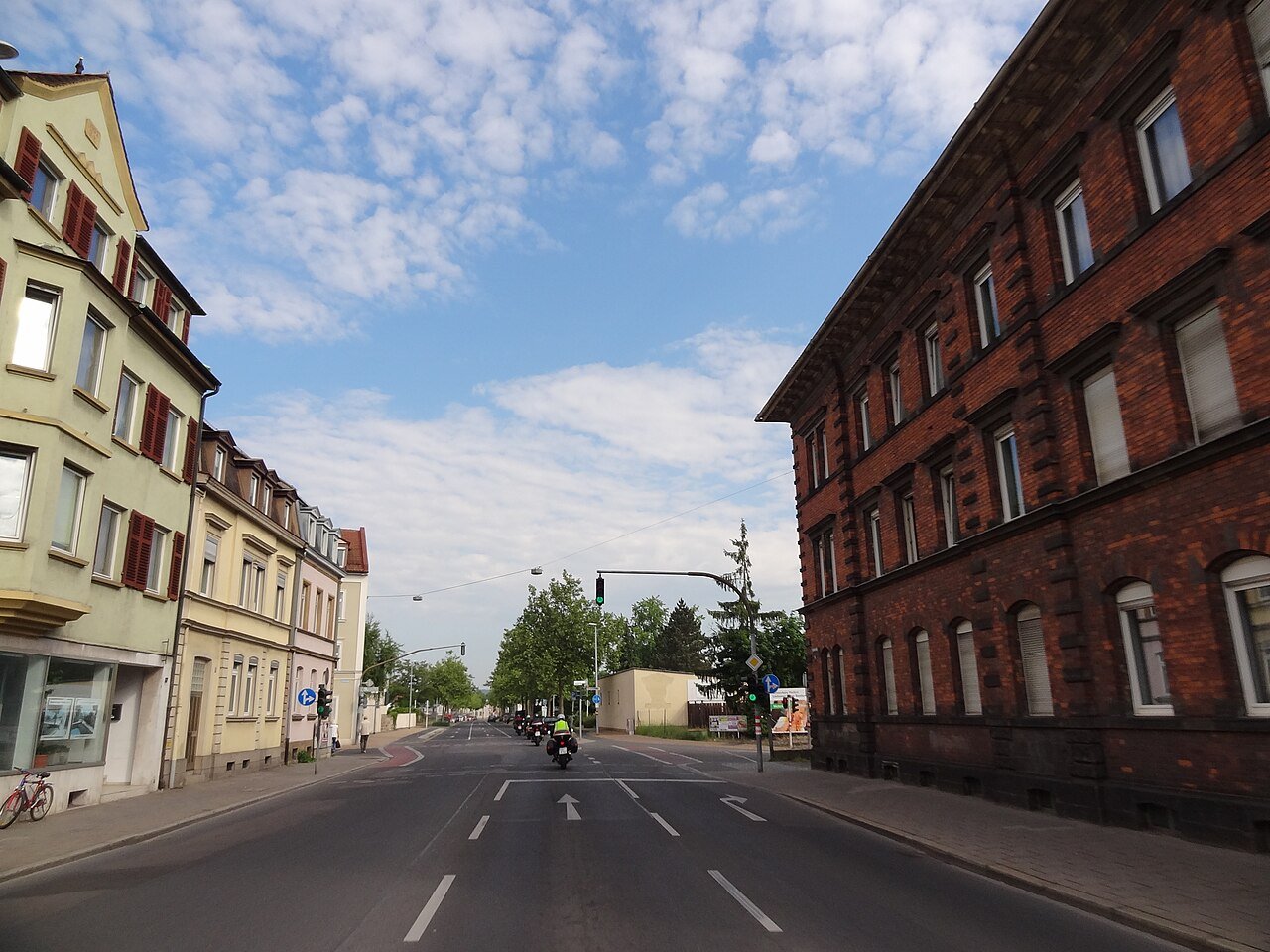
Bamberg is the farthest of the day-trip destinations by train, and the most architecturally coherent. UNESCO designated the old town in 1993, drawn by roughly 2,400 listed timber-frame and stone buildings that survived the Second World War untouched, forming one of the best-preserved medieval urban ensembles in Central Europe. The cathedral of St Peter and St George, first consecrated in 1012 under Emperor Henry II and rebuilt in its current late-Romanesque form after fires in the thirteenth century, rises on a hill above the Regnitz River on four corner towers. Inside, the tomb carved by Tilman Riemenschneider between 1499 and 1513 for Henry II and his wife Cunigunde stands as one of the finest pieces of late-Gothic sculpture in Germany. The cathedral also holds the only papal grave north of the Alps — Pope Clement II, buried here in 1047. A short walk down from the cathedral, the Altes Rathaus sits improbably on a bridge island in the middle of the Regnitz, its frescoed facades hanging over the water on both sides.
Getting there: ICE trains from Munich Hauptbahnhof run regularly with a change in Nuremberg; total journey approximately 2 hours. Allow: 3–4 hours. Best for: Travellers who want a complete medieval town centre rather than a single landmark, especially those interested in Romanesque architecture and medieval sculpture.
Prehistoric Pile Dwellings around the Alps 1 hr by car to Chiemsee
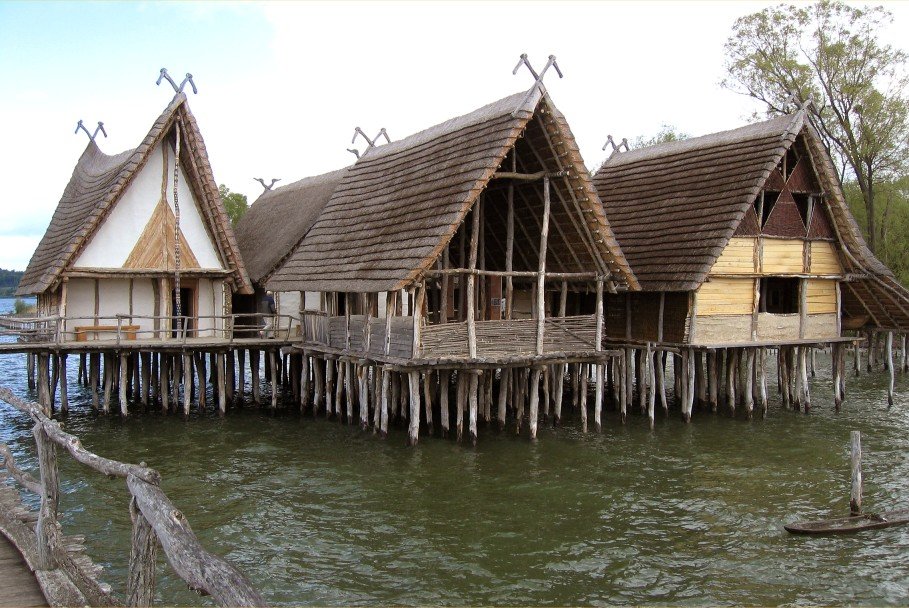
This UNESCO inscription, awarded in 2011, is the most dispersed on the list: 111 archaeological sites spread across six Alpine countries, covering settlements built on lake edges, riverbanks, and wetlands between approximately 5000 and 500 BC. Germany contributes 18 of those sites, including several around the Bavarian lakes. The Chiemsee, reachable in roughly an hour by car east of Munich, lies within the designated zone, and the lake itself gives a sense of the landscape these Neolithic and Bronze Age communities chose — calm water, forested shorelines, reliable fish stocks. The pile-dwelling method, anchoring wooden platforms above or near water on driven stakes, allowed settlements to exist where conventional building would have been impossible. Archaeological finds from German and Swiss sites have yielded textiles, wooden tools, cereal grains, and animal bones, giving a detailed picture of daily life four thousand years before the Roman road network crossed Bavaria. The lakeside museum at Unteruhldingen on the Bodensee offers the most accessible reconstruction, but the Chiemsee and Ammersee sites carry the same UNESCO designation.
Getting there: Approximately 1 hour by car to the Chiemsee or Ammersee lake sites; the Ammersee is also reachable by S-Bahn from Munich (S8 line, around 50 minutes to Herrsching). Allow: 1–2 hours at the lake. Best for: Travellers combining a scenic Bavarian lake outing with genuine prehistoric archaeology — particularly rewarding for families interested in hands-on history.
Frequently Asked Questions
How many UNESCO World Heritage Sites are near Munich?
Six UNESCO World Heritage Sites lie within approximately two hours of Munich by public transport or car. They include the Historic Town of Augsburg, the Pilgrimage Church of Wies, the Old Town of Regensburg, the Old City of Salzburg, the Town of Bamberg, and the Prehistoric Pile Dwellings around the Alps.
What is the closest UNESCO World Heritage Site to Munich?
The Historic Town of Augsburg is the closest UNESCO World Heritage Site to Munich, located about 50 kilometres to the west and reachable in approximately 30 minutes by ICE train from Munich Hauptbahnhof. Augsburg’s World Heritage designation covers its medieval water management system, inscribed in 2019.
Can you reach Salzburg from Munich by train?
Yes. ÖBB Railjet services connect Munich Hauptbahnhof to Salzburg Hauptbahnhof in approximately 1 hour 30 minutes, with several departures daily. The Salzburg main station sits at the edge of the UNESCO-designated Altstadt, within walking distance of Getreidegasse, the Salzburg Dom, and the funicular to Hohensalzburg Fortress.
Do you need a car to visit the Wieskirche from Munich?
A car is strongly recommended. The drive from Munich takes approximately 1 hour 15 minutes via the A95 motorway. Public transport is possible but requires at least 2 hours and involves a combination of train to Füssen and an onward bus connection — check timetables carefully as services are infrequent, particularly on weekends.
Sources used in this article
- UNESCO World Heritage Centre — World Heritage List.
- Wikipedia — Augsburg water management system.
- Wikipedia — Wieskirche.
- Wikipedia — Regensburg.
- Wikipedia — Bamberg Cathedral.
- CHO — Interactive heritage map.
Sources
- S1 — Huber, Brigitte. Regensburg: A Walk Through History. Verlag Friedrich Pustet, 2006. ISBN 978-3-7917-2003-6.
- S2 — Fulbrook, Mary. A Concise History of Germany. Cambridge University Press, 2004. ISBN 978-0-521-54071-1.
Spotted an error? Write to editorial@culturalheritageonline.com and we correct it the same day.