Belgium has 16 UNESCO World Heritage Sites, spanning medieval beguine communities and Baroque market squares, coal-age industrial landscapes and a primeval forest shared across a continent, right through to the sombre cemeteries of the Western Front inscribed as recently as 2023. The list is compact but extraordinarily layered, reflecting a country that has been simultaneously a crossroads of Europe and a crucible of its own distinctive urban, spiritual, and industrial traditions. From Cultural Heritage Online.
Why Belgium’s list looks the way it does
Belgium’s heritage profile is shaped by its dual identity as a medieval trading nation and a 19th-century industrial powerhouse. The Flemish cities that dominated North Sea commerce left behind a dense network of belfries, guild halls, and civic monuments. The Walloon coalfields, meanwhile, were among the first in continental Europe to industrialise at scale, and four of those complexes now carry World Heritage status as the Major Mining Sites of Wallonia. The result is a list that moves fluidly between the sacred and the industrial, the civic and the domestic.
The country also participates in six transnational serial inscriptions, more than many larger European nations. This reflects both Belgium’s geographic position — sharing borders and histories with France, the Netherlands, Germany, and Luxembourg — and the willingness of successive Belgian governments to champion collaborative nominations at UNESCO level.
The first inscriptions
Belgium joined the World Heritage family in 1998, with three sites inscribed simultaneously in the same session:
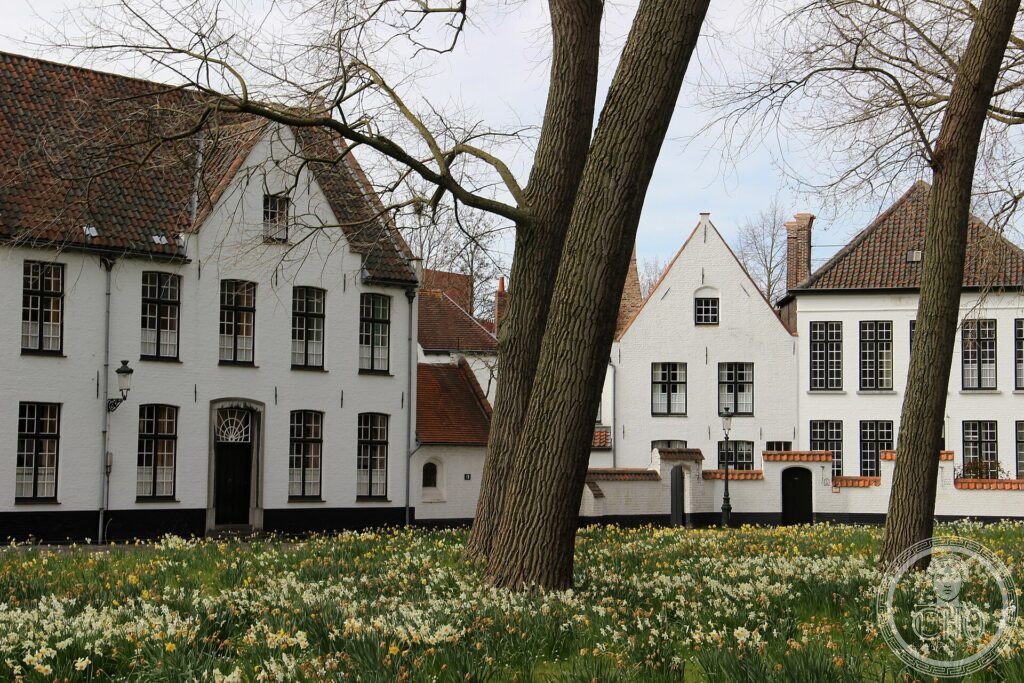
- The Flemish Béguinages — a network of enclosed communities built for lay religious women, scattered across Flemish cities from Bruges to Leuven.
- Grand-Place, Brussels — the gilded Gothic and Baroque market square at the heart of the Belgian capital, described by Victor Hugo as the most beautiful square in the world.
- The Four Boat Lifts on the Canal du Centre — a set of late 19th-century hydraulic lifts in Hainaut that raised canal barges more than sixty metres, a feat of Victorian engineering still largely intact.
The triple debut was a statement of intent. Rather than leading with a single flagship monument, Belgium presented three radically different types of heritage in one go — spiritual, civic, and industrial — setting the tone for a list that would resist easy categorisation.
The most visited — and the alternatives
Grand-Place draws the crowds, and the Belfries of Belgium and France (a serial inscription shared with France covering 56 towers, including those of Ghent, Bruges, and Mons) are well-established on the tourist circuit. The Stoclet House in Brussels, a private mansion designed by Josef Hoffmann between 1905 and 1911, is the purest expression of Vienna Secession architecture anywhere in the world — but because it remains a private residence, it can only be admired from the street, which keeps visitor numbers low and the experience surprisingly intimate.
The Neolithic Flint Mines at Spiennes, outside Mons, are among the most underrated inscribed sites in Western Europe: the largest and earliest Neolithic flint-extraction complex on the continent, with shafts sunk more than fifteen metres into the chalk. The Colonies of Benevolence — rural labour settlements established in the early 19th century across Belgium and the Netherlands to rehabilitate the poor through agricultural work — add yet another dimension that most visitors never encounter.
Natural and shared sites
Belgium has just one natural World Heritage Site: the Sonian Forest on the southern edge of Brussels, inscribed in 2017 as part of the Ancient and Primeval Beech Forests of the Carpathians and Other Regions of Europe, a serial inscription now spanning 18 countries. Within that transnational framework, the Sonian stands as one of the largest remnants of the primeval Hercynian Forest that once covered much of temperate Europe. Its old-growth beech stands support rare deadwood ecosystems and serve as a long-term reference site for forest ecology research.
The most recently added Belgian sites sit at the opposite end of the emotional register. In 2023, the Funerary and Memory Sites of the First World War (Western Front) were jointly inscribed with France, covering 139 cemeteries and memorials — 43 of them on Belgian soil in and around the Ypres Salient. The Great Spa Towns of Europe, a serial inscription Belgium shares with seven other countries (including the town of Spa, which gave the word to the English language), and the Architectural Work of Le Corbusier round out a transnational portfolio that ranges from 1920s modernist housing to thermal bath culture.
How to find them
Belgium’s World Heritage sites sit alongside thousands of other places on CHO’s interactive map, with GPS and sourced editorial history for each. See also our guides to Italy’s and France’s UNESCO sites, and our piece on cultural travel beyond mass tourism.
Frequently Asked Questions
How many UNESCO World Heritage Sites does Belgium have?
Belgium has 16 UNESCO World Heritage Sites as of 2023. Fifteen are classified as cultural and one — the Sonian Forest, part of a wider transnational beech-forest inscription — as natural.
What was Belgium’s first UNESCO World Heritage Site?
Belgium received its first three inscriptions simultaneously in 1998: the Flemish Béguinages, the Grand-Place in Brussels, and the Four Boat Lifts on the Canal du Centre. No single site can claim the title of “first” since all three were approved in the same UNESCO session.
What is Belgium’s most recently inscribed World Heritage Site?
The Funerary and Memory Sites of the First World War (Western Front), co-inscribed with France in 2023, is Belgium’s most recent addition. It encompasses 43 cemeteries and memorials in Belgium, concentrated in and around the Ypres Salient in West Flanders.
Does Belgium have any natural UNESCO World Heritage Sites?
Yes — one. The Sonian Forest south of Brussels was inscribed in 2017 as part of the Ancient and Primeval Beech Forests of the Carpathians and Other Regions of Europe, a serial natural site now shared by 18 European countries. It is one of the largest old-growth beech forest remnants in Western Europe.
Sources used in this article
- UNESCO — State Party Belgium — World Heritage list.
- UNESCO — Belgium: World Heritage Sites.
- CHO magazine — What is a World Heritage Site?
- CHO — Interactive map of heritage sites.
Sources
- S1 — Blom, J. C. H., and E. Lamberts, eds. History of the Low Countries. Berghahn Books, 1999. ISBN 978-1-57181-084-7.
- S2 — Nicholas, David. Medieval Flanders. Longman, 1992. ISBN 978-0-582-01678-1.
Spotted an error? Write to editorial@culturalheritageonline.com and we correct it the same day.