

Curated Itinerary
Milda and the Mascarons: A Riga Art Nouveau RoadBook (1896–1935)
Travel tips from CHOIn September, the doors that are usually shut openFor one long weekend every September, some fifty European […]
Get this route — explore at your own pace
The walk and the notes are open to everyone, right here. To take the route with you — the GPX and KML tracks for your phone — you need a CHO account, and a free one is enough. We do not sell these routes: we build them ourselves and give them to the people who read us.
Create a free accountAlready have one? Log in.
This route was built with the tools we give operators.
Guides, associations and cultural operators build their own routes here: pick the stops from the archive, add your notes, and the map, the GPX and the printable version come out on their own. Your programme gets a permanent page, your events go on the city pages people read while planning — and if you sell your route as a road-book or a virtual tour, you receive 80% of the price net of tax.
See how an operator account worksBefore you go
A word from your host
Alberta iela is eight buildings long. What makes it extraordinary is not any single building but the fact that all eight facades survive intact, in a city that was bombed, occupied and rebuilt across the twentieth century, and that together they constitute one of the most complete surviving examples of a European street built at the height of a single architectural moment. Most European cities lost their Art Nouveau buildings to one war or another; Riga kept them because the city centre was not a military target in 1944. The Quiet Centre is a historical accident, which is perhaps the best kind. One other thing to carry: Mikhail Eisenstein's name appears on most of the buildings on this walk, but the attribution is sometimes complex. What is certain is that several buildings bear his name in the Latvian cultural monument register. What is also certain is that whoever designed them, they were built by Latvian craftsmen using Latvian stone and stucco, in a city that was, in 1903, still officially part of the Russian Empire and would not be independent for another fifteen years. The Art Nouveau facades are not neutral decoration. They are, among other things, a claim about what Riga was and intended to become.
Getting around
The entire walk is on foot and covers approximately 2 kilometres through the Quiet Centre (Klusais centrs), one of the most walkable neighbourhoods in the Baltic capitals. From Riga Central Station it is a fifteen-minute walk north to Alberta iela; alternatively, take tram lines 11 or 12 from the station to the Strēlnieku iela stop (three stops, five minutes). The walk ends at the Freedom Monument, from which the Old Town and the station are both ten to fifteen minutes on foot. There are no significant gradients. In summer bring water — the Quiet Centre has relatively few shaded streets. In winter the facades are best seen in light snow or on overcast days when the grey stucco reads cleanly against the sky; plan around the short daylight hours.
Step by step
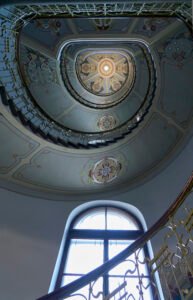
Riga Art Nouveau Museum – Virtual Tour 360°
Start inside the restored 1903 apartment of architect Konstantīns Pēkšēns. The spiral staircase — the building's real argument — winds upward beneath painted murals that Latvian painter Janis Rozentāls may have sketched. Rozentāls himself lived here.
The storyKonstantīns Pēkšēns (1859–1928) was the most prolific architect in Riga's history: over his career he designed more than 250 buildings in the city, covering the full arc from historicism through the Jugendstil peak to his later work. Alberta iela 12, begun in 1903 in collaboration with the young Eižens Laube, was his own apartment — the house he built to live in, decorated to the standard he wished to be judged by. He moved out in 1907. The painter Janis Rozentāls, who also lived in the building, may have painted the stairwell murals that are now the most-photographed interior in the Art Nouveau quarter. Rozentāls died in Helsinki in 1916, after the First World War forced him from Riga. Pēkšēns stayed through two occupations and died in the city in 1928.
Insider tipPay particular attention to the spiral staircase before entering the apartment rooms: the balustrade traces a single unbroken curve from the ground floor to the top, with murals on the curved ceiling above. This was Pēkšēns's domestic argument — the stairwell as the building's highest expression, more carefully finished than any room. The apartment rooms are quietly done by comparison, which is probably intentional: he was showing what Art Nouveau could make of an arrival, not a sitting room. Go on a weekday morning; the building fills with tours by mid-afternoon.
A fitting stopThe café at Lido Origo in the Origo shopping mall on Stacijas laukums (about ten minutes' walk south) is a reliable, affordable self-service option for Latvian cuisine at any hour. For something closer, Mārtiņš Osis's coffee bar at Elizabetes iela 2 is a few minutes away and uses beans roasted in Riga — this is the city that takes its coffee more seriously than most Baltic capitals.

Alberta iela 13 (Eisenstein Facade), Riga
Cross the street from the museum and look up. Alberta iela 13 is Mikhail Eisenstein at his most theatrical: sculpted heads, mythological figures, and band after band of Jugendstil ornament piled to the roofline, conceived as street theatre seen from below.
The storyMikhail Eisenstein came to Riga in the 1890s as a civil engineer working on the city's railway infrastructure. He had no formal architecture training in the academic sense, which may explain the freedom of his decorative language. By the early 1900s he was producing apartment facades at a pace and intensity that placed him at the centre of Riga's building boom: ten or more buildings in Alberta iela and the surrounding Quiet Centre attributed to his name, each one a variation on a visual programme that combined mythological figures, masks, floral ornament and asymmetric bays in configurations that no trained architect of his time would have permitted themselves. His son, Sergei Mikhailovich Eisenstein, was born in Riga in 1898 and grew up in the city until 1908. Whether the father's preoccupation with visual rhythm, with movement compressed into a static plane, and with monumental scale influenced the filmmaker has been debated by critics ever since.
Insider tipStand at the opposite pavement and look at the full composition from cornice to ground floor: the building is organised as three vertical bays, each differently articulated, with the central bay given the heaviest ornamental load. The density of the work — faces, garlands, figures, mouldings — is easier to resolve at a distance than close up, which is how Eisenstein composed, for the street rather than for inspection. Walk closer only after you have understood the overall composition from across the road.

Alberta iela 8 (Art Nouveau Facade), Riga
Alberta iela 8 shows a different register of the style — the ornament more restrained, the proportions more vertical. Reading the two buildings side by side, the range of the decorative phase becomes visible: Eisenstein's street was never a single note.
The storyAlberta iela 8 belongs to the same wave of Riga Jugendstil but was built for a different developer and to a slightly different programme. Where Eisenstein's buildings maximise ornament from ground to cornice, this facade uses restraint more selectively: the upper storeys carry the decorative load while the lower floors are relatively quiet, producing a building that reads differently from street level depending on where you stand and how the light falls. In Riga's Art Nouveau quarter, no two adjacent buildings are quite the same argument. The street's fascination is precisely this variety within the same moment.
Insider tipCompare the bay windows on this building with those on No. 13: the difference in how each architect handled the problem of projecting volume from a flat facade — one through carved ornament, the other through structural emphasis — makes visible the range of solutions available to the Jugendstil generation in a single city block.

Alberta iela 2a (Art Nouveau Facade), Riga – Virtual Tour 360°
Alberta iela 2a, built in 1906, closes the western end of the street. The facade runs the decorative programme from base to cornice with the assurance of a mature style — built only three years after the museum across the street, but with the confidence of a city that had found its idiom.
The storyAlberta iela 2a, attributed to Mikhail Eisenstein and dated to 1906, was among the later buildings in his Alberta iela sequence and shows the decorative style at full maturity. By 1906 the Riga Jugendstil had moved on from the exploratory phase of the early 1900s: architects knew exactly what the style required, and what clients expected of it. The result here is confident in a way that the earlier buildings are not — the ornamental programme is deployed with precision, without the sense of excess that marks No. 13. Riga's building boom was already slowing by this date; the First World War, only eight years away, would end it entirely.
Insider tipLook at the relationship between the entrance portal — heavily ornamented, dark-shadowed — and the upper facade above it: Eisenstein used the contrast between dark recesses and light ornamental bands to create a reading that changes with the time of day. Morning light hits the east-facing upper storey; afternoon light fills the portal. Come in the afternoon if you can.

Strēlnieku iela 4a (Eisenstein Facade), Riga
Turn the corner onto Strēlnieku iela: No. 4a is among Eisenstein's most elaborately ornamented buildings, its upper storey a continuous frieze of human figures and ornament that frames a deeply shadowed central bay. It is now a music academy, and the contrast between the building's dramatic exterior and its institutional purpose is entirely Riga.
The storyStrēlnieku iela 4a sits around the corner from the main Alberta iela sequence and receives fewer visitors as a result. It is attributed to Eisenstein and dated around 1905. The building is now occupied by the Latvian Academy of Music, which means that what you hear from the street on a weekday is practice: scales, arpeggios, chamber music from open windows, all emerging from behind a facade of concentrated ornament. The effect is entirely accidental and entirely right. Art Nouveau in Riga was always about performance — the building as an act of display, the city as audience.
Insider tipThe central bay is the key to this building: a deeply recessed arch carries a frieze of figures that runs across the full width of the facade at the third-floor level. From the pavement, with the arch above, the ornamental programme has a scale that is easy to miss from a distance. Walk up close to the entrance to understand what the original building users would have seen on their daily approach.

Elizabetes iela 10b (Eisenstein Facade), Riga
Walk south to Elizabetes iela, where Eisenstein's blue-and-white facade at No. 10b is his most purely decorative work in the city: a composition of faces, garlands and flowing ornament in two-tone stucco that reads across the street as an enormous piece of applied illustration. The building was completed in 1903, when Eisenstein was producing work at a rate that makes its quality almost inexplicable.
The storyElizabetes iela 10b is one of Mikhail Eisenstein's most distinctive works: a two-tone stucco facade in blue and white, completed in 1903, which uses colour — unusual in the Riga Jugendstil — as the primary compositional element. The faces that peer from the upper storey are larger than those on any Alberta iela building, and the arrangement of garlands, frames and figures is looser, almost poster-like in its handling. The building originally housed apartments and medical offices — several of the early Art Nouveau buildings in this district served mixed residential and professional use, which influenced the way their public facades were designed.
Insider tipThe two-tone colour makes this building legible across the full width of Elizabetes iela in a way that the grey or beige facades of Alberta iela are not. Eisenstein was composing for a broader street here — Elizabetes iela is wider than Alberta iela — and the colour adjustment is an architectural response to that fact, not a decorative whim. Read it from the far pavement first, then cross to examine the individual details.
A fitting stopThe Istaba café and bookshop on Elizabetes iela is a few minutes' walk east and is one of the most agreeable places in the city for coffee and a meal: mismatched furniture, Latvian design objects, good food. It is a reliable mid-walk stop.

Elizabetes iela 33 (Art Nouveau Facade), Riga
Elizabetes iela 33 introduces a different vocabulary: more restrained, the ornament concentrated at cornices and doorways rather than distributed across the whole facade. It was designed by architects other than Eisenstein and shows that the Riga Jugendstil was not a single architect's obsession but a shared moment with multiple voices.
The storyElizabetes iela 33 introduces an architect working in the same period and in the same city as Eisenstein but from a different starting position. The building's ornament is concentrated at the cornice and around the windows rather than spread across the entire facade; the overall effect is more vertical, less theatrical. It belongs to a reading of Jugendstil that was closer to the Viennese Secession than to the exuberant decorative phase that Eisenstein represented. Riga's Art Nouveau was not a single style: it was a conversation between architects trained in different cities — Berlin, Vienna, Helsinki — all building simultaneously in a city growing faster than almost anywhere else in the Russian Empire.
Insider tipCompare the use of iron at street level — the railings, the gate details, the lamp brackets — with what you have seen on Alberta iela. Iron was one of the Jugendstil's primary materials, and its handling is one of the most reliable ways to tell architects apart when facades look superficially similar. This building's ironwork is quieter and more precise than Eisenstein's; it reveals a craftsman working to a different idea of what ornament is for.
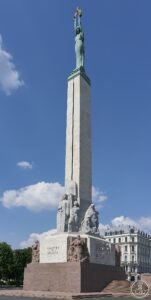
Freedom Monument, Riga
Walk south-west to the Freedom Monument: 42 metres of travertine and copper at the centre of Latvian civic life, completed in 1935. The architect Kārlis Zāle worked in a language that had already moved on from the Jugendstil — the stylistic distance from Alberta iela to this shaft is barely twenty years and almost impossible to cross. It is a better ending than a beginning. The figure of Milda, holding three golden stars above the city, faces west.
The storyThe Freedom Monument was inaugurated on 18 November 1935 — the seventeenth anniversary of the proclamation of Latvian independence. It was built without state funding: the 42-metre travertine-clad shaft and the copper figure of Milda were paid for entirely by private subscription, by tens of thousands of individual contributions. Sculptor Kārlis Zāle (1888–1942) won the design competition and oversaw the sculptural programme: the reliefs on the shaft, the bronze door panels, the figure at the summit. The three gold stars Milda holds refer to Vidzeme, Latgale, and Kurzeme, Latvia's three historical regions. Zāle completed the monument in 1935; he died in 1942, during the German occupation of Riga, and was buried with state honours after independence was restored. During the Soviet period, the monument was threatened with demolition but survived — in part through the active resistance of Latvian cultural figures, in part through the simple fact that destroying it would have been too large a statement for even the Soviet authorities to make without cost.
Insider tipThe changing of the guard takes place every hour on the hour during the day: two soldiers from the Latvian National Armed Forces stand at the base of the monument and are relieved with a ceremony that stops traffic on Brivibas bulvaris. Attend the change at the top of the hour if you are here then; it takes about five minutes and is one of the things you do not expect in a city of this size. The inscription on the base — "Tēvzemei un Brīvībai" (For Fatherland and Freedom) — was also the slogan of the independence movement of 1988–1991, which makes the monument a living object in Latvian political life rather than a historical one.
A fitting stopThe Old Town is five minutes' walk west from the monument, and its central market streets offer every register of refreshment from coffee to a full meal. Specifically: Rozengrāls, the medieval cellar restaurant on Rozena iela in the Old Town, is the most atmospheric place to end this walk — dark, vaulted, serving Latvian and Baltic cuisine in a space that predates Jugendstil by six centuries. Book ahead for dinner.
Download for tour navigation
PDF is the stop list with GPS, to print or keep on the phone. GPX for Garmin / Komoot / OsmAnd. KML for Google Earth and Maps.