
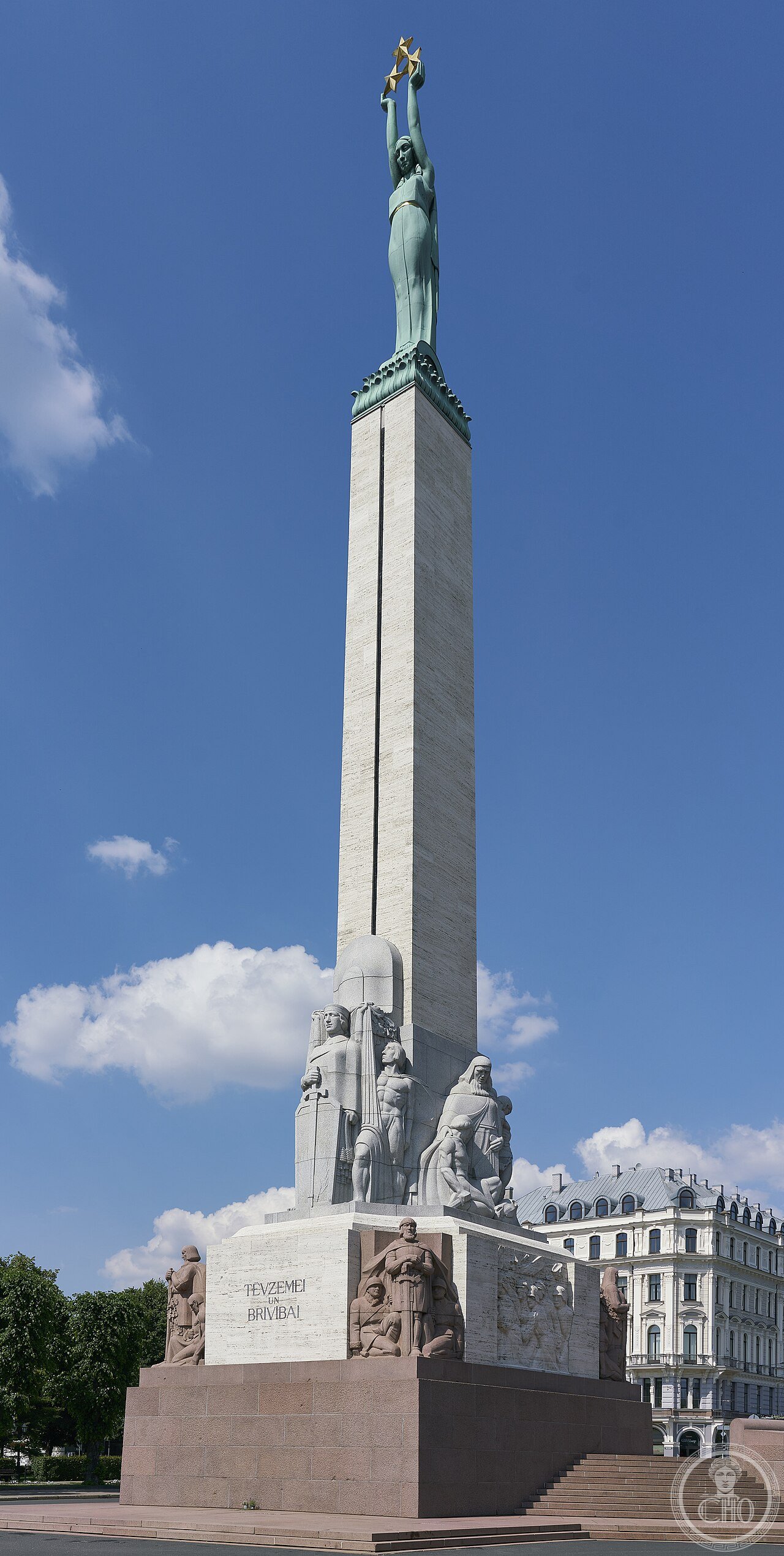
Rising 42 metres above the centre of Riga, the Freedom Monument is the most important national symbol of Latvia and one of the defining works of interwar European monumental sculpture. Crowned by the copper figure of Milda holding three golden stars above her head, the monument was erected through a collective act of national will: funded entirely by private donations from thousands of Latvian citizens, it was inaugurated on November 18, 1935, the seventeenth anniversary of the proclamation of Latvian independence. Sculptor Karlis Zale and engineer Frederick Skujins created a composition that fused Art Deco austerity with the spirit of Latvian National Romanticism, covering the granite shaft with relief panels depicting the historical and mythological narrative of the Latvian people. The three stars represent Vidzeme, Latgale, and Kurzeme, the three historical regions of Latvia. At the base of the monument the inscription reads: Tevzemei un Brivibai (For Fatherland and Freedom). During five decades of Soviet occupation the monument survived threatened demolition and became a site of quiet, dangerous resistance: laying flowers at its base was illegal, yet Latvians continued to do so. When independence was restored in August 1991, the monument became the focal point of national celebration and remains the gathering place for every significant civic moment in Latvian public life.
At a glance
- Type
- National monument and obelisk
- Period
- 1931-1935
- Style
- Art Deco / National Romanticism
- Location
- Brivibas bulvaris, Riga, Latvia
- Coordinates
- 56.9517 N, 24.1130 E
- Architect(s)
- Sculptor: Karlis Zale; Engineer: Frederick Skujins
Overview
The Freedom Monument stands at the intersection of Brivibas bulvaris and Raina bulvaris, at the symbolic heart of the Latvian capital. The 42-metre structure consists of a travertine-clad granite shaft rising from a stepped base decorated with relief sculptures, surmounted by the copper figure of Milda. The monument anchors the ceremonial axis of central Riga and functions simultaneously as public art, national shrine, and gathering space for civic events. An honour guard from the Latvian National Armed Forces stands at the monument every day of the year.
History
The idea for a freedom monument emerged immediately after Latvian independence in 1918 but required over a decade to materialise. A design competition was held in 1923 and again in the late 1920s; sculptor Karlis Zale won the final competition in 1929. Construction began in 1931 on the site of a statue of Tsar Peter the Great, which was removed as a deliberate symbolic act of decolonisation. The monument was built using funds raised through a national subscription campaign and inaugurated in the presence of President Alberts Kviesis. Under Soviet occupation from 1940 the monument was periodically threatened with demolition or conversion but survived, in part because of its cultural prominence and in part through the resistance of Latvian cultural figures who argued for its preservation as a work of art. The monument became a focal point of the Latvian national awakening in the late 1980s and was fully restored to its civic role after independence in 1991.
Architecture and Design
Karlis Zale conceived the monument as a total composition in which architecture and sculpture are inseparable. The shaft is clad in travertine brought from Hungary and is articulated with three tiers of relief panels carved by Zale depicting scenes from Latvian mythology, the independence war of 1918-1920, and the aspirations of the Latvian people. The stylistic language combines the geometric clarity of Art Deco with the emotionally charged figuration of National Romanticism, creating a monument that feels both modernist and rooted in a specifically Baltic visual tradition. The figure of Milda at the summit is 9.35 metres tall and was cast in copper; the three golden stars she holds aloft reference the three ethnographic regions of Latvia. The base features bronze door panels and a formal approach designed for ceremonial processions.
Cultural significance
The Freedom Monument occupies a position in Latvian national consciousness comparable to a combination of memorial, constitution, and flag. Its survival through Soviet occupation gives it a particular gravity: the monument witnessed fifty years of illegal flower-laying, secret commemorations, and eventually the mass demonstrations of the national awakening. The inscription Tevzemei un Brivibai has become a formulation that encapsulates the Latvian independence project across two periods of independence separated by occupation. Internationally the monument is recognised as one of the finest examples of interwar national Romantic monumental sculpture in Europe. It was central to Baltic Way in 1989, when two million people formed a human chain from Tallinn to Vilnius through Riga.
Visiting today
The Freedom Monument is an outdoor public monument accessible at all times without admission charge. An honour guard ceremony takes place every hour on the hour during daylight hours. The monument stands in a pedestrianised area at the edge of the Old Town and can be combined with visits to the surrounding Art Nouveau district of Alberta iela and the Old Town. The changing of the guard is a recommended visitor experience. The surrounding Brivibas bulvaris is a broad ceremonial boulevard lined with significant early-twentieth-century architecture.
Getting there
The Freedom Monument is in the centre of Riga, adjacent to the Old Town. The nearest tram and trolleybus stop is Brivibas piemineklis, served by multiple lines. From Riga Central Station it is a 15-minute walk north along Brivibas iela. The Old Town is fully walkable from the monument. Airport bus 22 connects Riga International Airport to the city centre in approximately 30 minutes.
Sources and resources
Find it on the map
See this place and what’s around it →Record researched and written by Luigi De Marchi for Cultural Heritage Online, 2026.
📷 Become a Cultural Heritage Online photographer
Share your photos of places: they stay published under your name as the author. The more they're seen, the more you get noticed — and soon a contest will reward the most appreciated photos.
Log in or sign up free to add a photoIs this page about you?
This page is read by travellers and heritage enthusiasts who find it on Google. Tell us how you are connected to this place and we will take it from there.