

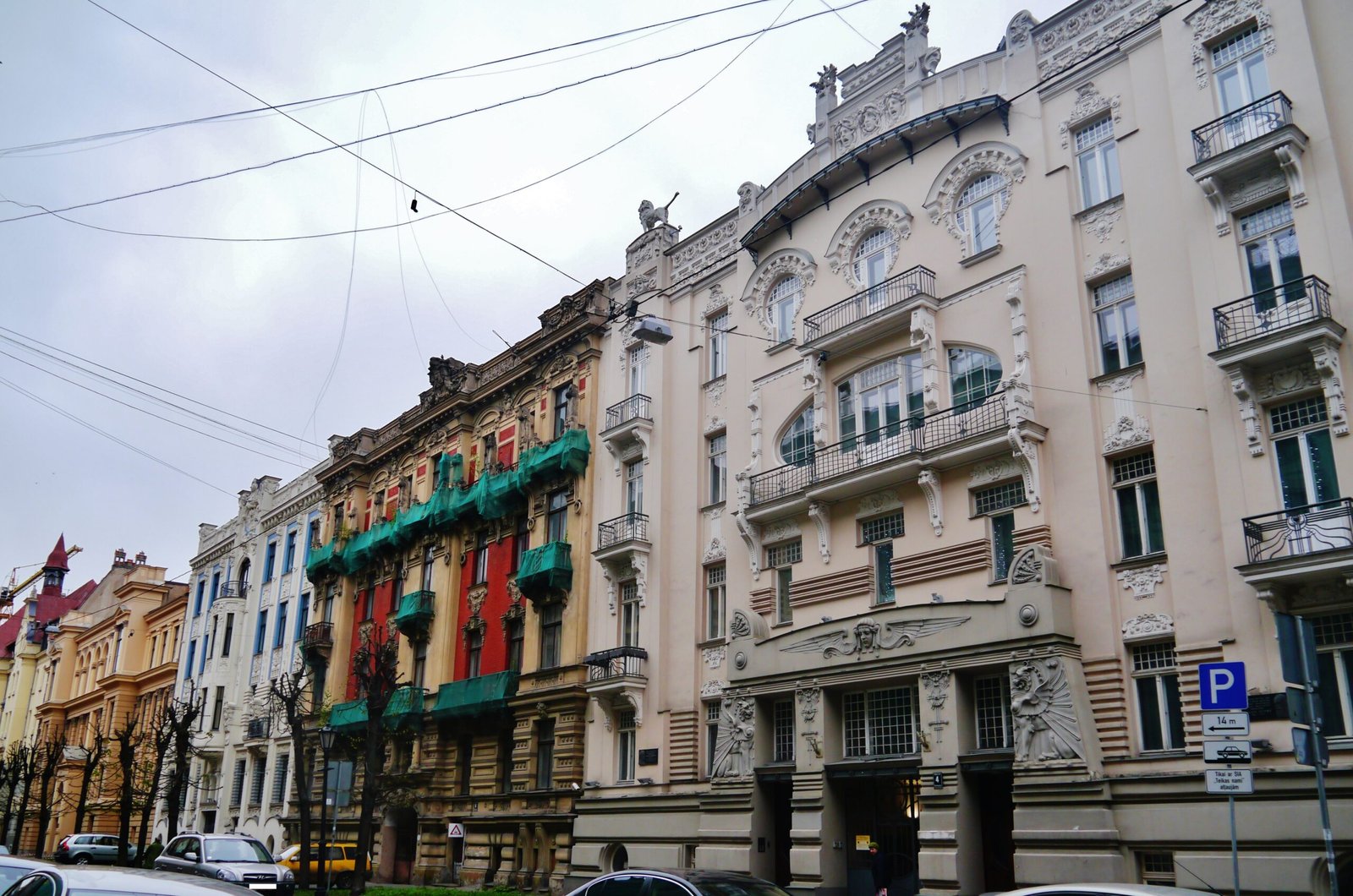
The Riga Art Nouveau Museum fills the 1903 apartment of architect Konstantīns Pēkšēns, on a street that holds one of Europe’s densest runs of Jugendstil. The staircase alone is worth the climb.
- Institution
- Riga Art Nouveau Museum (Rīgas Jūgendstila centrs)
- Location
- Riga, Latvia
- Address
- Alberta iela 12, Riga, LV-1010
- Building architect
- Konstantīns Pēkšēns with Eižens Laube — 1903
- Museum opened
- 2009 (restored 1903 interiors)
- Classification
- Within the UNESCO World Heritage Historic Centre of Riga (1997)
- Style
- Art Nouveau / Jugendstil
- Official site
- jugendstils.riga.lv


Story
The Riga Art Nouveau Museum occupies the second-floor apartment of the man who built the house around it. Konstantīns Pēkšēns (1859–1928), one of Latvia’s most prolific architects, raised the building at Alberta iela 12 in 1903 as his own residence, designing it together with the young Eižens Laube, then still a student. Pēkšēns lived and worked here until 1907. The museum opened in this apartment in 2009, after the original 1903 interiors were surveyed and carefully restored.
The address is no accident. Alberta iela was laid out in the years either side of 1900, and within a single short block it gathers one of the densest runs of Jugendstil architecture anywhere. Riga earned a place on the UNESCO World Heritage List in 1997, with its Art Nouveau quarters singled out for particular emphasis. The city is often called a capital of the style. Here that claim is not abstract: it is the street outside the window.
Inside, the museum restores the rhythm of an early-twentieth-century apartment rather than staging a gallery. Rooms follow the original plan. Wall paintings, plafonds, tiled stoves, furniture and fittings return the visitor to the year 1903, recreated during the 2008–2009 works. The effect is domestic and exact. One walks through a home, not a display case.
“A spiral staircase among the most impressive not only in Riga but in the whole of Europe.”
The building’s signature is its stairwell. A spiral staircase winds upward beneath a painted ceiling, its balustrade curving in a single unbroken sweep, the murals possibly sketched by the painter Janis Rozentāls, who himself lived in the same building. The climb is the experience. Light falls down the helix, ornament meets the eye at every turn, and the architecture stops being a backdrop and becomes the subject.
Riga’s Art Nouveau belongs to a wider European moment. The same impulse that produced the Jugendstil of Munich, the Secession of Vienna, the Liberty of Italy and the Art Nouveau of Brussels reached the Baltic coast and flourished with unusual reach, shaping whole streets rather than single landmarks. What sets Riga apart is survival in quantity. Few cities kept so much of the style intact, across facades, interiors and decorative objects alike.
For the visitor, the museum works best as a key to the district. It explains the vocabulary — the masks and mascarons, the floral relief, the sinuous iron — that then repeats along Alberta iela and the surrounding quiet centre. Open daily, it sits at the natural start of any Art Nouveau walk through Riga. See the apartment first. Then read the street.
Map & access
GPS 56.9596096, 24.1085166 · Open in Google Maps · OpenStreetMap
Alberta iela is in Riga’s quiet centre; the museum is a short walk from the city’s most famous Art Nouveau facades.
Sources & resources
Partner Ambassador
This is an independent editorial entry, compiled by Cultural Heritage Online from public, openly-licensed sources as part of our Founding Partner pilot. The institution shown has not joined, endorsed, or paid for the programme, and is under no obligation. Riga Art Nouveau Museum is welcome to claim, expand, correct, or request removal of it at any time. If you represent this institution, write to info@culturalheritageonline.com.
Plan your visit
Open to visitors year-round; check local tourism offices for seasonal hours, admission fees, and guided tour availability. GPS coordinates: 56.9596096, 24.1085166.
Find it on the map
See this place and what’s around it →📷 Become a Cultural Heritage Online photographer
Share your photos of places: they stay published under your name as the author. The more they're seen, the more you get noticed — and soon a contest will reward the most appreciated photos.
Log in or sign up free to add a photoIs this page about you?
This page is read by travellers and heritage enthusiasts who find it on Google. Tell us how you are connected to this place and we will take it from there.