
The National and University Library of Slovenia — known by its Slovenian acronym NUK — stands as Jože Plečnik’s greatest architectural achievement and one of Central Europe’s most compelling modernist buildings. Completed in 1941 after a decade of design and construction, this UNESCO World Heritage Site occupies a commanding block in Ljubljana’s historic centre. Its rough-hewn granite facade conceals one of architecture’s most celebrated interior sequences: a journey from a dim vestibule, up a dramatic colonnaded staircase, into a light-flooded reading room — a spatial metaphor for the human passage from ignorance to knowledge through books. Plečnik, who trained under Otto Wagner in Vienna, synthesised ancient Greek and Roman forms with his own poetic symbolism to produce a building that feels simultaneously timeless and deeply personal. The library holds Slovenia’s legal deposit collection and serves as the primary research institution for the nation’s scholars.
At a glance
- Type
- National library
- Period
- Designed 1930–1931; built 1936–1941
- Style
- Plečnik Classicism / Expressionist Modernism
- Location
- Turjaška ulica 1, Ljubljana, Slovenia
- Coordinates
- 46.0469° N, 14.5039° E
- Architect(s)
- Jože Plečnik
Overview
The National and University Library occupies a triangular city block in Ljubljana’s historical core, asserting itself through monumental scale yet speaking an intimate architectural language. Plečnik’s design draws on Egyptian, Greek, Roman, and Renaissance precedents while remaining entirely his own invention. The exterior’s rough black granite contrasts with polished stone detailing and bronze fittings, suggesting durability and permanence fitting a repository of national memory. Since 2021, the building has been inscribed on the UNESCO World Heritage List as part of the broader recognition of Plečnik’s Ljubljana.
History
Slovenia’s national library traces its origins to 1774 under Habsburg rule, when Empress Maria Theresa established the Lyceum Library in Ljubljana. For over a century the collection outgrew successive premises. After Slovenia became part of Yugoslavia, Plečnik — who had returned from Prague to reshape his native city — was commissioned in 1930 to design a purpose-built library. Construction began in 1936 and continued through the Nazi occupation of Ljubljana, with the building finally completed in 1941. This wartime opening lent the institution extraordinary symbolic weight: a monument to Slovenian intellectual life erected under occupation. Plečnik himself considered the NUK the work he would most wish to be remembered by.
Architecture & Design
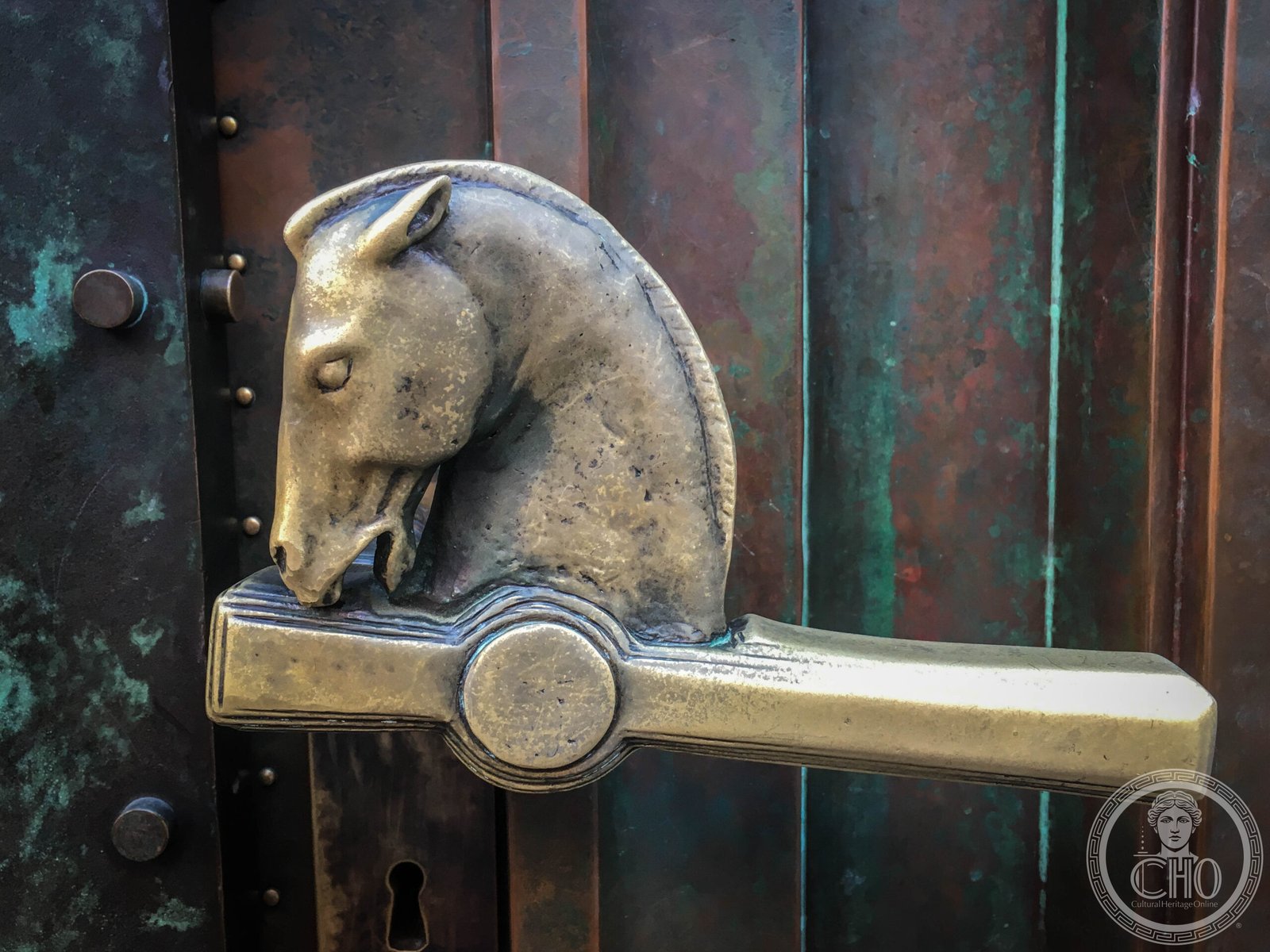
The library’s defining gesture is its grand ceremonial staircase. Visitors enter a deliberately dim vestibule, then ascend between horse-head columns through progressively brighter levels until the reading room opens in full Mediterranean light — a theatrical sequence Plečnik designed explicitly as a metaphor for enlightenment. The facade deploys rough-cut black granite alongside smooth limestone, with horse-head corbels and abstract ornament that defy easy stylistic classification. Interior details — bronze door handles cast in the shape of fish, intricate mosaic floors, custom furniture — were all designed by Plečnik, making NUK a total work of art. The reading room itself, with its slender columns and coffered ceiling, achieves a serene monumentality rare in twentieth-century architecture.
Cultural significance
NUK is the physical embodiment of Slovenian national identity in built form — a building conceived to house the nation’s memory and completed during a period of foreign occupation. Plečnik’s synthesis of international modernism with local Slavic and Mediterranean traditions created an architectural language that Ljubljana adopted as its own. The library’s UNESCO inscription in 2021 confirmed what Slovenes had long understood: that Plečnik’s Ljubljana, with NUK at its heart, constitutes one of the twentieth century’s most coherent and humane urban visions. It remains an active working library serving thousands of researchers and students.
Visiting today
The library is open to the public during reading-room hours; the grand staircase and main hall are accessible to all visitors without a library card. Guided architectural tours are available and highly recommended for understanding Plečnik’s spatial intentions. The building is best appreciated in morning light when the reading room is at its most luminous. Combined visits with Plečnik’s covered market, Triple Bridge, and the National Gallery make for an outstanding architectural day in Ljubljana’s compact centre.
Getting there
The library sits in central Ljubljana, approximately 600 metres from the main train and bus stations (Ljubljana Glavna postaja). The city centre is easily walkable; taxis and ride-share apps serve the area. Ljubljana Airport (Brnik) is 26 km north, with the GoOpti shuttle connecting to the city in about 30 minutes. No dedicated parking at the library — use the Kongresni trg underground car park nearby.
Sources & resources
Find it on the map
See this place and what’s around it →📷 Become a Cultural Heritage Online photographer
Share your photos of places: they stay published under your name as the author. The more they're seen, the more you get noticed — and soon a contest will reward the most appreciated photos.
Log in or sign up free to add a photoDo you manage this place?
This page is read by travellers and heritage enthusiasts who find it on Google. Keep it accurate — and make it work for you. Free for non-profit heritage institutions.