

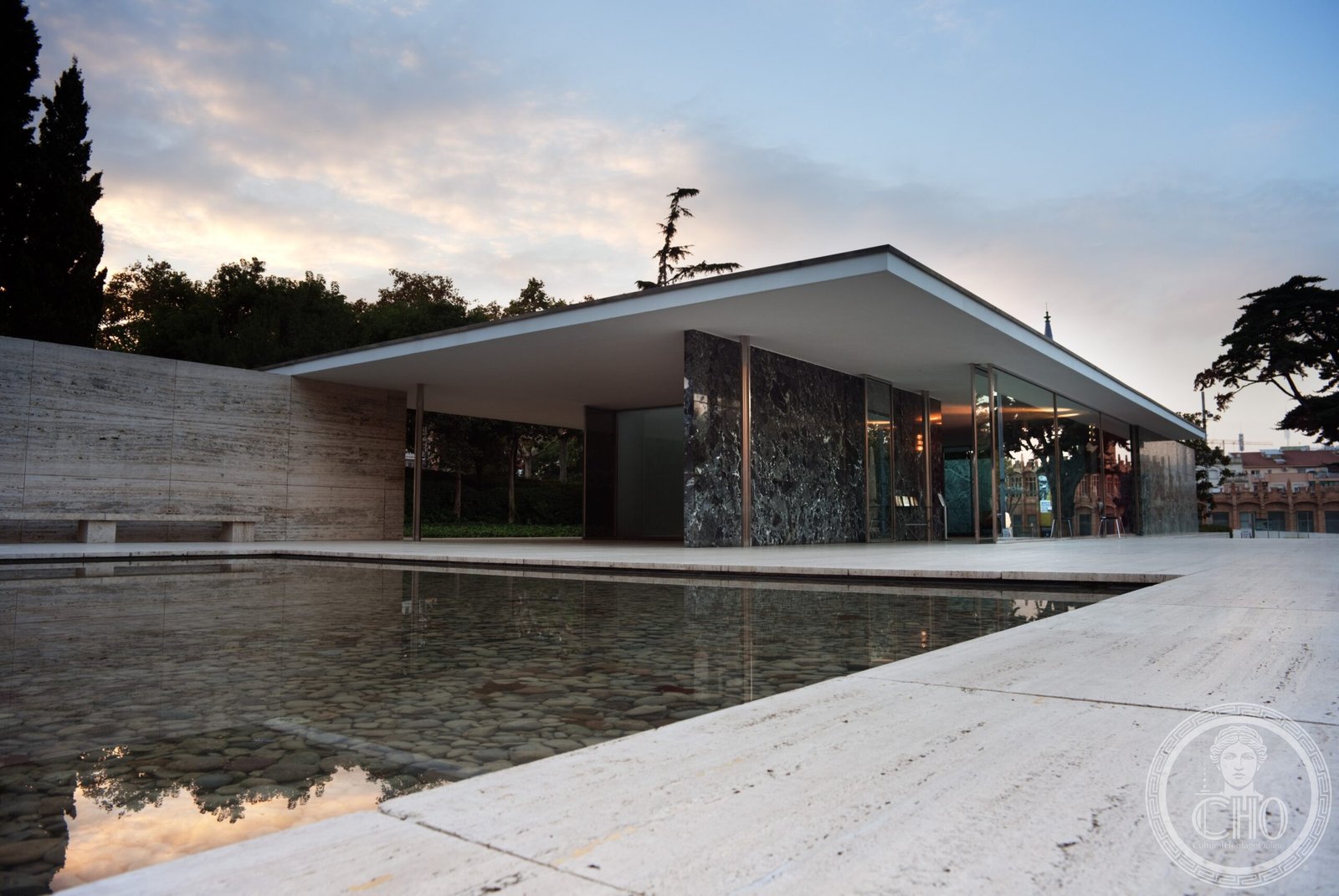
Designed by Ludwig Mies van der Rohe and Lilly Reich as the German national pavilion for the 1929 Barcelona International Exposition, the Barcelona Pavilion stands as one of the defining monuments of twentieth-century architecture. Its radical proposition — a building stripped of all decorative intent, composed solely through the precise placement of noble materials and the fluid organisation of space — overturned everything architecture had assumed about enclosure and ornament. Walls of green Tinos marble, Roman travertine, and golden onyx do not so much divide the interior from the exterior as dissolve the boundary between them, allowing the eye and the body to move freely through a shallow reflecting pool and a covered terrace under a thin white roof plane. Demolished when the Exposition closed in 1930, the pavilion existed only in photographs and memory for half a century. Its 1986 reconstruction on the original Montjuic site — driven by Oriol Bohigas, Ignasi de Sola-Morales, and Fernando Ramos — proved that an idea, not a building, had survived, and that the idea was worth rebuilding.
At a glance
- Type
- Exhibition pavilion (permanent reconstruction)
- Period
- Original 1929; reconstructed 1986
- Style
- International Style / Modernist
- Location
- Avinguda de Francesc Ferrer i Guardia 7, Montjuic, Barcelona, Spain
- Coordinates
- 41.3706° N, 2.1500° E
- Architect(s)
- Ludwig Mies van der Rohe; Lilly Reich (furnishings & interiors)
Overview
The Barcelona Pavilion represents the moment modern architecture found its most condensed expression. Mies van der Rohe’s design eliminated the traditional programme of rooms and replaced it with a single continuous space guided by free-standing planes of stone and glass. The famous Barcelona Chair, designed specifically for the pavilion and still in production today, is positioned near the small sculpture Der Morgen by Georg Kolbe, reflected in the pool. Though it served no practical exhibition function — it existed solely to represent Germany at the official opening ceremony — the pavilion proved to be the most influential building at the Exposition and arguably of the entire century.
History
Mies van der Rohe received the commission in 1928 when he was director of the Deutscher Werkbund. Construction on Montjuic hill was completed in time for the official opening in May 1929 by King Alfonso XIII and Queen Victoria Eugenia of Spain. When the Exposition closed in January 1930, the structure was dismantled as intended — a temporary national statement, not a permanent monument. For decades architects studied the pavilion from a handful of black-and-white photographs and Mies’s own drawings. In 1983, the Ajuntament de Barcelona approved a project to reconstruct it on the original foundations. Three Catalan architects — Ignasi de Sola-Morales, Cristian Cirici, and Fernando Ramos — led the work, which required sourcing matching Roman travertine and Tinos green marble from the original quarries. The reconstruction opened in 1986 and received the UIA’s Auguste Perret Prize the same year.
Architecture & Design
The pavilion rests on a low podium of Roman travertine. A thin steel roof plate, supported by eight cruciform chrome-clad columns, floats over the composition without touching the walls beneath it. The walls — four slabs of different stone and two of frosted or tinted glass — slide past one another in a pinwheel arrangement, creating interlocking interior and exterior spaces that flow without transition. The great wall of golden onyx dore, veined in amber and ochre, divides the main hall. Two shallow reflecting pools — one enclosed beneath the roof, one open to the sky — mirror the stone planes and amplify the sense of weightlessness. The sole furnishing, the Barcelona Chair in chrome and white leather, is as much architecture as furniture: a device to mark the royal greeting space without interrupting the spatial flow.
Cultural significance
Few buildings have exercised such disproportionate influence relative to their physical scale. Mies’s dictum “Less is more” finds its most precise embodiment here. The pavilion directly inspired the spatial organisation of Fallingwater, the Illinois Institute of Technology campus, the Seagram Building, and generations of minimalist houses worldwide. Its reconstruction in 1986 coincided with a broader reassessment of Modernism’s canonical works and helped reinstate Barcelona as a global city of architectural culture, a role the 1992 Olympics would cement. The Fundacio Mies van der Rohe, housed in the pavilion, administers the European Union Prize for Contemporary Architecture in his name.
Visiting today
The Fundacio Mies van der Rohe operates the pavilion as a cultural site open Tuesday through Sunday (closed Monday and 25 December / 1 January). Entry is approximately 14 EUR for adults, with reduced rates for students and groups. The visit is self-guided; a small bookshop sells Mies scholarship and reproductions. Photography is freely permitted throughout. The pavilion is small — allow 45 to 60 minutes — but many visitors stay longer. Early morning visits, before the Montjuic tourist flow builds, reward with the pools in still light.
Getting there
From central Barcelona, take Metro Line 1 (red) or Line 3 (green) to Espanya station, then walk approximately 10 minutes uphill along Avinguda de la Reina Maria Cristina toward Montjuic, or board the 150 bus. The Montjuic cable car and funicular also deposit visitors within a short walk. No dedicated parking exists on site; public car parks are available near Placa d’Espanya. Taxis and ride-share services set down directly outside.
Sources & resources
Find it on the map
See this place and what’s around it →Record researched and written by Luigi De Marchi for Cultural Heritage Online, 2026.
📷 Become a Cultural Heritage Online photographer
Share your photos of places: they stay published under your name as the author. The more they're seen, the more you get noticed — and soon a contest will reward the most appreciated photos.
Log in or sign up free to add a photoIs this page about you?
This page is read by travellers and heritage enthusiasts who find it on Google. Tell us how you are connected to this place and we will take it from there.