
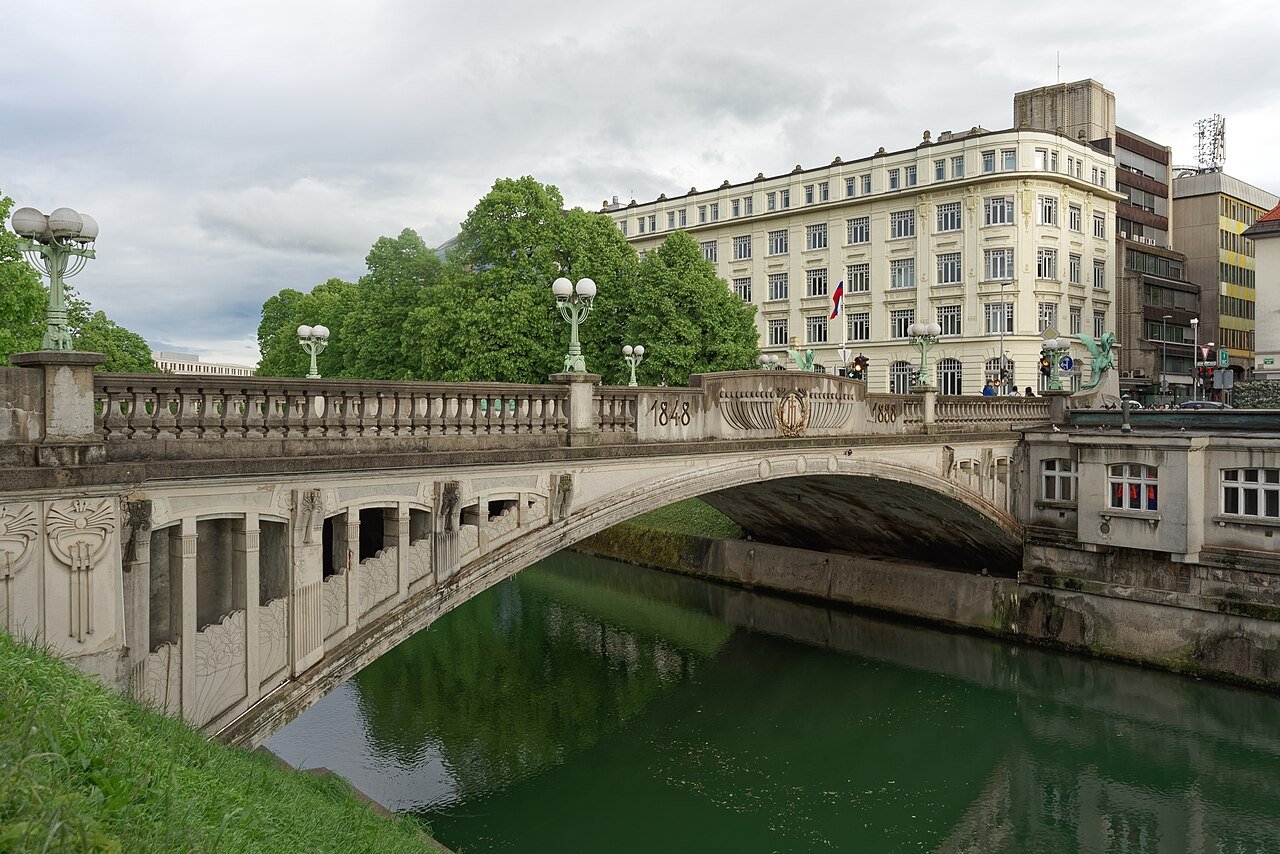
An earthquake in 1895 cleared the ground for a new Ljubljana. First came the Vienna Secession, then the architect Jože Plečnik, who reshaped the city along its river.
At a glance
Ljubljana wears two layers of early modern architecture, one laid over the other. The first followed the earthquake of Easter 1895, when much of the city was rebuilt in the Vienna Secession idiom by architects trained in or near Otto Wagner’s circle — among them Maks Fabiani, who drew the new urban plan, and the engineers behind the Dragon Bridge of 1901. The second layer belongs to Jože Plečnik, who returned to his native city in 1921 and, over the following two decades, redesigned its bridges, embankments, market and central library. In 2021 a selection of Plečnik’s interventions was inscribed by UNESCO as “The works of Jože Plečnik in Ljubljana – Human Centred Urban Design.” Walking the banks of the Ljubljanica today means reading both stories at once.
Key facts
- Country: Slovenia
- Key period: post-1895 earthquake Secession rebuild + Plečnik’s interwar transformation (1921–1941)
- Key figures: Jože Plečnik (1872–1957), Maks Fabiani (1865–1962), Jurij (Giorgio) Zaninović (Dragon Bridge)
- UNESCO: The works of Jože Plečnik in Ljubljana – Human Centred Urban Design, inscribed August 2021
- Essential sites: Dragon Bridge, Triple Bridge, National and University Library, Central Market colonnade, Ljubljanica embankments
History
On Easter Sunday, 14 April 1895, an earthquake struck Ljubljana and damaged or destroyed a large part of the old town. The disaster became an opportunity. A competition for the city’s reconstruction was won by Maks Fabiani (1865–1962), a Slovene architect who had joined Otto Wagner’s Vienna studio on Wagner’s personal invitation and stayed there to the end of the century. Fabiani’s plan, chosen over a rival scheme by the Viennese theorist Camillo Sitte, gave Ljubljana wide new streets, parks and the framework for a modern provincial capital.
The architecture that filled this frame was largely Secessionist — the Austrian variant of Art Nouveau radiating out from Vienna. Its most spectacular surviving monument is the Dragon Bridge, built in 1900–1901 to replace the old Butchers’ Bridge of 1819 that the earthquake had shaken. Designed by Jurij Zaninović, a graduate of Wagner’s school, and engineered in reinforced concrete using Josef Melan’s patented system, it is widely regarded as one of the finest bridges the Vienna Secession ever produced. Four large copper dragons stand at its corners.
The second transformation came after the First World War. Jože Plečnik (1872–1957), also a Wagner pupil, returned to Ljubljana in 1921 after major work in Vienna and Prague. Over the next twenty years he gave the city a coherent civic identity, working along the Ljubljanica with a personal language that fused classical, vernacular and modern elements. His impact on Ljubljana is often compared to that of Gaudí on Barcelona.
What you see
The Dragon Bridge carries you across the Ljubljanica between the central market and the old town; its copper dragons, designed by Zaninović and cast in Vienna, have become the unofficial emblem of the city. A short walk downstream brings you to Plečnik’s Triple Bridge (Tromostovje), where in 1931–32 he flanked an older stone bridge of 1842 with two angled pedestrian crossings and lined all three with stone balustrades, turning a single span into a small public square over the water.
Behind it rises Plečnik’s masterpiece, the National and University Library (NUK), built 1936–1941. Its façade combines brick and rough stone in the manner of an Italian palazzo; inside, a dark staircase of Podpeč limestone columns climbs toward a luminous reading room, a deliberate passage “from the twilight of ignorance to the light of knowledge.” Plečnik also designed the riverside Central Market with its long covered colonnade, and reshaped the embankments themselves, so that the river, its bridges and its quays read as a single designed landscape.
Practical information
- The Plečnik House (Plečnikova hiša), the architect’s preserved home and studio in the Trnovo district, is open as a museum and is the best single introduction to his work.
- Most key sites — Dragon Bridge, Triple Bridge, Central Market and the NUK exterior — cluster within a 15-minute walk along the Ljubljanica.
- The NUK interior and grand staircase can be visited; check current opening arrangements before you go.
- Allow a half to a full day to walk the embankments and see both the Secession and Plečnik layers without rushing.
- The old-town riverbank is pedestrianised, making the whole circuit comfortable on foot.
Getting there
Ljubljana Jože Pučnik Airport (LJU) lies about 25 km north of the city, connected by bus and taxi. The central railway and bus station sit a short walk north of the old town, with direct trains from Vienna, Zagreb, Trieste and other regional capitals; from the station the historic core and the river are easily reached on foot.
Related in CHO
- Vienna — Capital of the Vienna Secession
- Budapest — Ödön Lechner and the Hungarian Szecesszió
- Prague — Alphonse Mucha and the Art Nouveau Legacy
Sources
Find it on the map
See this place and what’s around it →Record researched and written by Luigi De Marchi for Cultural Heritage Online, 2026.
📷 Become a Cultural Heritage Online photographer
Share your photos of places: they stay published under your name as the author. The more they're seen, the more you get noticed — and soon a contest will reward the most appreciated photos.
Log in or sign up free to add a photo