
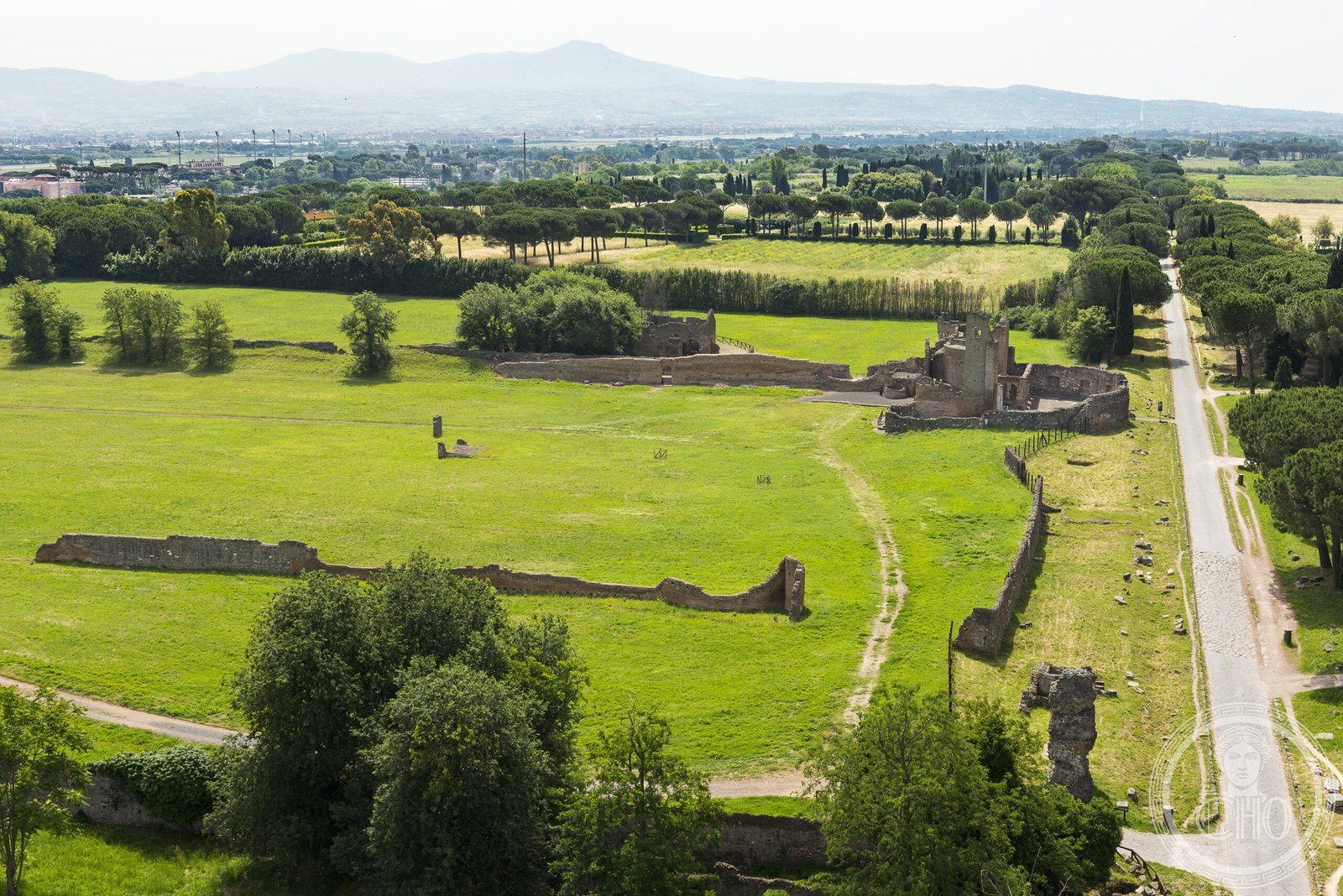
Europe’s largest urban park stretches across 4,580 hectares of ancient Roman monuments, early Christian catacombs, and native Mediterranean landscape along Rome’s legendary Appian Way.
At a glance
Established in 1988, the Appia Antica Regional Park protects a vast corridor of archaeological and ecological significance spanning Rome, Ciampino, and Marino. The park preserves layers of history from the Republican period through the Medieval and Baroque eras while serving as Rome’s primary biological corridor for urban biodiversity.
History
The Appian Way itself, one of ancient Rome’s greatest engineering achievements, anchors the park’s collection of monuments. Republican and Imperial-era structures line the route: the Porta San Sebastiano and Aurelian Walls, the Tomb of Geta, Cecilia Metella’s circular mausoleum, the Imperial Palace of Maxentius, and the Villa dei Quintili. Early Christian catacombs of San Callisto, Domitilla, and San Sebastiano document the faith’s first centuries, while the Basilica of Pretestato and the Church of Quo Vadis reflect later devotion. Medieval fortifications and Renaissance-Baroque churches—including towers built atop Roman ruins—mark successive cultural layers.
What you see
Monumental remains dominate the landscape: the Casal Rotondo, a large cylindrical sepulcher; the Temple of Redicolo and Nymphaeum of Egeria in the Caffarella Valley; and the massive Claudio-Anio Novus Aqueduct, whose pipes once carried water across the terrain. Church interiors and catacomb passages document early Christian burial practices. The Caffarella Valley preserves traces of ancient agricultural settlement, while restored churches such as Sant’Urbano showcase medieval and Baroque embellishment on older foundations.
Cultural significance
The park safeguards Rome’s most complete archaeological continuum from antiquity to the early modern period. It functions as the city’s ecological heartland, protecting fragmented habitats and native plant communities. Downy and cork oaks in the Bosco Farnese, Mediterranean scrub, spontaneous orchids in humid meadows, and rare species such as peeled buttercup represent the region’s natural heritage alongside its built monuments.
Key facts
- Established 1988 by Lazio Region
- Area: 4,580 hectares
- Address: Via Appia Antica, 60, Rome
- Coordinates: 41.8668816, 12.5029866
- Phone: +39 06 5135316
- Website: https://www.parcoappiaantica.it
Practical information
The park is open to visitors year-round. Many monuments require entry; check the official website for current hours and admission fees. Footpaths vary in accessibility; wear appropriate footwear for unpaved routes. The visitor center and website provide detailed site maps and archaeological context for major monuments.
Getting there
From Rome’s city center, take the Metro Line A (red) to Colli Albani, then bus 660 toward the Appian Way, or drive directly via Via Appia Antica. The park’s main entrance and facilities are accessible from the historic road itself. Public transport connections are frequent; parking is available near the visitor center.
See the place
Sources & resources
Find it on the map
See this place and what’s around it →Historical events at this place (81)
- 2017 Lungo i basoli dell'Appia Antica, verso la Campagna Romana: il V ed il VI Miglio della Regina Viarum
- 2018 Le Dominae del Parco
- 2018 Le strutture idrauliche della Caffarella
- 2018 La Valle della Caffarella e la Via Appia Antica - Visita guidata in Bici
- 2018 Le Dominae del Parco
- 2018 Le strutture idrauliche della Caffarella
- 2018 I Sepolcri di Priscilla e di Geta
- 2018 English bike tour - Hidden gems in the Appia Antica Park
- 2018 Le strutture idrauliche della Caffarella
- 2018 Pedalata nella storia 1
- 2018 Visita guidata naturalistica in Bici - La Valle della Caffarella e la Via Appia Antica
- 2018 Pedalata naturalistica al tramonto nel Parco dell'Appia Antica
- 2018 Visita guidata in Bici - La Valle della Caffarella e la Via Appia Antica
- 2018 L'Appia Antica al tramonto e l'eclissi di luna
- 2018 Aspettando il Tramonto alla Villa dei Quintili sulla Via Appia
- 2018 La Via Appia Antica su Due Ruote
- 2018 La Via Appia Antica a Piedi Pubblico · Organizzato da Le Domeniche
- 2019 La Via Appia Antica a Pedali
- 2019 La Via Appia Antica a Piedi
- 2019 La Via Appia Antica a Pedali
- 2019 La Via Appia Antica a Piedi
- 2019 ArcheoNatura in Bici 4
- 2019 Pedalata della Luna Piena nel Parco dell'Appia Antica
- 2019 Pedalata al Tramonto nel Parco dell'Appia Antica
- 2019 Pedalata nella Storia
- 2019 La Via Appia Antica fino a Tor Carbone - Visita guidata in bicicletta
- 2019 1 Novembre sulla Via Appia Antica a Piedi
- 2020 Roma Archeologica: La Via Appia Antica a Piedi
- 2020 Pedalata tra storia e natura - Parco Appia Antica
- 2020 Pedalata tra storia e natura - Parco Appia Antica
- 2020 Pedalata al tramonto in Caffarella tra storia e natura
- 2020 La Villa dei QUINTILI e S. MARIA NOVA
- 2020 Il sepolcro di PRISCILLA e la chiesa del DOMINE QUO VADIS
- 2020 La Appia Antica (tra V e VI miglio)
- 2020 Pedalata tra storia e natura
- 2020 Pedalata sull'Appia alla scoperta di Villa dei Quintili
- 2020 Roma Archeologica: Via Appia Antica a Piedi (ingressi gratuiti)
- 2020 Pedalata nella Storia - Parco Appia Antica
- 2020 Garbatella in Bicicletta
- 2020 Tramonto Sulla Via Appia Antica a Piedi (ingressi gratuiti)
- 2020 Pedalata tra storia e natura
- 2020 Roma Archeologica: La Via Appia Antica a Piedi(ingressi gratuiti)
- 2020 In bici nella natura
- 2021 Pedalata in famiglia nella Valle della Caffarella
- 2021 La Cartiera LATINA
- 2021 La Via Appia Antica a Piedi dal II al IV miglio
- 2021 Passeggiata con le lucciole in Caffarella
- 2021 In bici con le lucciole in Caffarella
- 2021 In bici con le lucciole in Caffarella
- 2021 Pedalata storico-archeologica sull'Appia Antica
📷 Become a Cultural Heritage Online photographer
Share your photos of places: they stay published under your name as the author. The more they're seen, the more you get noticed — and soon a contest will reward the most appreciated photos.
Log in or sign up free to add a photo