
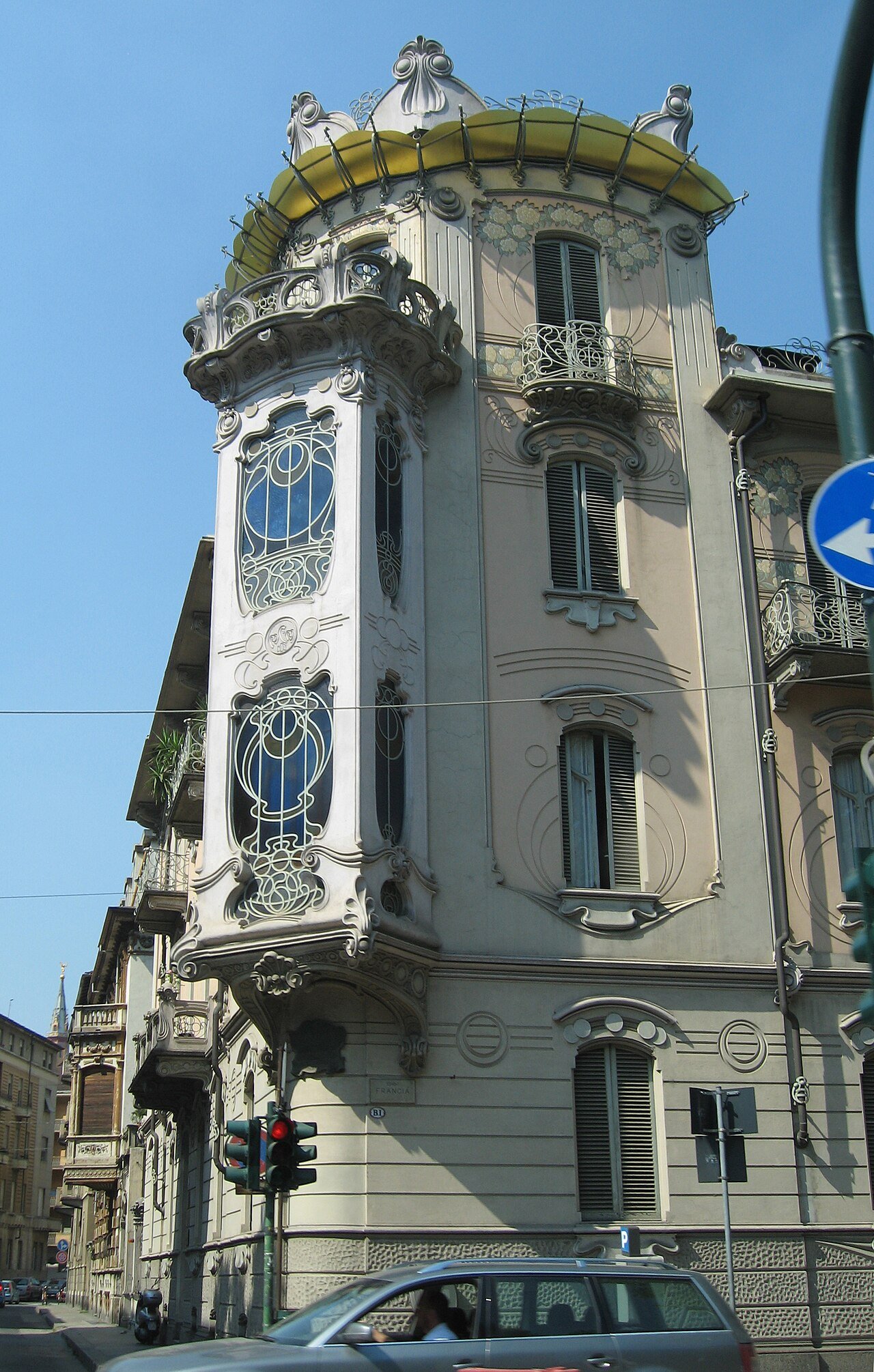
Turin hosted the 1902 Esposizione Internazionale d’Arte Decorativa Moderna — the event that defined Liberty as Italy’s Art Nouveau — and its streets still hold the country’s densest concentration of the style, culminating in Pietro Fenoglio’s sinuous oriel-window apartment blocks in the Crocetta and Borgo Po districts.
At a glance
Turin entered the twentieth century as the capital of unified Italy’s most dynamic industrial region and its most ambitious cultural ambitions. The 1902 Esposizione Internazionale d’Arte Decorativa Moderna — which deliberately excluded historical revivalism, the first major exhibition to do so — consecrated Liberty as Italy’s answer to Art Nouveau and placed Turin at the movement’s international centre. Pietro Fenoglio, Raimondo D’Aronco, Giovanni Gribodo and their contemporaries produced apartment blocks whose wrought-iron balconies, polychrome ceramic tiles and sinuous carved stonework transform entire residential streets into continuous Liberty ensembles. Two decades later, the Lingotto factory (1916–1923) added a different modernism: Giacomo Matté-Trucco’s rooftop test track for Fiat made industrial architecture as spectacular as any palace.
Key facts
- Country: Italy (Piemonte)
- Key periods: Liberty italiano (1900–1918); Razionalismo industriale (1915–1935)
- Key figure: Pietro Fenoglio (1865–1927) — architect, creator of Turin’s Liberty apartment block canon
- Also notable: Giacomo Matté-Trucco (Lingotto, 1916–1923), Raimondo D’Aronco (1902 Expo pavilions)
- Landmark event: Esposizione Internazionale d’Arte Decorativa Moderna, Turin 1902
- Essential sites: Casa Fenoglio-Lafleur, Lingotto, Galleria Subalpina, Villa Scott, Villaggio Leumann
History
Pietro Fenoglio was born in Turin in 1865 and trained at the Regio Museo Industriale. His early career combined engineering commissions with decorative work; by 1900 he had developed the Liberty vocabulary that would define his most productive decade. Casa Fenoglio-Lafleur (Corso Francia 8, 1902) is his masterpiece: a four-storey apartment block whose corner oriel window — a continuous sinuous protrusion from ground to eaves, faced in polychrome tiles and topped with a glass-and-iron cap — is the most recognisable Liberty element in any Italian city. Fenoglio designed over twenty buildings in Turin between 1898 and 1918; many survive in Crocetta, Borgo Po and the streets around Corso Francia.
The 1902 Esposizione, organised in Valentino Park, brought international figures including Raimondo D’Aronco — its chief architect — into contact with the Viennese Secession, the Glasgow Four and the Belgian Art Nouveau pioneers. Its exclusion of historical styles made it the first fully modernist international design exhibition; the temporary pavilions were demolished after six months but their influence persisted. The Galleria Subalpina (1874, Emilio Marchesi), Turin’s finest covered passage, predates Liberty by twenty years but established the iron-and-glass aesthetic that Liberty architects would later push to organic extremes.
The Lingotto factory (Via Nizza 230) opened in 1923 as the largest automobile plant in Europe: Matté-Trucco’s design stacked the production line on five floors and placed the test track — two banked curves and two straights — on the roof, 22 metres above street level. Le Corbusier, who visited in 1925, called it one of the most impressive industrial sights in the world. The factory closed in 1982 and was converted by Renzo Piano into a conference, hotel and concert complex; the rooftop track — and the helipad at one curved end — survive.
What you see
Casa Fenoglio-Lafleur (Corso Francia 8 / Via Principi d’Acaja 11) is a private apartment building but its corner oriel is fully visible from the street — best photographed from the Corso Francia–Via Principi d’Acaja corner. Villa Scott (Corso Montevecchio 3), the Dario Argento house from Profondo Rosso, is another Fenoglio building in eclectic Liberty style; it can be seen from outside. The Galleria Subalpina (Piazza Castello 27) is a public covered shopping passage that can be walked freely.
The Lingotto (Via Nizza 230) is the city’s most dramatic modernist site: the rooftop track is accessible via the complex’s internal elevators, and the Pinacoteca Giovanni e Marella Agnelli — a glass jewel box designed by Piano on the roof — houses an exceptional small collection including a Matisse, four Renoirs and a Canaletto. The Villaggio Leumann (Corso Rosselli, Collegno) is a 30-minute tram ride from the centre: a complete company village built from 1875 to 1907 in Liberty and vernacular styles by the Swiss textile magnate Napoleone Leumann, with housing, school, church, dispensary and recreational facilities, all surviving intact.
Practical information
- Casa Fenoglio-Lafleur: privately owned; exterior visit only
- Lingotto Pinacoteca Agnelli: open Tue–Sun 10:00–19:00; pinacoteca-agnelli.it
- Galleria Subalpina: open during shop hours, free
- Villaggio Leumann: freely accessible exterior; guided tours available at weekends
- Torino+Piemonte Card: covers transport and museums
- Time needed: full day for Fenoglio district + Lingotto; half-day extra for Villaggio Leumann
Getting there
Turin Caselle Airport (TRN) is 16 km north; the Sadem bus reaches Porta Nuova station in 45 minutes. High-speed trains connect Turin to Milan (1h), Paris (5h30) and Rome (4h30). The Liberty district is concentrated around Corso Francia and Corso Re Umberto, served by trams 15 and 16 from the centre. Lingotto is on metro line 1 (Lingotto station).
Related in CHO
- Lingotto FIAT — Test Track Factory by Giacomo Matté-Trucco (existing CHO card ID 4079)
- Roma — Liberty Romano e EUR
- Milano — Liberty milanese e Razionalismo
See the place
Sources
Find it on the map
See this place and what’s around it →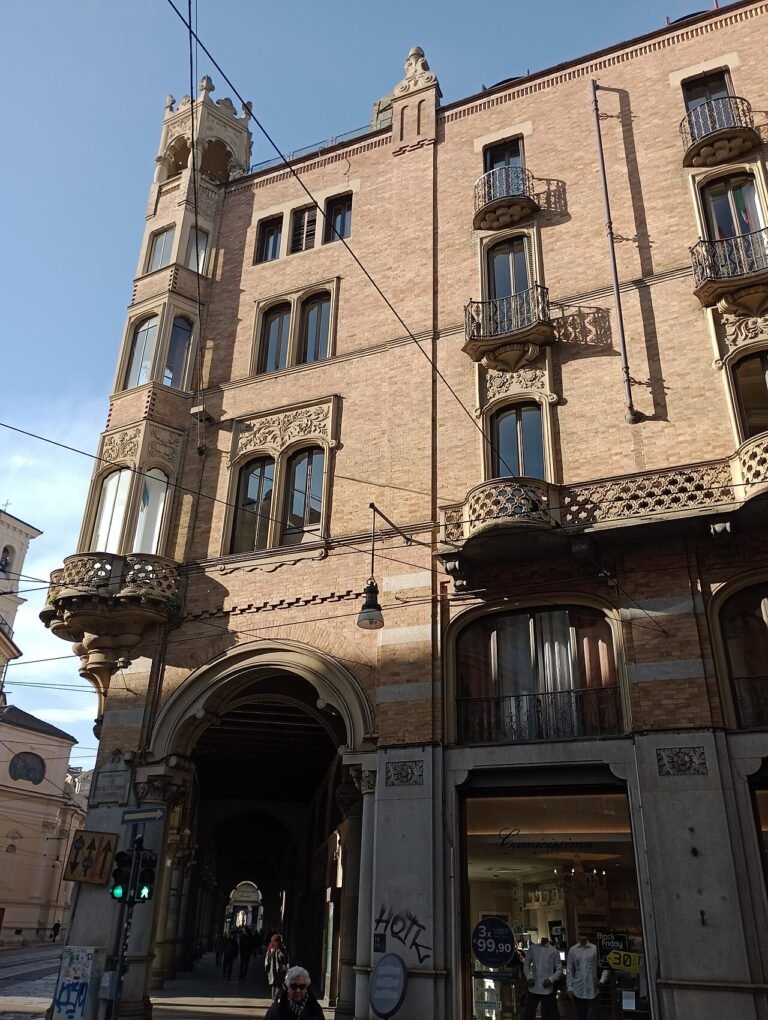

Events here — now on & upcoming
- Flashback Art Fair – L'arte è tutta contemporanea 202629 Oct 2026 — 01 Nov 2026See the event →
- Artissima – Internazionale d'Arte Contemporanea 202630 Oct 2026 — 01 Nov 2026See the event →
- Death Anniversary: Raimondo D'Aronco — May 3, 193203 May 2027See the event →
Historical events at this place (53)
- 2018 Identifying traditional printmaking techniques
- 2018 Street Food Festival Ciriè
- 2018 Street Food fest Leinì
- 2018 Donne che hanno fatto grande Torino + Colazione in caffè storico
- 2018 Colazione al caffè Storico + Appartamenti di Palazzo Carignano
- 2018 Torino Osè nei vicoli torinesi: tour guidato
- 2018 Colazione in sala panoramica + visita guidata Appartamento Reale
- 2018 Workshop Gratuito per la formazione di registrar
- 2018 Contemporary Art Week: a Torino il tempo di arte contemporanea
- 2018 Van Dyck Pittore di corte
- 2018 Con i miei occhi. Opere che raccontano diversamente la vita
- 2019 Monica Bonvicini, As Walls Keep Shifting
- 2019 Space Adventure
- 2020 Frida Kahlo: la mostra fotografica per la 1° volta in Europa!
- 2020 Torino Eros e Tabù: il volto nascosto della città
- 2020 Visita alla fabbrica di cioccolato e degustazione
- 2020 San Valentino romantico in sala rinascimentale del Borgo Medievale
- 2020 Torino Eros e Tabù: il volto nascosto della città
- 2020 San Valentino con serenata in location di charme a Nizza M.to
- 2020 Colazione dell'amicizia: Ti presento un libro
- 2020 Bando Esponente
- 2020 Biennale d’Arte METROPOLI di TORINO
- 2020 La Torino di Dario Argento e i luoghi dei suoi film horror
- 2020 Museo di Antropología Criminale:visita Guidata
- 2020 Palazzo Barolo: I meravigliosi appartamenti della marchesa Giulia
- 2020 Palazzo Barolo
- 2020 Tour al museo di Casa Martini e Vermouth class experience
- 2020 Visita allo storico villaggio Leumann e aperitivo sfizioso
- 2021 Torino Segreta:apertura Straordinaria sala Gonin
- 2020 Torino Eros e Tabù: il volto nascosto della città
- 2020 Gioielli sotterranei di Torino: le gallerie del forte misterioso
- 2020 La Torino dei Caffè storici. Tour guidato
- 2020 Tour al Museo Lavazza - memoria storica dell'eccellenza italiana
- 2020 Ciak si gira! Torino ed il Grande Cinema: tour guidato
- 2020 I gioielli sotterranei di Torino: Tour guidato nelle gallerie
- 2020 I gioielli sotterranei di Torino: Tour guidato nelle gallerie
- 2020 Halloween - Dario Argento e i luoghi dei suoi film horror - tour
- 2020 Gioielli sotterranei di Torino: le gallerie del forte-tour serale
- 2020 I meravigliosi appartamenti dei Principi di Carignano - tour
- 2020 La Torino dei Caffè storici.
- 2020 Gioielli sotterranei di Torino: Tour guidato nelle gallerie
- 2020 Torino Eros e Tabù: il volto nascosto della città
- 2020 Luci d'Artista: significato e storia. Tour guidato privato
- 2020 La Torino dei Caffè storici.Tour guidato nei
- 2020 I gioielli sotterranei di Torino: Tour guidato nelle gallerie
- 2022 True Colors - mostra personale di Filiberto Crosa
- 2022 Vivi Ciriè in Danza
- 2022 Eredi Boggiano: Il nuovo libro d’artista di Cristiano Berti
- 2023 Sabrina Poli, lo Sguardo Diagonale SANTAFRIKA a Torino
- Open House Torino
📷 Become a Cultural Heritage Online photographer
Share your photos of places: they stay published under your name as the author. The more they're seen, the more you get noticed — and soon a contest will reward the most appreciated photos.
Log in or sign up free to add a photo