
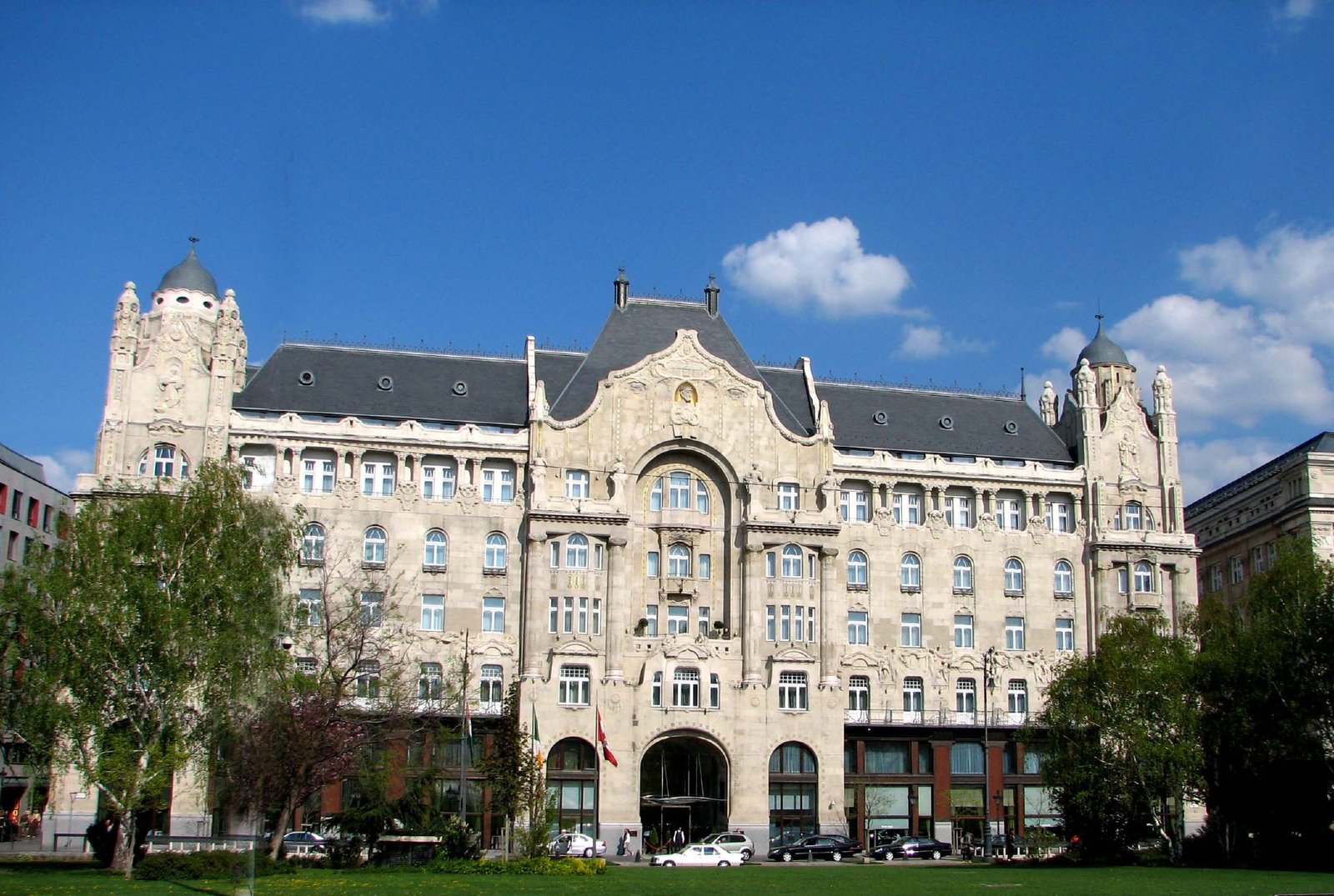
A London insurance company’s Budapest address turned Art Nouveau showpiece: wrought-iron peacock gates, Zsolnay tile and a glass-roofed arcade facing the Chain Bridge.
At a glance
The Gresham Palace faces the Danube at the Pest end of the Széchenyi Chain Bridge, on Széchenyi Square. Completed in 1906 for the Gresham Life Assurance Company of London as an office and apartment block, it is one of the finest works of Hungarian Art Nouveau. Zsigmond Quittner designed it with the architect brothers József and László Vágó. After decades of neglect under state ownership in the twentieth century, the building was restored and reopened in 2004 as the Four Seasons Hotel Budapest, returning its ironwork, mosaics and glass to their original brilliance.
Key facts
- Completed: 1906
- Architect: Zsigmond Quittner, with József and László Vágó
- Style: Hungarian Secession (Art Nouveau)
- Built for: Gresham Life Assurance Company, London
- Address: Széchenyi István tér 5–6, 1051 Budapest, Hungary
- GPS: 47.499747, 19.047981 — Open in Google Maps
- Today: Four Seasons Hotel Budapest Gresham Palace
History
The Gresham Life Assurance Company, a British insurer, had owned the riverside plot since the 1880s. In the new century it commissioned a building to match its prestige, and Quittner — with the younger Vágó brothers — produced a palace of apartments, offices and shops behind one of the most elaborate Art Nouveau fronts in the city. It opened in 1906 and gave its name to a circle of artists and writers, the “Gresham circle,” who later met in its café.
Requisitioned and divided after the Second World War, the building declined for decades. A full restoration in the early 2000s brought it back as a luxury hotel, conserving the stained glass, the wrought-iron gates and the mosaics rather than replacing them. It reopened in 2004 facing the bridge it has always framed.
What you see
The curved façade carries bay windows, sculpted stone and a crowning bust said to represent Sir Thomas Gresham, the Elizabethan financier whose name the building bears. The signature features are the wrought-iron “Peacock Gates” at the entrance, their fanned tails worked in metal and glass, and the T-shaped glazed arcade that runs through the ground floor.
Inside, the arcade is roofed in coloured glass and lined with Zsolnay ceramic and mosaic, leading to a grand staircase under a stained-glass window by Miksa Róth, the leading Hungarian glass artist of the age. The hotel conversion kept these spaces public, so the arcade can still be walked through.
Practical information
- Access: A working luxury hotel; the ground-floor arcade and public areas can usually be seen by visitors
- Etiquette: Be discreet — it is a hotel, not a museum; the café and bar are open to non-guests
- Time needed: 20–30 minutes, including the arcade and staircase
- Best view: From Széchenyi Square, with the Chain Bridge behind you
Getting there
The palace stands on Széchenyi István tér, at the Pest foot of the Chain Bridge, in the fifth district. The nearest metro is Vörösmarty tér (Line M1), a short walk south; trams 2 along the Danube embankment stop close by. From Buda, cross the Chain Bridge on foot and the building is directly ahead.
Nearby
- Széchenyi Chain Bridge and the Danube embankment
- The Hungarian Parliament Building, a short walk north
- Museum of Applied Arts — Lechner’s Art Nouveau landmark across the city
Sources
- Hungarian cultural heritage authority — listed monument record
- Four Seasons Hotel Budapest Gresham Palace — building history and restoration documentation
- Budapest city heritage descriptions
Find it on the map
See this place and what’s around it →Record researched and written by Luigi De Marchi for Cultural Heritage Online, 2026.
📷 Become a Cultural Heritage Online photographer
Share your photos of places: they stay published under your name as the author. The more they're seen, the more you get noticed — and soon a contest will reward the most appreciated photos.
Log in or sign up free to add a photoIs this page about you?
This page is read by travellers and heritage enthusiasts who find it on Google. Tell us how you are connected to this place and we will take it from there.