
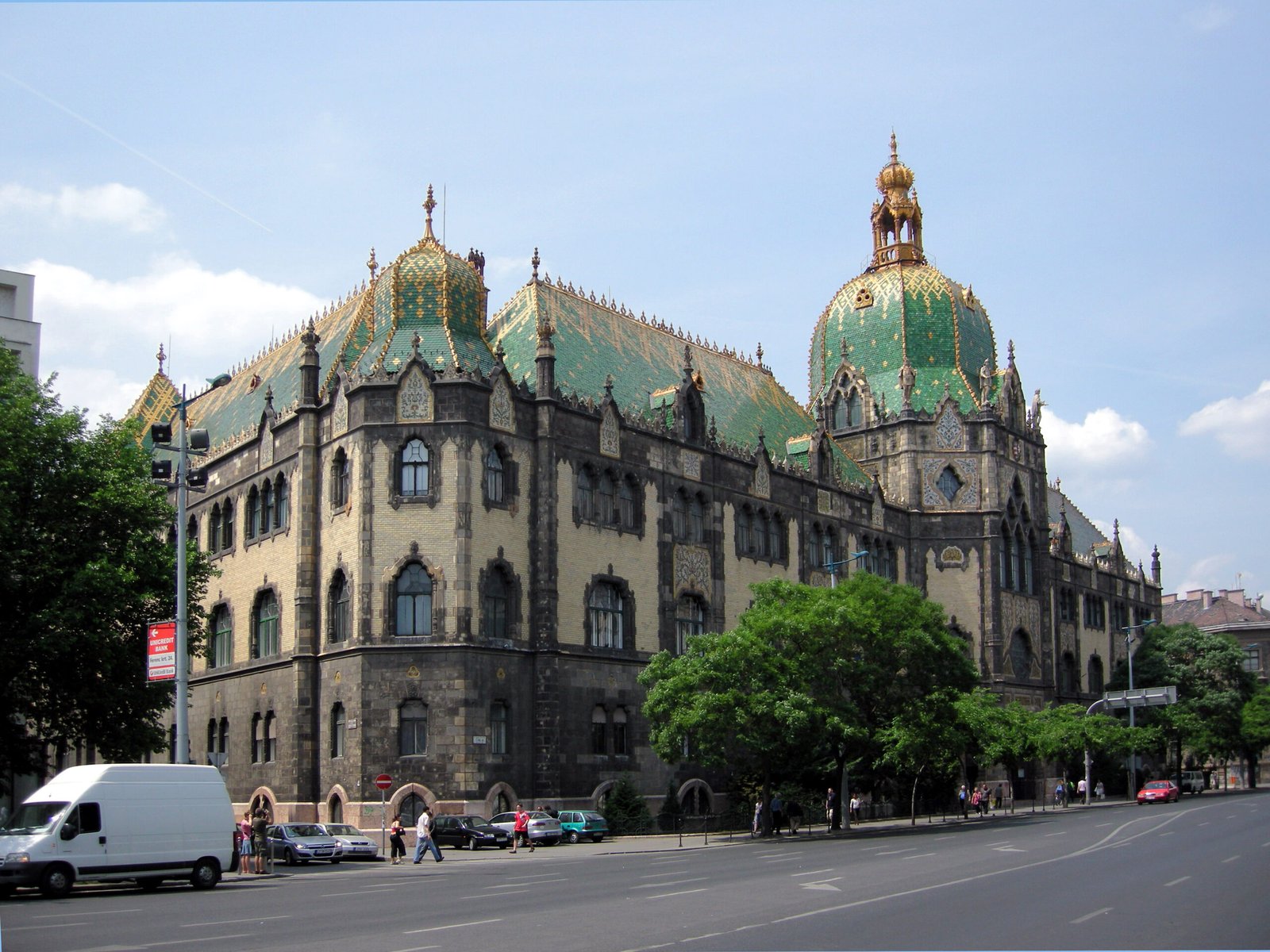
Ödön Lechner’s manifesto for a Hungarian national style: a green-and-gold Zsolnay roof over a white hall where Indian and Islamic forms meet Art Nouveau.
At a glance
The Museum of Applied Arts, the third-oldest museum of its kind in the world, was founded by the Hungarian Parliament in 1872. Its building, raised between 1893 and 1896 to designs by Ödön Lechner and Gyula Pártos, opened for the millennium celebrations marking a thousand years of Hungarian settlement. Lechner set out to invent a distinctly Hungarian architecture, drawing on folk ornament and on Indian and Islamic models, and clad the whole in the glazed ceramics of the Zsolnay factory in Pécs. The roof, in green and yellow tile, is the most recognisable in the city.
Key facts
- Built: 1893–1896
- Architects: Ödön Lechner and Gyula Pártos
- Style: Hungarian Secession (Art Nouveau), with Indian and Islamic influences
- Opened: 1896, for the Hungarian millennium
- Address: Üllői út 33–37, 1091 Budapest, Hungary
- GPS: 47.486111, 19.068333 — Open in Google Maps
- Material: Zsolnay glazed ceramic roof and ornament
History
Parliament established the museum in 1872 to collect the applied arts — furniture, glass, metalwork, ceramics, textiles — on the model of London’s South Kensington (now the Victoria and Albert). Two decades later the institution received a purpose-built home. Lechner, by then the leading figure in the search for a Hungarian national style, won the commission with Pártos and delivered a building unlike anything in Central Europe: structurally up to date, with iron and glass, but dressed in pyrogranite ceramics and folk-derived ornament.
The museum opened in October 1896 in time for the millennial exhibition. It survived the twentieth century, including damage in the Second World War and the 1956 uprising, and remained a working museum of design. In recent years the building has undergone a long restoration of its ceramics and interiors.
What you see
The exterior reads as a single sculptural object: a broad symmetrical front under a great tiled dome, the surfaces patterned in green, yellow and white Zsolnay ceramic that resists soot and rain alike. The detailing — pointed arches, bulbous finials, floral motifs — fuses Hungarian folk art with forms Lechner studied from Indian Mughal architecture.
The surprise is inside. Behind the coloured shell, the central hall opens as a bright white court roofed in iron and glass, its arcades carrying lace-like plasterwork that suggests Indian and Islamic screens. The contrast between the dark, mineral exterior and the luminous interior is the building’s great effect.
Practical information
- Note: The building has been closed for major restoration in recent years — check the museum’s current status before visiting
- Exterior: The Zsolnay roof and façade are visible from Üllői út at any time
- Time needed: 20 minutes for the exterior; longer when the galleries are open
- Best light: Midday, when the glazed roof catches the sun
Getting there
The museum is on Üllői út in the ninth district, south-east of the centre. The metro station Corvin-negyed (Line M3) is at the door. From the city centre, Line M3 runs directly to it. The building anchors a stretch of Üllői út that includes other late-nineteenth-century institutional architecture.
Nearby
- Gresham Palace, on the Danube — Budapest’s other great Art Nouveau landmark
- The Great Market Hall and the Danube embankment, to the north-west
- The Hungarian National Museum, a short distance north
Sources
- Iparművészeti Múzeum (Museum of Applied Arts) — official institutional history
- Hungarian cultural heritage authority — listed monument record
- Zsolnay Manufactory, Pécs — documentation on the museum’s ceramics
Find it on the map
See this place and what’s around it →Record researched and written by Luigi De Marchi for Cultural Heritage Online, 2026.
📷 Become a Cultural Heritage Online photographer
Share your photos of places: they stay published under your name as the author. The more they're seen, the more you get noticed — and soon a contest will reward the most appreciated photos.
Log in or sign up free to add a photoIs this page about you?
This page is read by travellers and heritage enthusiasts who find it on Google. Tell us how you are connected to this place and we will take it from there.