
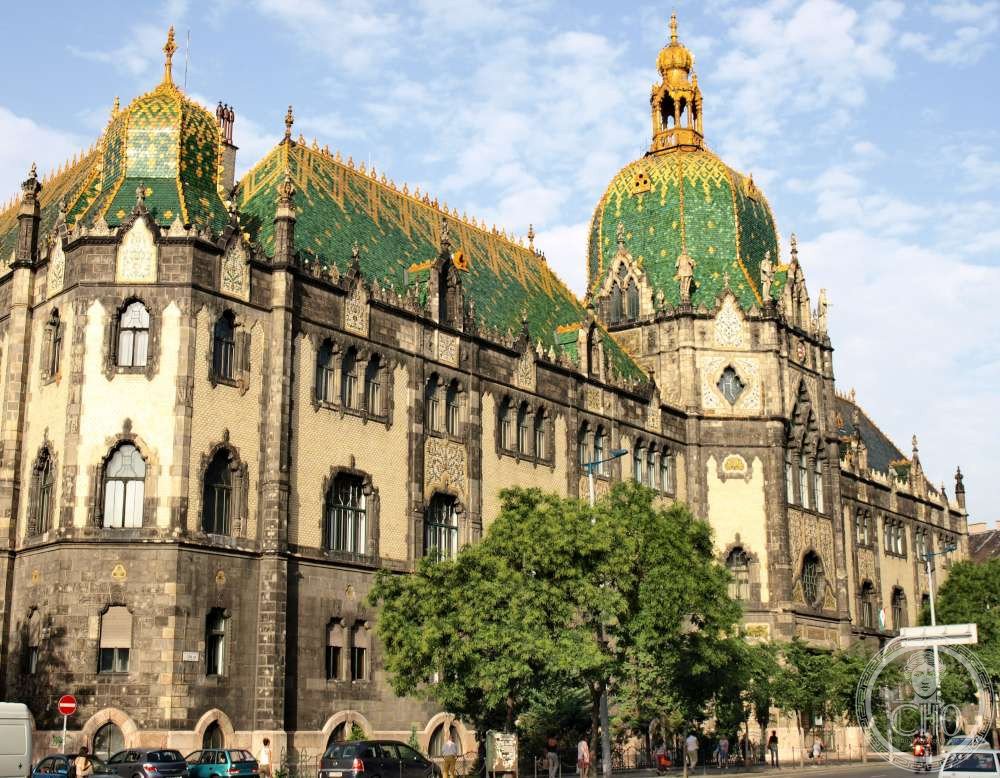
Budapest’s Art Nouveau — the Szecesszió — is unlike any other in Europe: Ödön Lechner merged Viennese Secession geometry with Magyar folk ornament and Zsolnay polychrome ceramics, producing buildings that are simultaneously rational in structure and explosively colourful in surface.
At a glance
Budapest in the 1890s was in the grip of a nationalist cultural renaissance: a Hungary that had achieved partial autonomy within the Austro-Hungarian Empire in 1867 was now searching for an architectural identity distinct from Viennese historicism. Ödön Lechner provided it. His Museum of Applied Arts (1896), the Geological Institute (1900) and the Post Office Savings Bank (1901) combined Hungarian folk textile patterns, Indian Mughal motifs and Zsolnay ceramic tiles fired at the Pécs factory into a synthesis no other European architect was attempting. Budapest also embraced the international Jugendstil mainstream — the Gresham Palace (1906) and the Gellért Baths hotel complex (1918) represent its most lavish commercial expression — making the city one of the most architecturally rich stopping points between Vienna and Riga on any Art Nouveau itinerary.
Key facts
- Country: Hungary
- Key period: 1890s–1918 (Szecesszió / Hungarian Art Nouveau)
- Key figure: Ödön Lechner (1845–1914) — architect, creator of the Hungarian National Style (Magyar stílus)
- Signature material: Zsolnay ceramics (Pécs factory) — polychrome, frost-resistant, used for roofs, tiles and ornament
- UNESCO heritage: Banks of the Danube, Buda Castle Quarter and Andrássy Avenue (World Heritage since 1987 / 2002)
- Essential sites: Museum of Applied Arts, Gresham Palace, Gellért Baths, Post Office Savings Bank, Geological Institute
History
Ödön Lechner was born in Pest in 1845 and trained in Budapest, Berlin and Paris before joining the French-influenced school of Hungarian eclecticism. His decisive break came in 1889, when he began developing a specifically Hungarian architectural vocabulary by studying Magyar folk art, Transylvanian wooden churches and — less obviously — the ceramics of the Mogul Empire, which he considered a parallel evolution of the decorative arts originating from the Central Asian homeland that linguists associate with Hungarian origins. His Museum of Applied Arts (1893–1896), built for the Hungarian Millennium celebrations, is the first major realisation of the experiment: a white-rendered structure articulated by turquoise, yellow and green Zsolnay roof tiles, with interiors that echo the structural logic of Gothic vaulting in Art Nouveau organic forms.
Parallel to Lechner’s nationalist strand, international Art Nouveau arrived in Budapest through the luxury hotel market. The Gresham Palace (1904–1906, Zsigmond Quittner) on Roosevelt Square — now the Four Seasons Hotel — is one of Europe’s most intact Art Nouveau lobbies: its wrought-iron gates, mosaic floors and stained-glass peacock windows survive entirely from the original construction. The Gellért Hotel and Baths complex (1909–1918) on the Buda riverfront combined a thermal bath tradition dating back to the Ottoman occupation with the full decorative apparatus of late Art Nouveau — mosaics, majolica tilework, skylights and sculptural fountains. Both buildings were listed as architectural monuments in the 1950s and have never been significantly altered.
What you see
The Museum of Applied Arts (Üllői út 33–37) is the essential Lechner visit: its exterior Zsolnay roof — a cascading polychrome surface of turquoise, yellow and green ceramics — is visible from the street; the interior court, covered by a glass-and-iron roof in Moorish-tinged Art Nouveau ironwork, is one of the most spatially original rooms of the period. The museum’s collection of applied arts and design is a separate attraction. The Post Office Savings Bank (Hold utca 4, now OTP Bank) is not regularly open for visits but its exterior — covered in ceramic bees, sunflowers and angels — is extraordinary from the street; Lechner is said to have placed the bee ornament because the bees would find their way there regardless of whether the building was visible from ground level.
The Gresham Palace Four Seasons (Roosevelt tér 5–6) admits non-guests to its lobby and bar: the peacock-gate wrought iron, the mosaic floor and the stained glass of the staircase hall are freely visible during hotel hours. The Gellért Baths (Kelenhegyi út 4) require a bathing ticket to enter; the main pool’s barrel-vaulted arcade and the outdoor wave pool terrace are worth the price regardless of whether you intend to swim.
Practical information
- Museum of Applied Arts: open Tue–Sun 10:00–18:00; iparművészeti.hu
- Gellért Baths: open daily from 06:00; tickets from HUF 8,400; gellertfurdo.hu
- Budapest Card: covers public transport and discounts at most museums
- Currency: Hungarian forint (HUF); cards accepted almost everywhere
- Time needed: 2 days for a complete Art Nouveau + Szecesszió itinerary
Getting there
Budapest Ferenc Liszt International Airport (BUD) is 16 km southeast of the centre; bus 100E runs non-stop to Deák Ferenc tér (40 min, HUF 3,000). Metro M4 (green) connects the Museum of Applied Arts area (Kálvin tér) to the city centre in 5 minutes. Direct trains connect Budapest Keleti to Vienna (2h30), Bratislava (1h) and Prague (6h).
Related in CHO
- Vienna — Capital of the Vienna Secession
- Prague — Alphonse Mucha and Czech Art Nouveau
- Riga — The World Capital of Art Nouveau
Sources
Find it on the map
See this place and what’s around it →Events here — now on & upcoming
- Birth Anniversary: Ödön Lechner — August 27, 184527 Aug 2027See the event →
- Death Anniversary: Ödön Lechner — June 10, 191410 Jun 2027See the event →
- Credo in Concrete — a tour of Central European University's Nádor Street campus with KÉK, Budapest18 Oct 2026See the event →
📷 Become a Cultural Heritage Online photographer
Share your photos of places: they stay published under your name as the author. The more they're seen, the more you get noticed — and soon a contest will reward the most appreciated photos.
Log in or sign up free to add a photo