
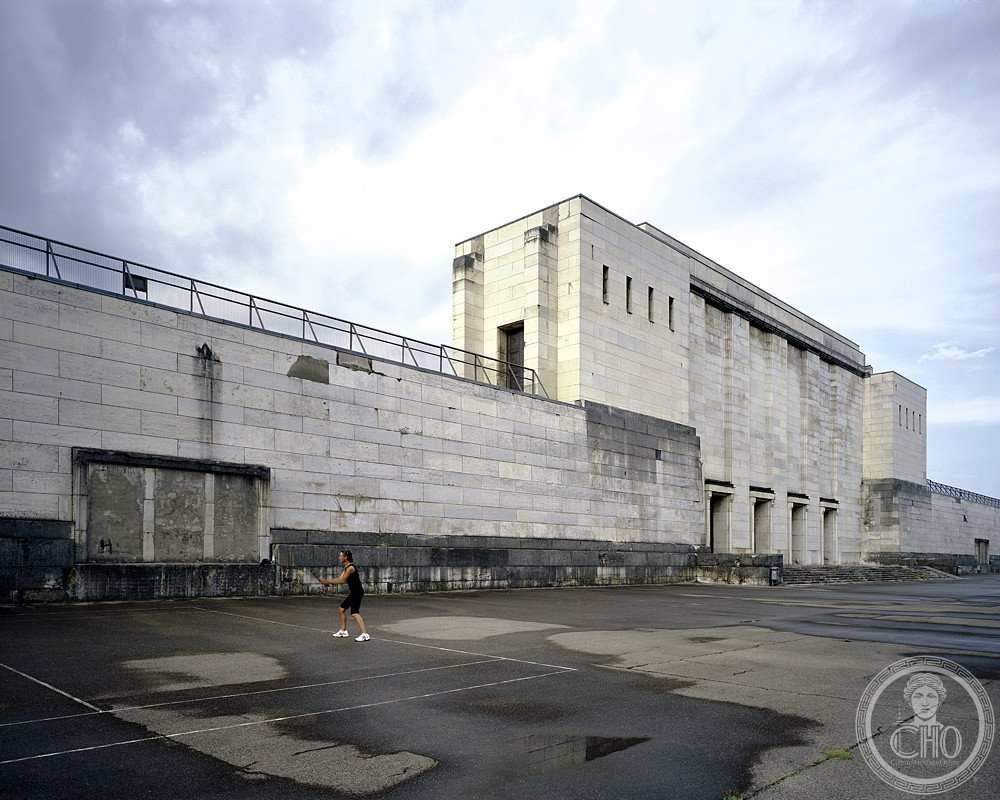
Standing at the southern end of the Nazi Party Rally Grounds in Nuremberg, the Zeppelin Field grandstand is among the most powerful and unsettling monuments of the twentieth century: a grandstand roughly 360–370 metres long where Adolf Hitler addressed mass rallies of up to 200,000 people, and where Leni Riefenstahl filmed the defining images of Nazi spectacle in her 1935 film Triumph of the Will. Designed by Albert Speer and modelled on the ancient Altar of Pergamon — itself a monument excavated to Berlin — the grandstand bristled with 34 stone towers and 70,000 flag holders, transforming politics into theatre on an imperial scale. On 22 April 1945, US Army troops held a victory parade on the field before blowing up the swastika crowning the grandstand — a symbolic act filmed for newsreels — and the grounds later found a mundane postwar life as a motor-racing circuit still run today. Since 2024 the grandstand and field have been under a long-term conservation programme, closed to visitors while the city stabilises rather than restores the structure; the wider rally grounds and the documentation centre remain open.
At a glance
- Type
- Rally ground grandstand / Heritage monument
- Period
- 1934–1937 (construction); rallies 1933–1938
- Style
- National Socialist Architecture / Stripped Classicism
- Location
- Zeppelinstraße 100, 90471 Nuremberg, Germany
- Coordinates
- 49.4214° N, 11.1221° E
- Architect(s)
- Albert Speer
Overview
The Nazi Party Rally Grounds covered approximately 11 square kilometres of southeast Nuremberg, making them the largest surviving complex of Nazi-era architecture in the world. The Zeppelin Field — named for an early aviation display held there before WWI — was the centrepiece: its grandstand modelled by Albert Speer on the Altar of Pergamon, a Hellenistic monument excavated to Berlin in the 1870s. The grandstand’s length is given as 360 metres by the site’s documentation centre and 370 metres in the city’s own chronology; the field itself, at roughly 312 by 285 metres, is described by the documentation centre as larger than twelve football pitches, with a capacity of up to 200,000 people at mass events. Speer added a dramatic lighting scheme using anti-aircraft searchlights aimed vertically into the sky — the documentation centre’s own figure is 130 searchlights, though other accounts give 152 — the «Cathedral of Light» that became one of the most reproduced images of the Nazi period. Today the grandstand is under active conservation, its façade and steps significantly damaged: an estimated one-fifth of the façade stones and three-fifths of the natural-stone steps are destroyed, and the interior ceilings currently rest on temporary wooden supports pending repair.
History
The Nazi Party chose Nuremberg as the site of its annual rallies in 1933 partly for its medieval Germanic associations and partly for its excellent rail links. Speer was commissioned to redesign the existing Rally Grounds on a colossal scale; work on the Zeppelin Field grandstand began in 1934 and was substantially complete by 1937. Six major rallies were held here between 1933 and 1938, each a choreographed spectacle of flags, searchlights, and mass formations; at the 1936 rally the documentation centre’s own figures record roughly 90,000 political leaders massed on the field before 70,000 spectators on the stands. Riefenstahl’s Triumph of the Will (1935) fixed these images permanently in global consciousness. The 1938 rally — Rally of Greater Germany — was the last; the 1939 rally was cancelled on the eve of war. In April 1945 American forces captured Nuremberg and held a victory parade on the grandstand before engineers dynamited the swastika from the central tower, a ceremony filmed for the world’s newsreels. The city then used the field for decades of ordinary public life: the first postwar motorcycle races were held around the grandstand on 17–18 May 1947, drawing 60,000 spectators on fuel supplied by the American occupation authorities, and the race that grew from them, the Norisring, still runs here every July. Rock concerts followed from the late 1970s, including a Bob Dylan show on 1 July 1978; in 1967 the city demolished the grandstand’s open colonnade, citing structural deterioration, in a decision that caused sharp public controversy at the time. The US Army continued to use the field as sports and parade ground until returning it to the city on 30 June 1995.
Architecture & Design
Speer’s design for Zeppelin Field was an exercise in deliberate historical quotation. The grandstand’s colonnaded profile was derived directly from the Altar of Pergamon — a second-century BC monument that had been excavated by German archaeologists and reconstructed in Berlin’s Pergamon Museum. By quoting this ancient monument at monumental scale, Speer linked the Nazi regime to classical antiquity and to German scholarly prestige simultaneously. The grandstand’s 34 towers were designed to carry the flags of Nazi Party formations, and the 70,000 individual flag holders along the parapet created an unbroken wall of colour when the stands were full. The podium projection — where Hitler stood — was designed for maximum theatrical effect, placing the speaker above and apart from the crowd while remaining visually connected to the grandstand mass behind him.
Cultural significance
The Zeppelin Field is one of the most important sites in the study of political architecture and mass propaganda. Speer’s understanding that architecture could be weaponised — that scale, symmetry, and historical allusion could induce awe and submission in crowds — was unprecedented in its self-consciousness and its effectiveness. The images produced here by Riefenstahl remain among the most studied examples of film propaganda ever made. At the same time, the postwar history of the site — motor racing, rock concerts, and now a documentation centre — illustrates the difficulty of repurposing buildings whose original meaning was violence. Julius Posener’s description of the Rally Grounds as the most visible and threatening ruins in all of Europe captures their continuing power to disturb.
Who tells it, and where the accounts diverge
Speer’s own postwar memoirs claimed the Cathedral of Light as his personal and most enduring achievement — the one spatial creation, in his words, that outlasted its own time. The documentation centre that now occupies the grounds contests the originality of that claim directly: comparable searchlight displays had already been staged at other regime events, including the 1933 harvest festival at Bückeberg, and the searchlights themselves were borrowed hardware from Hermann Göring’s air ministry, not an architectural material Speer invented. The British ambassador’s often-quoted description of a «cathedral of ice» is presented by the documentation centre as a diplomat’s brief enthusiasm, not an endorsement that held.
The city’s own decisions about the site have shifted more than once. The 1967 demolition of the grandstand’s colonnade, justified at the time as a safety measure, was controversial even then; three decades later the city committed instead to a policy — reaffirmed after a 2015 symposium pointedly titled «Preserve! For what?» — of securing the structure exactly as it stands, without restoration or reconstruction, so that the ruin itself remains legible as evidence. That policy is currently funded at some 85 million euros, three-quarters from the federal and Bavarian governments, over a project the city expects to complete around 2030.
Media
Street View — a 360° panorama facing the Zeppelintribüne.
Video — Museen der Stadt Nürnberg, «Vom Luitpoldhain zur Zeppelintribüne».
Historical footage — US Army film, April 1945, the demolition of the swastika atop the grandstand.


Visiting today
The Zeppelin Field grandstand and field are currently closed to visitors for the conservation works under way since 2024: the city’s own visitor information gives the tribune as accessible again from around September 2028 and the field from around the first quarter of 2031. In the meantime, the wider rally grounds remain freely open, with 23 outdoor information stations across the site and an app offering 360-degree panoramas. The Documentation Centre Nazi Party Rally Grounds (Dokumentationszentrum Reichsparteitagsgelände), housed inside the unfinished Congress Hall nearby, reopened in trial operation in May 2026 with a new permanent exhibition, with a full public opening planned for November 2026; it remains one of the most rigorous museum treatments of Nazi history in Germany. Entry fees apply for the Documentation Centre; the outdoor grounds are freely accessible.
Getting there
Tram line 9 from Nuremberg city centre stops at Doku-Zentrum, a short walk from the grandstand. The site is approximately 4 kilometres southeast of Nuremberg Hauptbahnhof. Car parking is available on site. The Documentation Centre is well signposted from the city centre. Nuremberg is served by regular ICE and IC trains from Munich (1 hour), Frankfurt (2 hours), and Berlin (3 hours).
Sources & resources
Find it on the map
See this place and what’s around it →Record researched and written by Luigi De Marchi for Cultural Heritage Online, 2026.
📷 Become a Cultural Heritage Online photographer
Share your photos of places: they stay published under your name as the author. The more they're seen, the more you get noticed — and soon a contest will reward the most appreciated photos.
Log in or sign up free to add a photoIs this page about you?
This page is read by travellers and heritage enthusiasts who find it on Google. Tell us how you are connected to this place and we will take it from there.