
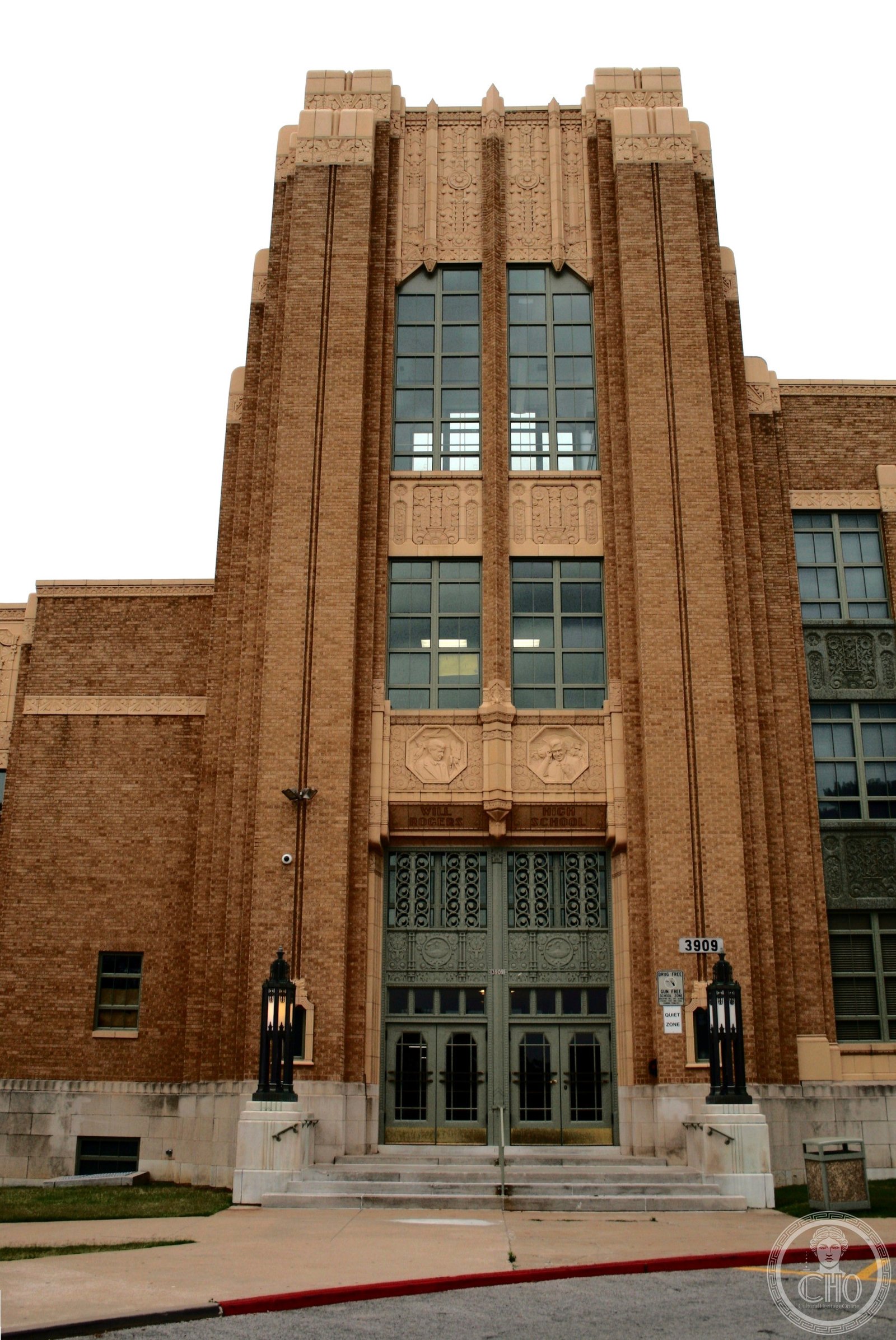
A three-story Art Deco public school at 3909 East 5th Place in Tulsa — built in 1939 using WPA workers by architects Joseph R. Koberling Jr. and Leon B. Senter, recognized by the National Park Service as one of the finest examples of Art Deco high school architecture in the United States, and named for the Oklahoma-born humorist Will Rogers.
At a glance
Will Rogers High School stands at 3909 East 5th Place in Tulsa, Oklahoma, on a 26.984-acre campus in a residential neighborhood east of downtown. Built in 1939 with funding from the federal Public Works Administration and constructed using WPA workers, the three-story-plus-basement Art Deco building was designed by Joseph R. Koberling Jr. and Leon B. Senter — two of the architects most responsible for the distinctive Art Deco character that Tulsa’s oil boom of the 1920s and 1930s produced across the city’s civic and commercial buildings. Named for the Cherokee Nation humorist, actor, and social commentator Will Rogers, who died in an Alaska plane crash with aviator Wiley Post in 1935, the school was added to the National Register of Historic Places on September 6, 2007 with a national significance designation. The National Park Service has called it one of the best examples of Art Deco high school architecture in the United States.
Key facts
- Built: 1939
- Style: Art Deco
- Architects: Joseph R. Koberling, Jr. and Leon B. Senter
- Construction method: Built using WPA (Works Progress Administration) workers; funded by PWA (Public Works Administration) grant received October 22, 1936
- Building: Basement plus three stories
- Campus: 26.984 acres (10.920 ha) in east Tulsa residential area
- NRHP area (building and immediate grounds): 3.3 acres
- Named for: Will Rogers (1879–1935) — Cherokee Nation humorist, silent-film and radio star, syndicated newspaper columnist, and social critic; died in August 1935 in an Alaska plane crash with aviator Wiley Post
- School colors: Royal blue and gold; mascot: the Ropers
- Enrollment (2008): Approximately 1,000 students; over 39,000 alumni
- NRHP: September 6, 2007 (ref. 07000918; national significance; “one of the best examples of Art Deco high school architecture in the United States” — National Park Service)
- Current designation: Will Rogers College Middle and High School (since 2011 dual enrollment program conversion)
- Address: 3909 East 5th Place, Tulsa, Oklahoma 74112
- GPS: 36.153833, −95.933272
History
By the 1930s, Tulsa had become one of the wealthiest cities per capita in the United States, the capital of the American oil industry and a place where the revenues of the petroleum economy were translated directly into civic architecture of unusual ambition. The city had built three senior high schools by 1920 — Central in the downtown area, Booker T. Washington in North Tulsa, and Clinton in West Tulsa — but by the mid-1930s, the population growth that the oil boom had driven into the city’s eastern neighborhoods had created demand for a fourth. The Tulsa School District purchased the 26.984-acre site in September 1936, the same month that the federal Public Works Administration approved the grant that would fund the building. Bids were opened in July 1937; construction began using Works Progress Administration labor.
The architects were Joseph R. Koberling Jr. and Leon B. Senter, two figures central to Tulsa’s Art Deco building program of the late 1920s and 1930s. Senter had designed the Philcade Building (1931), one of the masterpieces of Tulsa Art Deco and a National Register property. Koberling had worked on the Medical and Dental Arts Building and was known for his ability to translate the Deco idiom from the commercial skyscraper scale to the scale of civic and institutional buildings. Their design for Rogers High School — completed in 1939 — was named for the Cherokee Nation humorist, film star, radio personality, and syndicated columnist Will Rogers, who had died in an Alaska plane crash four years earlier alongside the aviator Wiley Post. The school’s Roper mascot and blue-and-gold colors referenced Rogers’s identity as a ranching man who could rope cattle and spin a lasso as easily as he could deliver a one-liner.
The building was added to the National Register of Historic Places on September 6, 2007 with a designation of national significance — a classification that placed it in the company of the most important historic properties in the United States rather than merely in its state or region. The National Park Service citation identified it as one of the best examples of Art Deco high school architecture in the United States, a judgment that reflects the ambition of the design and the quality of its execution. In 2011, Tulsa Public Schools converted Rogers to a dual enrollment institution, allowing students to complete up to 66 college credits — the equivalent of an associate degree — through the program. The school was renamed Will Rogers College Middle and High School in connection with the conversion, though the historic building retains its original character.
What you see
The school presents its Art Deco character primarily through its main entrance facade, where the Deco design vocabulary is expressed at two scales simultaneously: the large-scale massing of the three-story brick volume with its controlled vertical proportions and its emphasis on the entry pavilion as the building’s organizing gesture; and the fine-scale decorative program of terra cotta relief panels that concentrate ornament at the points of entry and at the cornice line. The building’s brick surface — warm buff against the greenery of its campus — is characteristic of the WPA/PWA institutional buildings of the late 1930s, a material choice that grounded the Deco stylism in the tactile quality of regional masonry. The Art Deco treatment of the facade is restrained by the standards of the late 1920s commercial Deco that Senter had produced in his office towers, translating the high-style vocabulary into forms appropriate to an educational institution.
The school’s identity is inseparable from the figure it commemorates: Will Rogers, the Cherokee Nation performer and public intellectual whose life — born in Indian Territory in 1879 to a ranching family, educated at schools for Cherokee students, performer with circuses and Wild West shows before becoming the most widely read newspaper columnist in America — is encoded in the ornamental program at the entry and in the school’s traditions. The mascot, the Ropers, commemorates the lasso skills that first brought Rogers to public attention. The school sits on the east side of Tulsa in a residential neighborhood that developed in the 1920s and 1930s as the oil industry’s employees and professionals moved into the city’s expanding eastern grid — a neighborhood whose character reflects the same oil-era prosperity that funded the school.
Practical information
- Will Rogers High School is an active public school; the campus and building exterior are accessible during school hours for visitors interested in the architecture.
- The building is best viewed from East 5th Place (the street frontage) and from the main campus approach.
- The NRHP designation plaque is at the main entrance.
- Tulsa’s Art Deco heritage is extensive; the Tulsa Art Deco Museum (in the Philcade Building, listed on NRHP) provides comprehensive context for the city’s remarkable concentration of 1920s-1930s Deco architecture.
Getting there
Will Rogers High School is at 3909 East 5th Place in Tulsa, Oklahoma. Tulsa International Airport (TUL) is approximately 9 miles northeast of downtown Tulsa. The Metropolitan Tulsa Transit Authority (MTTA) serves the city by bus; routes serve the midtown and eastern neighborhoods. By car, US-169 and OK-51 (the Broken Arrow Expressway) are the major east-west arteries serving east Tulsa; East 5th Place is accessible from the 33rd East Avenue exit of OK-51. The school is approximately 4 miles east of downtown Tulsa and 2 miles north of the Utica Square shopping district. The Boston Avenue Methodist Church (National Historic Landmark, 1929) and the Philcade Building (NRHP, 1931) are among the central Art Deco buildings accessible on the same half-day tour of Tulsa architecture.
Nearby
- Boston Avenue Methodist Church (1929) — approximately 4 miles west at 1301 South Boston Avenue; National Historic Landmark and one of the finest Art Deco ecclesiastical buildings in the United States, designed by Adah Robinson and Bruce Goff in a building program that established the church as the visual centerpiece of Tulsa’s Art Deco heritage; the 255-foot tower with its Art Deco spire is visible from much of midtown Tulsa
- Philcade Building (1931) — approximately 4 miles west at 511 South Boston Avenue; National Register listed; designed by Leon B. Senter (one of the co-architects of Will Rogers High School), this 14-story office tower is one of the most accomplished Art Deco commercial buildings in the region; now home to the Tulsa Art Deco Museum
- Greenwood District / Greenwood Cultural Center — approximately 4 miles northwest; the historic Greenwood Avenue corridor that was home to the “Black Wall Street” commercial district before the Tulsa Race Massacre of May 31–June 1, 1921, which destroyed 35 blocks of the neighborhood; the Greenwood Cultural Center now anchors a commemorative district that includes the Greenwood Rising History Center (2021) and memorials to the massacre’s victims
Sources
- Wikipedia: “Will Rogers High School” (Tulsa, Oklahoma)
- Wikipedia: “List of Art Deco buildings in Tulsa, Oklahoma”
- National Register of Historic Places: Will Rogers High School, ref. 07000918, National Park Service (September 6, 2007)
- Wikimedia Commons: Will_Rogers_High_School.jpg, CC BY-SA 4.0, ExqBoredinNac
Find it on the map
See this place and what’s around it →Record researched and written by Luigi De Marchi for Cultural Heritage Online, 2026.
📷 Become a Cultural Heritage Online photographer
Share your photos of places: they stay published under your name as the author. The more they're seen, the more you get noticed — and soon a contest will reward the most appreciated photos.
Log in or sign up free to add a photoIs this page about you?
This page is read by travellers and heritage enthusiasts who find it on Google. Tell us how you are connected to this place and we will take it from there.