
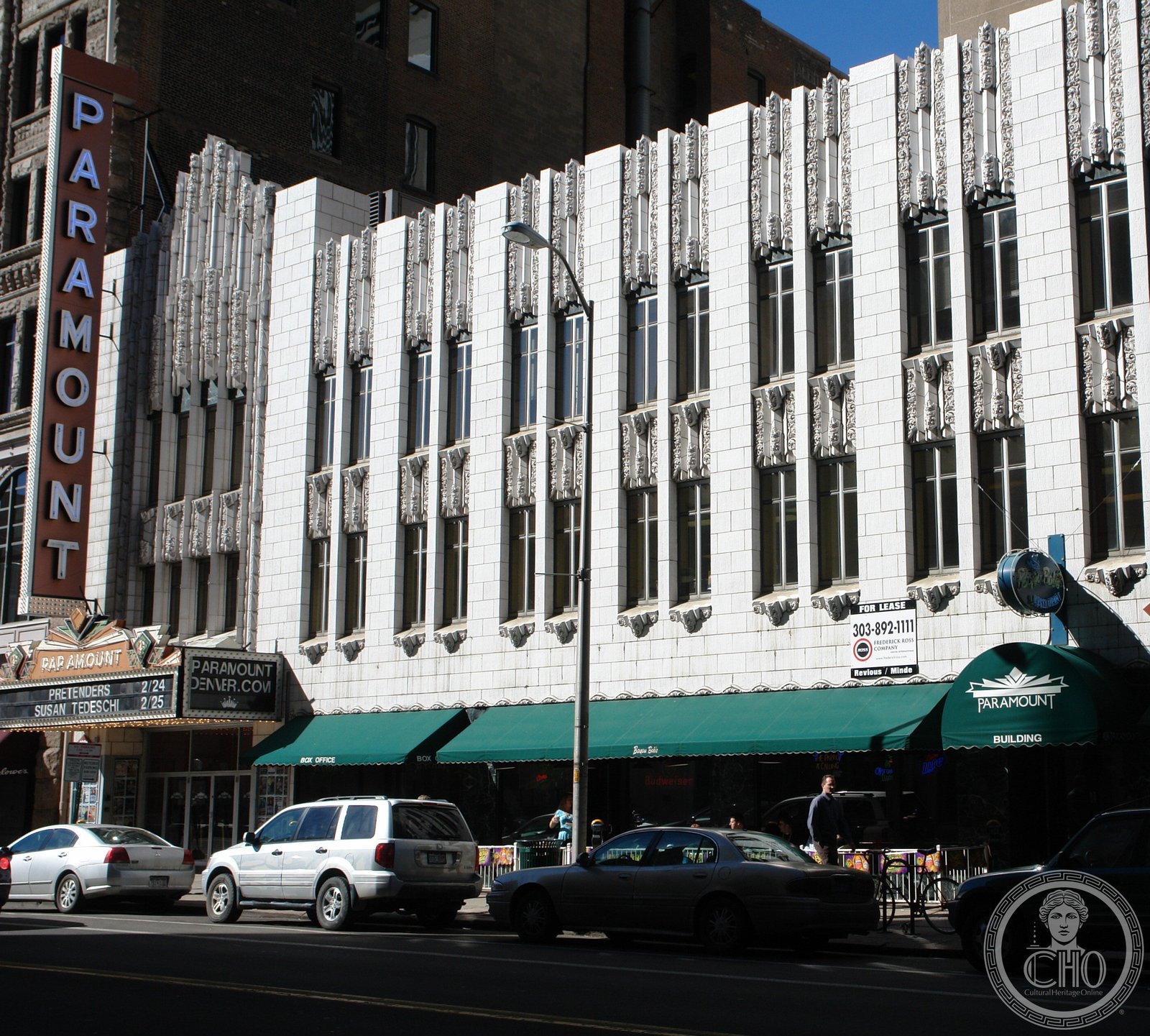
A 1930 Art Deco concert venue on Glenarm Place in Denver — designed by the Chicago firm Rapp & Rapp with murals by Louis Grell and one of only two remaining twin-console Wurlitzer theatre organs in the United States, now hosting major concerts and events for Kroenke Sports & Entertainment.
At a glance
The Paramount Theatre stands on Glenarm Place near the 16th Street Mall in downtown Denver, Colorado. Built in 1930 by the Chicago firm Rapp & Rapp — the architectural practice that designed the most influential movie palaces of the 1920s and that here produced an Art Deco interior with decorative work by Vincent Mondo and murals by Louis Grell of Chicago — the 1,870-seat theater was originally the flagship venue of the Paramount-Publix Theatre Circuit. Listed on the National Register of Historic Places on November 21, 1980 (ref. 80000893) and designated a Denver Historic Landmark in 1988, the Paramount now operates as a concert venue under Kroenke Sports & Entertainment. Its most celebrated possession is the Wurlitzer Opus 2122 — one of only two remaining twin-console theatre organs in the United States, the other being at Radio City Music Hall in New York — installed on July 23, 1930 with its 1,600-plus pipes and four-manual keyboard, restored by the American Theatre Organ Society in 2012.
Key facts
- Built: 1930
- Style: Art Deco
- Architects: Rapp & Rapp, Chicago (theatre); Temple H. Buell (office/commercial building with main entrance — “a modernized, Art Deco interpretation of the Gothic style” in cast concrete and white terra cotta)
- Decorative artists: Vincent Mondo (interior decorations); Louis Grell of Chicago (murals)
- Seating: 1,870 (current)
- Original operator: Paramount-Publix Theatre Circuit (Paramount Pictures’ exhibition arm)
- Wurlitzer organ: Opus 2122, Publix #1 style; four manuals, 21 ranks; 1,600+ pipes; installed July 23, 1930; designed by Jesse Crawford; one of only two remaining twin-console Wurlitzers in the US (the other: Radio City Music Hall)
- NRHP: November 21, 1980 (ref. 80000893)
- Colorado State Register: No. 5DV.190
- Denver Historic Landmark: 1988
- Current owner/operator: Kroenke Sports & Entertainment (since 2002)
- Address: Glenarm Place, Denver, Colorado 80202
- GPS: 39.74442, −104.99021
History
The Paramount Theatre in Denver was a product of the most confident moment in American movie palace construction. Rapp & Rapp, the Chicago firm that designed the building, had been at the center of the movie palace boom since the early 1920s: their Paramount Theatre in New York (1926), their Chicago Theatre (1921), and the series of regional Paramount theaters they produced for the Balaban & Katz circuit had made them the most influential architects of large-scale entertainment venues in the country. The Denver Paramount — commissioned by the Paramount-Publix Theatre Circuit, which was Paramount Pictures’ national theater exhibition arm — opened in 1930 as the flagship cinema venue of the Rocky Mountain region, its capacity of nearly 2,000 seats positioning it as the dominant entertainment destination in Denver’s rapidly expanding downtown.
The Wurlitzer organ installed on July 23, 1930 was the instrument that defined the Paramount’s cultural identity from the beginning. Designed by Jesse Crawford — the most famous theater organist of the silent film era — the Opus 2122, a Publix #1 style twin-console instrument with four manuals and twenty-one ranks of pipes, was one of the most sophisticated theater organs ever installed. Its twin-console format — allowing two organists to play simultaneously, or one organist to switch between consoles at each side of the stage — was a technological feat that made the Paramount’s organ program more elaborate than anything available elsewhere in the region. When the sound revolution made theater organs obsolete in the early 1930s, the Paramount’s Wurlitzer remained in place, its 1,600 pipes silent through the decades of cinema operation that followed.
The theater’s transition from movie palace to concert venue mirrors the history of the American city movie palace more broadly. By 1978, the Paramount was Denver’s last remaining movie palace; in October of that year, the Denver Opera Company opened a season of Madama Butterfly there, initiating the building’s second life as a live performance venue. The 2002 acquisition by Kroenke Sports & Entertainment consolidated its position as one of the Rocky Mountain region’s premier concert destinations. The 2012 restoration of the Wurlitzer’s Vox Humana rank by the American Theatre Organ Society’s Rocky Mountain chapter — using a donated pipe chest from the former Phoenix Organ Stop — returned the organ to its original specification, completing a circle of preservation that the theater’s NRHP listing and Denver landmark designation had begun.
What you see
The Paramount Theatre’s architecture is a collaboration between two distinct designers working at different scales. The main theater interior — Rapp & Rapp’s domain — is organized around the Art Deco vocabulary of vertical emphasis, geometric ornament, and the carefully calibrated drama of entry sequence: you move from the street through the lobby of Temple H. Buell’s adjacent office building — described as “a modernized, Art Deco interpretation of the Gothic style, executed largely in cast concrete and white terra cotta” — and into the auditorium, where Vincent Mondo’s decorative program and Louis Grell’s murals define an interior that aims for the heightened unreality that movie palace design required. The Wurlitzer organ consoles, one at each side of the stage, are the most distinctive visual element of the auditorium: twin wooden cases that frame the proscenium and announce the building’s commitment to the full theatrical experience of the silent film era.
The exterior, facing Glenarm Place, is Buell’s work: the concrete and white terra cotta of his “Art Deco Gothic” composition provides the building’s public face toward the 16th Street Mall corridor. The signage — the Paramount name in Art Deco lettering, the marquee that announces the current show — gives the building the identity that its quiet Gothic-inflected exterior might otherwise withhold. As a concert venue, the Paramount’s intimacy — 1,870 seats in a space designed for an audience that came to see as well as hear — is its principal asset: a hall where the line-of-sight to the stage from any seat is clear, and where the acoustic properties of a purpose-built entertainment venue serve the demands of contemporary live performance as well as they served the 1930 film program.
Practical information
- The Paramount Theatre is an active concert venue; tickets are available through Kroenke Sports & Entertainment and standard ticketing platforms.
- The Wurlitzer organ is occasionally featured in special concert events; check the venue’s programming calendar for organ performances.
- The theater is adjacent to the 16th Street Mall, Denver’s pedestrian and transit mall; free MallRide buses run the length of the mall connecting Union Station to Civic Center.
Getting there
The Paramount Theatre is on Glenarm Place near the 16th Street Mall in downtown Denver, Colorado. Denver International Airport (DEN) is approximately 24 miles northeast of downtown via Interstate 70 or the University of Colorado A Line commuter rail (Union Station terminus, approximately 5 blocks from the Paramount). RTD Light Rail serves downtown Denver extensively; the 16th Street Station on the W, E, and R lines is a short walk from the theater. By car, Interstate 25 and Interstate 70 serve downtown Denver; the Colfax Avenue and Speer Boulevard exits provide the most direct access to the 16th Street Mall corridor. The Paramount is a 5-minute walk from Denver’s Larimer Square historic district and a 10-minute walk from Union Station.
Nearby
- Larimer Square — approximately 4 blocks southwest; the 1400 block of Larimer Street, Denver’s oldest commercial block (1858–1882), preserved as a historic district in 1971; Victorian commercial buildings now housing restaurants, galleries, and retail; the starting point of Denver’s preservation movement and the city’s most architecturally coherent historic streetscape
- Denver Art Museum — approximately 10 blocks south via Broadway at 100 West 14th Avenue Parkway; a major encyclopedic art museum with notable collections of Native American art and Western American art; the building complex includes Gio Ponti’s 1971 castle-like North Building and Daniel Libeskind’s 2006 Frederick C. Hamilton Building addition
- Brown Palace Hotel (1892) — approximately 3 blocks southeast at 321 17th Street; the landmark triangular Victorian hotel built by Henry Cordes Brown, designed by Frank Edbrooke, with its nine-story atrium lobby and onyx-paneled walls; a National Historic Landmark and one of the continuously operating grand hotels of the American West
Sources
- Wikipedia: “Paramount Theatre (Denver)”
- National Register of Historic Places: Paramount Theatre, Denver, ref. 80000893, National Park Service (November 21, 1980)
- Colorado State Historical Society: Colorado State Register No. 5DV.190
- American Theatre Organ Society Rocky Mountain Chapter: Wurlitzer Opus 2122 restoration documentation
- Wikimedia Commons: Paramount_Theater_Denver_CO.jpg, CC BY-SA 3.0, Hustvedt
Find it on the map
See this place and what’s around it →Record researched and written by Luigi De Marchi for Cultural Heritage Online, 2026.
📷 Become a Cultural Heritage Online photographer
Share your photos of places: they stay published under your name as the author. The more they're seen, the more you get noticed — and soon a contest will reward the most appreciated photos.
Log in or sign up free to add a photoIs this page about you?
This page is read by travellers and heritage enthusiasts who find it on Google. Tell us how you are connected to this place and we will take it from there.