
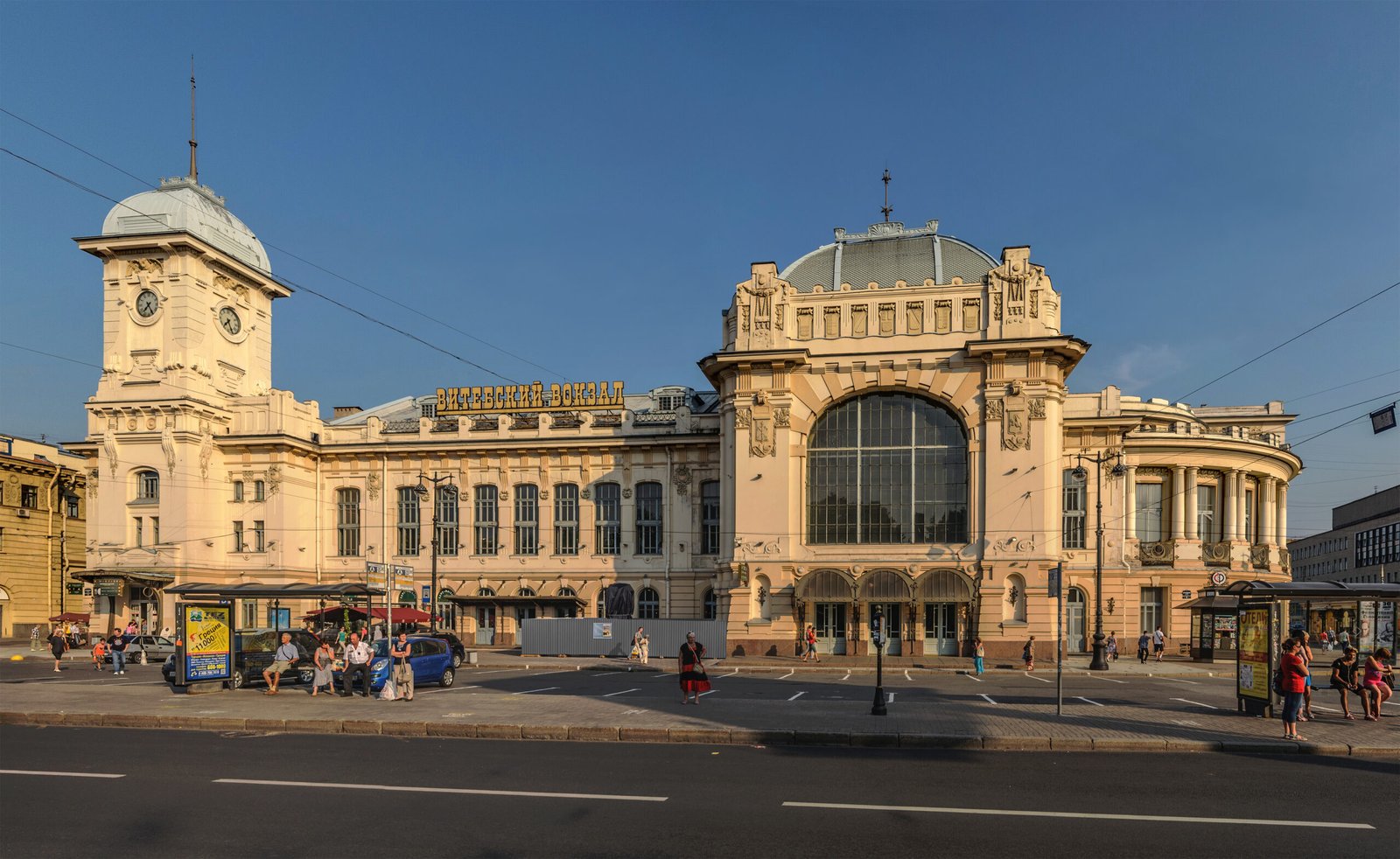
On the site of Russia’s first railway line (1837) — born as a wooden shed beside the Tsar’s private line — the present 1904 building is Saint Petersburg’s most ornate monument to the Style Moderne.
At a glance
Built between 1901 and 1904 at 52 Zagorodny Prospekt, Vitebsky Station is an active intercity and suburban railway terminal serving trains south and west of Saint Petersburg. Its exterior, designed by Stanislav Brzozowski, pairs a pseudo-Renaissance dome and a square clock tower with Jugendstil reliefs and oversized Romanesque windows. Inside, Sima Minash created the city’s most lavish station interior: sweeping marble staircases with bronze inlays, stained-glass foyers, and painted murals chronicling the birth of Russian railways.
Key facts
- Address: 52 Zagorodny Prospekt, Saint Petersburg, Russia
- Built: 1901–1904 (current building); original station 1837
- Architects: Stanislav Antonovich Brzozowski (exterior); Sima Isaakovich Minash (interiors)
- Style: Style Moderne (Russian Art Nouveau)
- Historical distinction: Site of Russia’s first railway departure, 30 October 1837
- Current use: Active passenger terminus — intercity and suburban services
- Heritage status: Protected cultural monument, Russian Federation
History
On 30 October 1837, a steam locomotive named Provorny (‘Swift’) pulled the first train in Russia out of a modest timber station on this site, carrying Tsar Nicholas I and his court the 23 kilometres south to Tsarskoye Selo. That inaugural journey placed Saint Petersburg — and the Russian Empire — into the age of steam. The architect Konstantin Ton designed the original wooden terminus in the summer of 1837; a permanent stone replacement followed in 1849–51, reconstructed again in the 1870s.
By the turn of the twentieth century the station was handling far more traffic than its Victorian fabric could bear. In 1902, the engineer Stanislav Antonovich Brzozowski (1863–c.1930s) received the commission to design an entirely new building in the fashionable Style Moderne idiom then sweeping Europe. Brzozowski gave the two-storey exterior a bold silhouette: a pseudo-Renaissance dome above the central hall, a tall square clock tower, outsize semicircular windows flooding the concourse with light, and façade panels of floriate Jugendstil relief work that ripple like Art Nouveau metalwork frozen in stone.
The interior commission went to the architect Sima Isaakovich Minash (1877–1945), whose work here is widely regarded as the finest station interior in the city. Minash’s great hall soars more than twenty metres high, its walls covered with painted panels by Nikolai Samokish and Ekaterina Samokish-Sudkovskaya depicting scenes from the Tsarskoye Selo Railway — Russia’s first line — from 1837 to the early twentieth century. The main staircase ascends beneath marble banisters inlaid with bronze; the foyer is lit through stained-glass windows whose organic lead lines echo the station’s botanical reliefs outside. The building opened in 1904 and was immediately recognised as the most ornate of Saint Petersburg’s five great termini.
In 1987, to mark the 150th anniversary of Russian railways, a glass pavilion was installed on the platform holding a replica of the Provorny locomotive and passenger coaches of the 1837 type. The station continues to operate under Russian Railways (RZhD), serving lines south to Pushkin (Tsarskoye Selo), Pavlovsk, and international routes toward Vitebsk and Minsk — the Belarusian connection that gave the building its present name.
What you see
The façade on Zagorodny Prospekt announces itself through contrast: the dome’s classical composure against the restless Jugendstil ornament below. Look for the large semicircular windows that draw the eye upward before the clock tower claims it. The relief panels between windows show stylised plant forms — tendrils, lilies, elongated stems — that are the grammar of Russian Style Moderne and a direct cousin of Brussels or Vienna’s Art Nouveau vocabulary. Two small turrets flank the main entrance and reinforce the station’s civic authority without tipping into pomposity.
Step inside and scale changes dramatically. Minash’s hall is cathedral-generous, the painted panels — oil on canvas, warm ochres and deep greens — running around the upper walls at a height that requires you to tilt back to read them. The bronze handrail of the main staircase rewards close inspection: the casting is intricate, botanical, entirely hand-finished. Below the stained-glass foyer, the everyday flow of commuters and intercity passengers moves through a space designed for imperial ceremony, a useful reminder that Russian Art Nouveau was as ambitious as any in Europe.
Practical information
- Status: Active railway station, open to the public at all hours of operation
- Nearest metro: Pushkinskaya (Line 1, red) — one minute on foot via the underpass connecting directly to the station
- Also close: Zvenigorodskaya (Line 5, purple) — five minutes on foot
- Time to visit: Allow 30–45 minutes to walk the concourse, examine the murals, and descend to the platform pavilion with the 1837 locomotive replica
- Entry: Free access to the public concourse; platform access requires a valid rail ticket
- Travel note: check your country’s current travel advisories for Russia before planning a visit.
Getting there
Vitebsky Station sits at the southern end of Zagorodny Prospekt in central Saint Petersburg, roughly two kilometres south of Nevsky Prospekt. The simplest approach is the metro: Pushkinskaya station (Line 1, red) connects underground directly into the terminus building — follow signs from the metro concourse and you emerge at platform level without touching the street. By tram, lines serving Zagorodny Prospekt stop immediately outside the main entrance. From the historic centre on foot, cross Sennaya Ploshchad heading south on Zagorodny Prospekt for roughly ten minutes.
Nearby
- Vladimirsky Cathedral — eighteenth-century Russian Baroque church, five minutes north on Vladimirsky Prospekt
- Dostoevsky Museum (Kuznechny Lane 5/2) — the novelist’s final apartment, ten minutes on foot; he lived steps from this station district
- Sennaya Ploshchad — one of the city’s oldest market squares and the setting of several scenes in Crime and Punishment, fifteen minutes on foot
- Tsarskoye Selo (Pushkin) — Catherine Palace and the Amber Room, reachable by suburban train from this very terminus, 30 minutes south
Sources
- Saint Petersburg Encyclopaedia (encspb.ru): Vitebsky Railway Station — architects, construction dates, artistic programme (Samokish murals)
- Bank of Russia commemorative coin documentation (cbr.ru): Vitebsky Railway Station, early 20th century — official heritage recognition
- About Art Nouveau (aboutartnouveau.wordpress.com): The Vitebsky Railway Station in St. Petersburg — Minash interior analysis
- saint-petersburg.com: Building of Vitebsk Rail Station — architectural description and Brzozowski biography
- Russia Beyond (rbth.com): The train station that saw two Tsar Nicholases and three Anna Kareninas — historical narrative and 1987 locomotive pavilion
Find it on the map
See this place and what’s around it →Record researched and written by Luigi De Marchi for Cultural Heritage Online, 2026.
📷 Become a Cultural Heritage Online photographer
Share your photos of places: they stay published under your name as the author. The more they're seen, the more you get noticed — and soon a contest will reward the most appreciated photos.
Log in or sign up free to add a photoIs this page about you?
This page is read by travellers and heritage enthusiasts who find it on Google. Tell us how you are connected to this place and we will take it from there.