
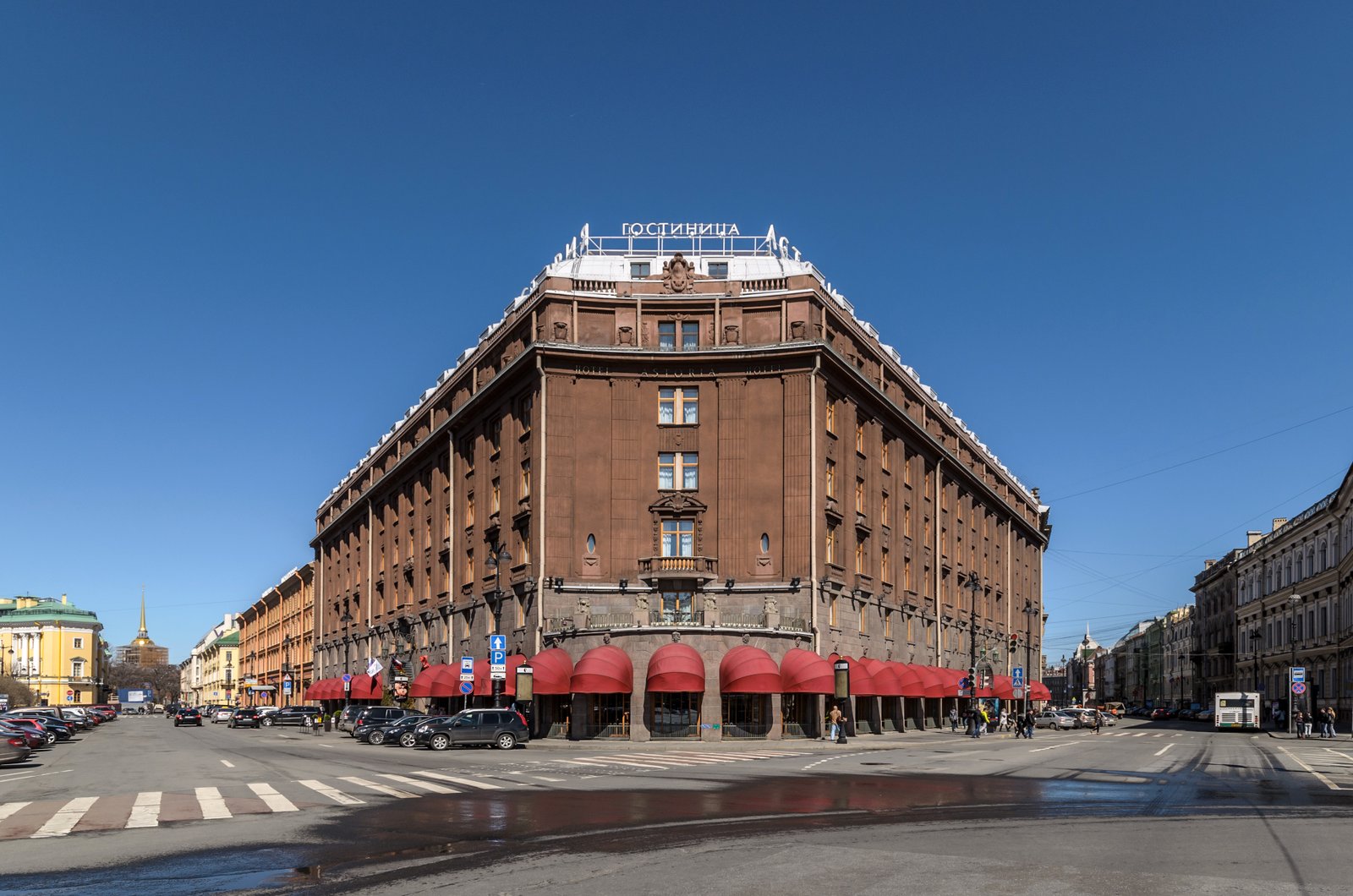
One of St Petersburg's defining addresses: a granite-clad Northern Art Nouveau building by Fyodor Lidval, opened in 1912 on St Isaac's Square and still operating as a luxury hotel.
At a glance
The Astoria stands at the southwest corner of St Isaac's Square, its reddish Vyborg granite facade curving slightly to follow the plaza. Commissioned as a world-class hotel for the Romanov tercentenary celebrations of 1913, it was conceived by a German consortium and designed by the Stockholm-born St Petersburg architect Fyodor Lidval. After more than a century of turbulent history, it continues to operate as a five-star property under Rocco Forte Hotels, which has managed it since 1997.
Key facts
- Architect: Fyodor (Fedor) Lidval (1870–1945)
- Construction: 1911–1912
- Opened: 23 December 1912
- Style: Northern Art Nouveau (Style Moderne / Nordic Jugendstil)
- Address: Bolshaya Morskaya Ulitsa 39, Saint Petersburg, Russia
- Current operator: Rocco Forte Hotels (since December 1997)
- Sister hotel: Angleterre Hotel, adjoining on the same block
History
The Astoria was built to a precise deadline. The German-funded company Weiss & Freitag engaged Fyodor Lidval in 1910 with a single purpose: deliver a hotel capable of hosting foreign dignitaries for the three-hundredth anniversary of the Romanov dynasty in May 1913. Construction began in 1911 on the site of a building known as Bristol's furnished rooms; the foundations were reinforced concrete, a rarity in St Petersburg at the time, and the interior was specified as fire-resistant throughout. The hotel opened on 23 December 1912 and received its first wave of imperial guests months later. Lidval's granite cladding, sourced from quarries in the Vyborg region of Finland, gave the building the characteristic warm rust-red tone that still sets it apart along the square.
The hotel's twentieth century was lived at the intersection of Russian history. During the First World War it served as a billet for imperial officers. In February 1917, revolutionary soldiers broke into the building and looted it; thereafter, the new Soviet administration converted it into the First House of the Petrograd Soviet, with rooms monitored by the Cheka. Lenin used it for Moscow stopovers. In 1926 it passed to Intourist management and hosted a stream of foreign visitors including the writer H. G. Wells and the American entrepreneur Armand Hammer. Through the Soviet decades the Astoria functioned as a semi-official reception venue for foreign delegations, its glamour dimmed but never entirely extinguished.
In the early 1990s, following privatisation, Finnish investors undertook a major reconstruction. Rocco Forte Hotels acquired the property in December 1997 and invested a reported $20 million in further restoration, including the adjoining Angleterre Hotel on the same block. The two buildings now operate as a single destination. Despite these transformations, the exterior Lidval designed in 1911 remains largely intact and the Astoria is listed among the architectural monuments of St Petersburg.
What you see
Lidval positioned the Astoria within the tradition of Northern Art Nouveau, a variant that filtered the organic curves of Jugendstil through a cooler, more monumental Scandinavian sensibility. The street-level base is finished in polished reddish-pink Vyborg granite; above it, the middle storeys introduce the rounded bays, shallow relief ornament, and large glazed openings characteristic of the style. The roofline is clean and horizontal, restraining the decorative impulse without suppressing it. The building reads as solid and assured rather than florid — a quality Lidval achieved consistently in his best St Petersburg commissions, including the Lidval House on Kamennoostrovksy Prospekt.
The interior has been remodelled in successive renovations, though the proportions of the principal rooms — the lobby, the Rotonda bar, and the main dining room — retain the generous scale of the original brief. St Isaac's Cathedral is directly visible from many of the rooms on the square-facing side, a view that remains one of the most recognisable in the city.
Practical information
- Status: Operating luxury hotel (Rocco Forte Hotels); open year-round
- Dining: The Astoria Restaurant and the Rotonda bar are open to non-residents; advance reservation recommended, especially for dinner
- Nearest metro: Admiralteyskaya (Line 5, purple) — approximately 650 m on foot
- Telephone: Contact via the Rocco Forte Hotels website for current reservations and bar enquiries
- Best time to visit: The façade and square are at their most dramatic in early summer (white nights, late May–July) and in winter snow
- Travel note: check your country’s current travel advisories for Russia before planning a visit.
Getting there
The hotel stands at Bolshaya Morskaya Ulitsa 39, on the southwest side of St Isaac's Square. From Admiralteyskaya metro station (Line 5), walk south along Voznesensky Prospekt for roughly ten minutes. Nevsky Prospekt is a five-minute walk to the north. The square is a recognised landmark and clearly signed; St Isaac's Cathedral dominates the immediate skyline and serves as an unmistakable orientation point.
Nearby
- St Isaac's Cathedral — immediately adjacent to the north; one of the largest domed churches in the world and a centrepiece of the square
- Angleterre Hotel — adjoining the Astoria to the west; part of the same Rocco Forte property and of similar historical significance
- Bronze Horseman (Falconet's equestrian statue of Peter the Great) — Senate Square, a five-minute walk along the embankment
- Mariinsky Theatre — approximately 1.5 km southwest; accessible on foot via Voznesensky Prospekt
Sources
- Guide For You Tours, "Hotel Astoria in St Petersburg — History, Facts" (guideforyou-russia.com, consulted June 2026)
- Rocco Forte Hotels, "The Story of Hotel Astoria" (roccofortehotels.com/hotels-and-resorts/hotel-astoria/story/)
- Wikipedia, "Fyodor Lidval" (en.wikipedia.org/wiki/Fyodor_Lidval) — architect biography
- Wikipedia, "Hotel Astoria (Saint Petersburg)" (en.wikipedia.org/wiki/Hotel_Astoria_(Saint_Petersburg)) — general overview cross-referenced
- Wikimedia Commons, "Astoria Hotel SPB.jpg" by Alex 'Florstein' Fedorov, CC BY-SA 4.0 (commons.wikimedia.org/wiki/File:Astoria_Hotel_SPB.jpg)
Find it on the map
See this place and what’s around it →Record researched and written by Luigi De Marchi for Cultural Heritage Online, 2026.
📷 Become a Cultural Heritage Online photographer
Share your photos of places: they stay published under your name as the author. The more they're seen, the more you get noticed — and soon a contest will reward the most appreciated photos.
Log in or sign up free to add a photoIs this page about you?
This page is read by travellers and heritage enthusiasts who find it on Google. Tell us how you are connected to this place and we will take it from there.