
For roughly fifteen years before the First World War, Saint Petersburg developed its own reading of Art Nouveau, known in Russian as modern. Nevsky Prospekt still carries its most public landmarks.
At a glance
Russian Style Moderne — modern in Russian — was the local strand of Art Nouveau that flourished in Saint Petersburg and Moscow between the late 1890s and the outbreak of war in 1914. The movement’s first acknowledged example in Saint Petersburg was the Hauswald summer house of 1898, by Vladimir Chagin and Vasily Schoene. Because the capital sat close to the border with the Grand Duchy of Finland, its architects absorbed the National Romantic manner of the Nordic countries, producing a restrained, granite-faced variant often called Northern Art Nouveau. Three commercial landmarks on or near Nevsky Prospekt remain the clearest places to read the style: the Singer House, the Eliseyev Emporium and the Vitebsky railway station, all built within a few years of one another.
Key facts
- Country: Russia
- Key period: c. 1898–1914
- Architects: Pavel Suzor (1844–1919), Fyodor Lidval (1870–1945), Gavriil Baranovsky, Stanisław Brzozowski
- Essential sites: Singer House (28 Nevsky Prospekt), Eliseyev Emporium (56 Nevsky Prospekt), Vitebsky railway station, Lidval House (Kamennoostrovsky Prospekt), Hotel Astoria
- Local name: modern (Style Moderne / русский модерн)
History
Art Nouveau reached Russia from several directions at once. Architects in Saint Petersburg drew on the Glasgow School, the German Jugendstil and the Vienna Secession, but they filtered these influences through the National Romantic style of the neighbouring Nordic countries and through the older Russian Revival tradition. The proximity of the Grand Duchy of Finland mattered: Finnish National Romanticism left a strong mark on the capital, encouraging the sober, stone-clad manner that later writers labelled Northern Art Nouveau.
The decisive years were the early 1900s. In 1902–1904 Pavel Suzor built the Singer House at 28 Nevsky Prospekt as the Russian headquarters of the Singer Sewing Machine company. At almost the same moment, in 1902–1903, Gavriil Baranovsky completed the Eliseyev Emporium a little further along the avenue, a combined food hall, retail and entertainment complex for the Elisseeff merchant family. Between 1901 and 1904 Stanisław Brzozowski, with interiors by Sima Minash, rebuilt the Vitebsky railway station — the terminus of the line to Tsarskoye Selo that had opened in 1837 as the first railway in the Russian Empire.
Fyodor Lidval, born in Saint Petersburg to a Swedish family, became the period’s most prolific figure. His Lidval House on Kamennoostrovsky Prospekt (1899–1904) is often cited as a model of the style, and in 1912 he completed the Hotel Astoria, still a working hotel today. Lidval emigrated to Stockholm in 1917, and the war and revolution closed the chapter that these buildings belong to.
What you see
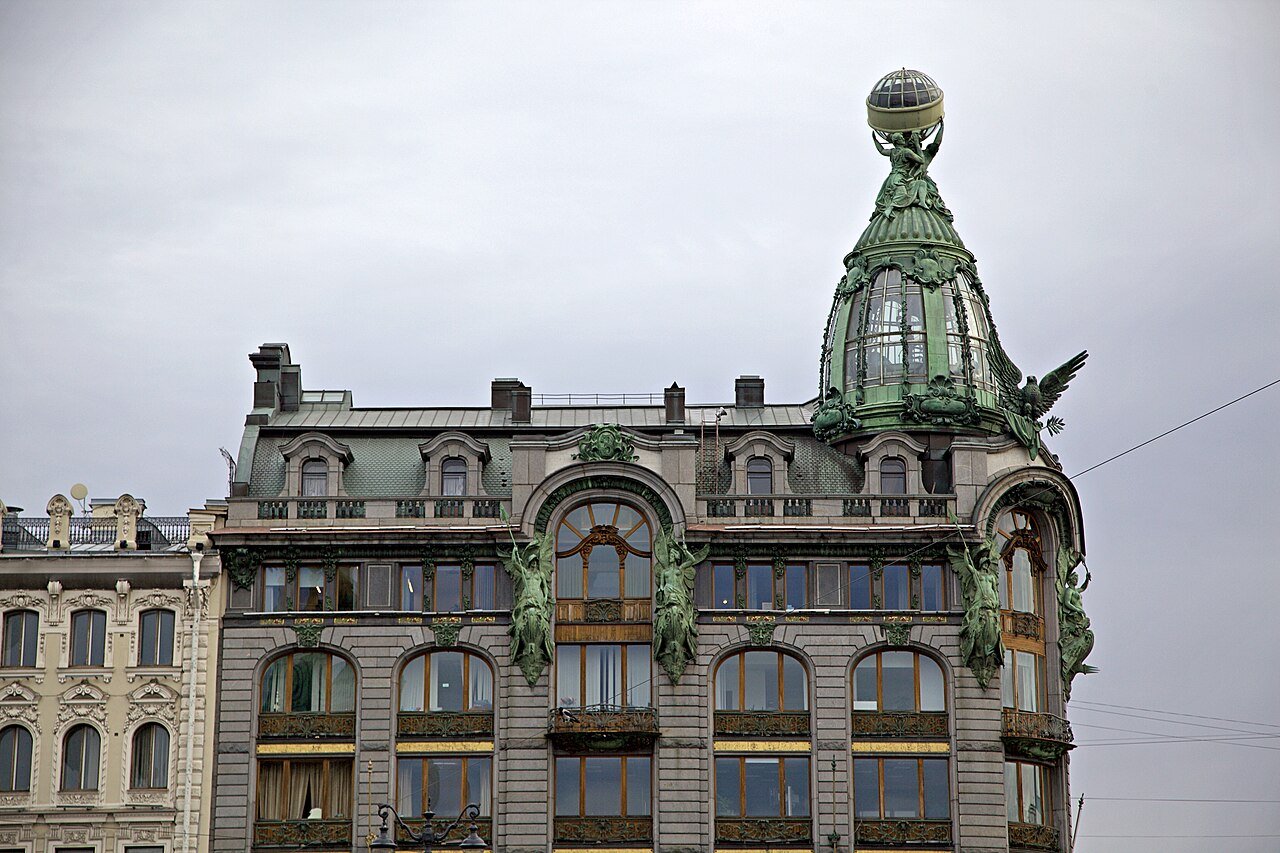
The Singer House is a six-storey building faced in polished pink and grey granite and crowned at its corner with a glass tower carrying a globe sculpture by the Estonian artist Amandus Adamson. Bronze decoration — including figures of valkyries — runs across the upper storeys; a bronze eagle once topped the tower but disappeared in the 1920s. Since 1919 the building has housed the city’s largest bookshop, the Dom Knigi or House of the Book, and visitors can step inside freely during shop hours.
A short walk away, the Eliseyev Emporium presents a façade dominated by a single huge arch filled with stained glass, with allegorical sculptures of Commerce, Industry, Science and the Arts — again by Adamson — set against the granite. The ground-floor food hall preserves one of the best Art Nouveau interiors in Saint Petersburg. The Vitebsky station completes the picture, its frontage carrying floriated Jugendstil detail, its interior reached by sweeping staircases and lined with stained glass and painted panels recording the history of Russia’s first railway.
Practical information
- Singer House (Dom Knigi) is a working bookshop at 28 Nevsky Prospekt; the interior is open during shop hours.
- The Eliseyev Emporium food hall at 56 Nevsky Prospekt operates as a shop and café and can be entered freely.
- The Vitebsky railway station remains an active station with public access to its historic halls.
- The buildings stand within walking distance of one another along Nevsky Prospekt and can be seen in a single morning.
- Interiors and operating hours change; check current details before a dedicated visit.
Getting there
Saint Petersburg is served by Pulkovo Airport (LED), south of the city. From the centre, the Nevsky Prospekt and Gostiny Dvor metro stations open directly onto the avenue, placing the Singer House and the Eliseyev Emporium within a few minutes’ walk; the Vitebsky station lies a short distance south and has its own metro stop, Pushkinskaya.
Related in CHO
- Riga — Art Nouveau
- Vienna — Capital of the Vienna Secession
- Helsinki — Nordic National Romanticism
Sources
Find it on the map
See this place and what’s around it →Record researched and written by Luigi De Marchi for Cultural Heritage Online, 2026.
📷 Become a Cultural Heritage Online photographer
Share your photos of places: they stay published under your name as the author. The more they're seen, the more you get noticed — and soon a contest will reward the most appreciated photos.
Log in or sign up free to add a photo