
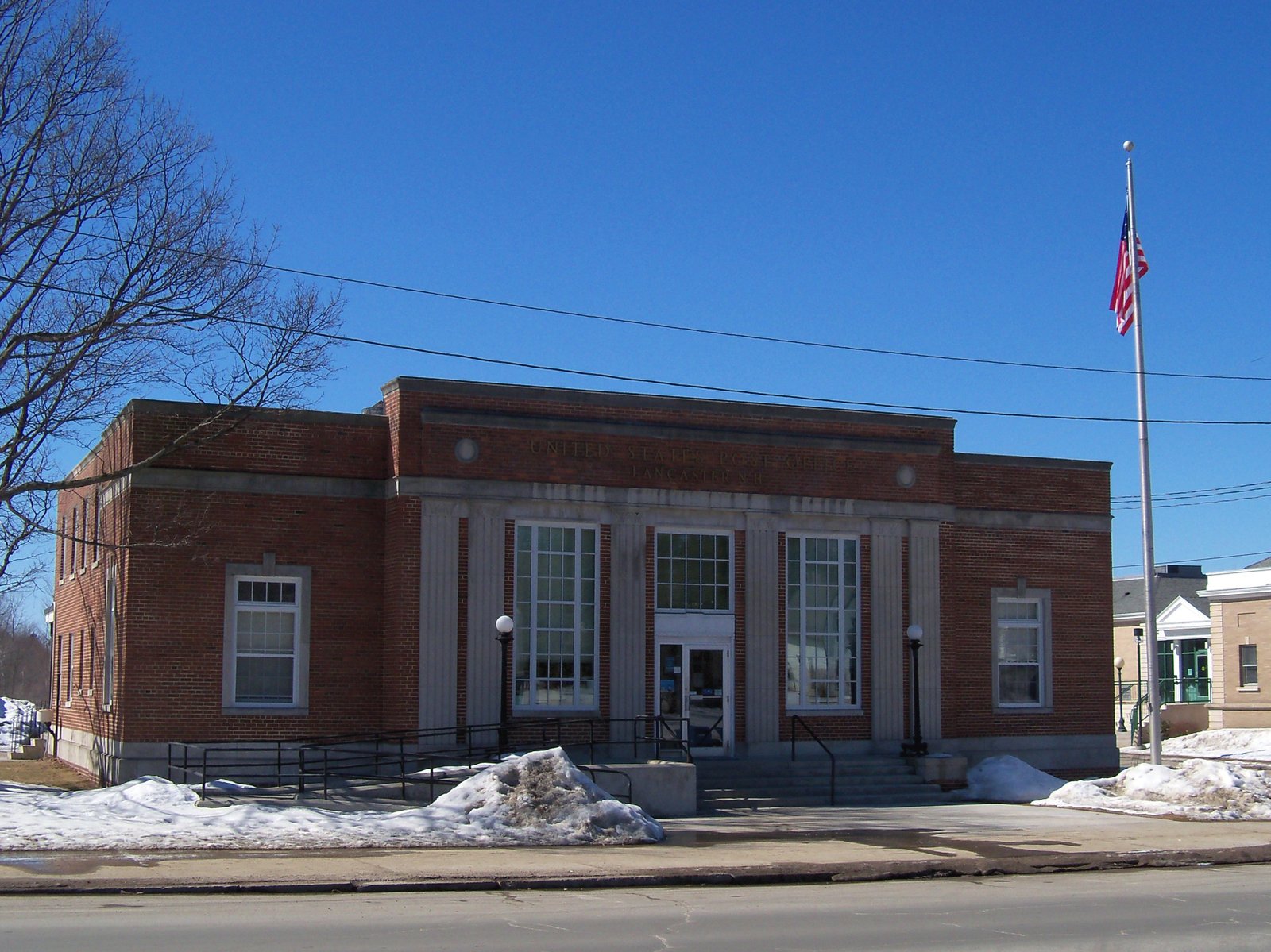
Louis A. Simon’s 1935 federal post office at 120 Main Street in Lancaster applies the distinctive “Starved Classicism” variant of Art Deco—rare in northern New England—to a single-story masonry building whose six fluted granite pilasters and marble floors carry the federal design program into the remotest reaches of the White Mountains region.
At a glance
The United States Post Office at 120 Main Street in Lancaster, New Hampshire was designed in 1935 by Louis A. Simon, the Supervising Architect of the United States Department of the Treasury, and represents one of the few examples of Art Deco architecture in northern New Hampshire. The style employed is specifically identified as “Starved Classicism,” a variant of Art Deco that was unusual and rare in the region: where classical buildings use full-scale columns, entablatures, and ornamental programs, Starved Classicism reduces these elements to their geometric essence—pilasters instead of columns, flat incised ornament instead of carved relief, bare surfaces instead of elaborate frieze programs. The result is a building that reads simultaneously as permanent and modern, institutional and restrained. Listed on the National Register of Historic Places in 1986, the Lancaster Post Office preserves its original character including the lattice grillwork at service windows and the marble floors finished in an Art Nouveau multicolored pattern.
Key facts
- Built: 1935
- Architect: Louis A. Simon, Supervising Architect, United States Department of the Treasury
- Style: Art Deco / Starved Classicism
- Address: 120 Main Street, Lancaster, NH 03584
- NRHP: ref. 86002245, listed 17 July 1986
- Current use: Active United States Post Office
History
The federal government’s Depression-era public buildings program produced hundreds of post offices, courthouses, and federal buildings in American communities of every size, from major cities to small county seats and rural towns. Louis A. Simon served as Supervising Architect of the Treasury Department from 1934 to 1934, overseeing a program that applied consistent design standards to federal buildings across the country while allowing regional variation in material and ornamental detail. The Lancaster commission reflects the program’s approach to small-town federal buildings: a single-story structure whose scale acknowledges its context rather than overwhelming the Main Street setting, but whose material quality—granite, marble, brick—and architectural program communicate the permanence and authority of the federal government in a community whose connection to the national postal system was fundamental to its economic and social life.
Lancaster, New Hampshire is the county seat of Coos County, the northernmost and largest county in New Hampshire, situated at the confluence of the Connecticut and Israel rivers in the upper Connecticut River Valley at the edge of the White Mountains. The region’s architecture before the federal buildings program of the 1930s had been dominated by Federal and Greek Revival styles from the early nineteenth century, making the Art Deco vocabulary of the 1935 post office genuinely unusual in its context. The building’s NRHP listing in 1986 recognized it as a significant example of the government’s Depression-era architectural program, and as one of the few Art Deco buildings in a region where the style had very limited penetration outside the major urban centers of the southern part of the state.
What you see
The Lancaster Post Office is a single-story masonry building with a granite base and common bond brickwork above. The projecting center facade is organized by six fluted granite pilasters that rise from the base to the raised parapet—the defining motif of the Starved Classicism style, which translates the full-column program of classical architecture into the flat geometric vocabulary of Art Deco. The parapet above the pilasters provides the building with a horizontal termination that reads on the Main Street scale without the excessive height that would make a small-town post office appear self-important.
Inside, the original character survives in the most important details: the marble floors, finished in an Art Nouveau multicolored pattern that provides a counterpoint to the austere exterior geometry, and the original lattice grillwork at the service windows, which is the most direct point of contact between postal workers and the public and remains the most intimate architectural detail of the building. The quarry tile wainscoting completes the material program of an interior that was designed to communicate cleanliness, permanence, and federal authority to everyone who entered the building to collect or send mail.
Practical information
- Current use: Active United States Post Office; open during normal postal business hours
- Exterior: Freely viewable from Main Street at all times
- Interior: Accessible during postal hours; the marble floors and original service windows are visible from the public lobby area
- Photography: Exterior freely permitted from public sidewalk; interior photography subject to standard USPS regulations
- Time needed: 15 minutes for exterior and lobby
Getting there
Lancaster, New Hampshire is in the upper Connecticut River Valley at the junction of US Routes 2 and 3, approximately 90 miles north of Concord and 120 miles north of Manchester. The nearest airports are Manchester-Boston Regional Airport (120 miles south) and Burlington International Airport (90 miles northwest across the Vermont border). The post office is at 120 Main Street in the center of Lancaster’s small downtown, within walking distance of the Lancaster Town Hall and the town common. Lancaster is a logical stopping point on a journey through the White Mountains or the upper Connecticut River Valley.
Nearby
- Lancaster Town Hall (1909) — Neoclassical civic building at the center of the Lancaster common, providing an architectural contrast to the 1935 post office
- White Mountains National Forest — the forest’s northern reaches begin within miles of Lancaster; the Presidential Range is visible from the town
- Weeks State Park — summit of Mount Prospect, 4 miles south, with views across the upper Connecticut River Valley
- Saint-Gaudens National Historical Park — the Cornish, NH / Windsor, VT complex preserving sculptor Augustus Saint-Gaudens’s summer home and studios, 50 miles south
Sources
- Wikipedia, “United States Post Office–Lancaster Main” — primary narrative source
- National Register of Historic Places, ref. 86002245 (17 July 1986)
- Wikimedia Commons, Lancaster_NH_Post_Office_5.JPG (CC BY-SA 3.0)
Find it on the map
See this place and what’s around it →Record researched and written by Luigi De Marchi for Cultural Heritage Online, 2026.
📷 Become a Cultural Heritage Online photographer
Share your photos of places: they stay published under your name as the author. The more they're seen, the more you get noticed — and soon a contest will reward the most appreciated photos.
Log in or sign up free to add a photoIs this page about you?
This page is read by travellers and heritage enthusiasts who find it on Google. Tell us how you are connected to this place and we will take it from there.