
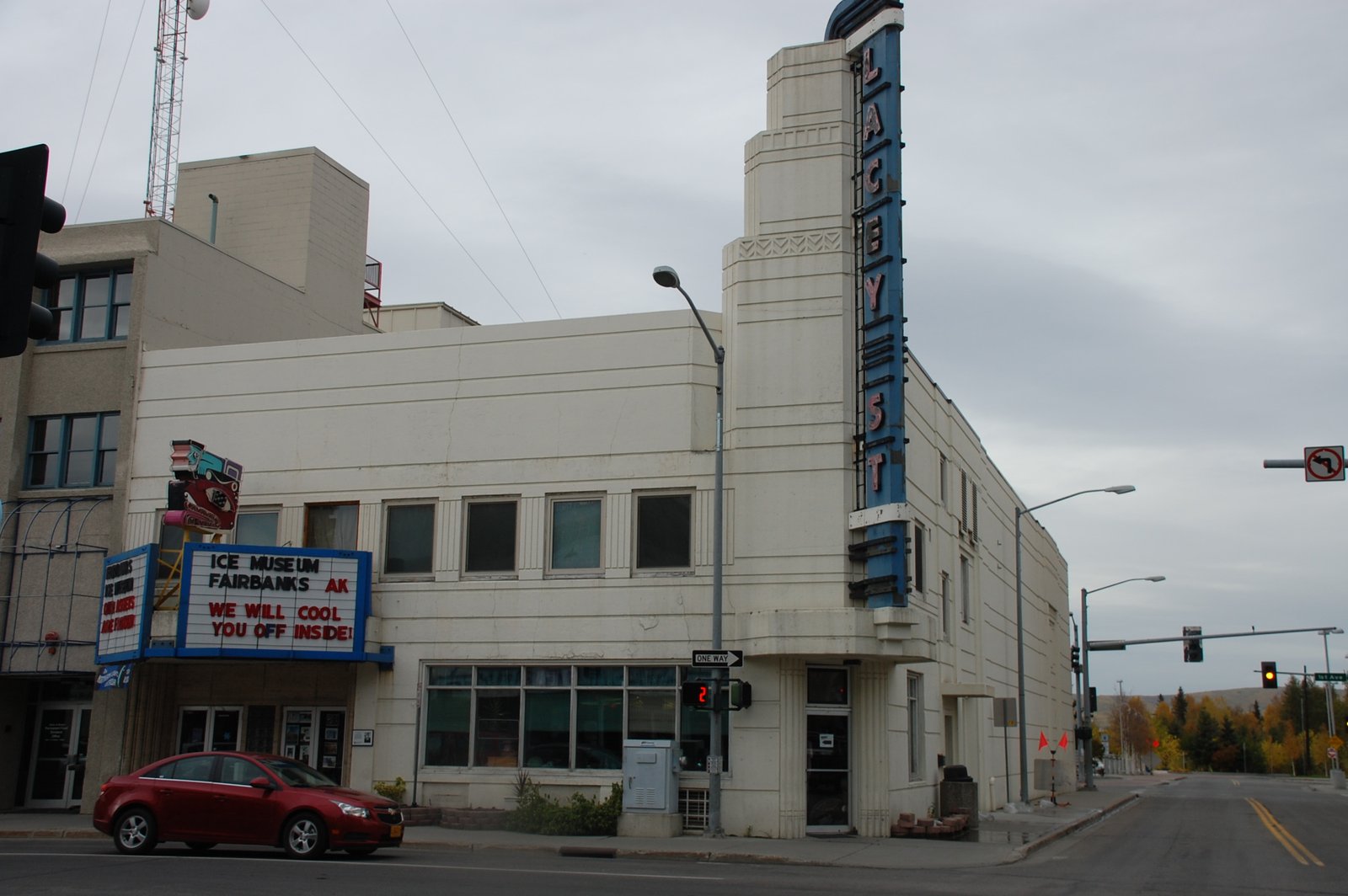
B. Marcus Priteca’s 1939 Art Deco theater at 500 Second Avenue in Fairbanks—built at the edge of the American world, 200 miles south of the Arctic Circle, for exhibitor Austin “Cap” Lathrop’s Alaska movie theater chain—is one of the northernmost Art Deco buildings in the United States, and the architectural anchor of downtown Fairbanks’s surviving historic commercial fabric.
At a glance
The Lacey Street Theatre at 500 Second Avenue in Fairbanks, Alaska was designed by B. Marcus Priteca and built in 1939 by contractor C.W. Hufeisen for Austin E. “Cap” Lathrop, the Alaskan entrepreneur and theater exhibitor who built the most significant movie palace circuit in pre-statehood Alaska. The theater opened on January 25, 1940, and operated until December 1980, when it closed after forty years of continuous operation. Listed on the National Register of Historic Places in 1990, the building now houses the Fairbanks Ice Museum, which uses the building’s year-round cold storage and its Art Deco auditorium as the setting for a museum of ice sculpture. The Lacey Street Theatre is one of the few examples of Art Deco architecture in Alaska and represents the extension of the American movie palace tradition to one of the most remote urban settings in the country.
Key facts
- Built: 1939; opened January 25, 1940
- Architect: B. Marcus Priteca (Seattle)
- Contractor: C.W. Hufeisen
- Style: Art Deco
- Address: 500 Second Avenue, Fairbanks, AK 99701
- NRHP: ref. 90000878, listed 14 June 1990
- Current use: Fairbanks Ice Museum (ice sculpture museum, since 1992)
History
Austin E. “Cap” Lathrop (1865–1950) was the most prominent independent theater operator in pre-statehood Alaska, building a circuit of movie houses in Fairbanks, Anchorage, and other Alaskan towns during the 1920s and 1930s. His theaters brought first-run Hollywood films to Alaskan audiences at the same time they were playing in Seattle and San Francisco, connecting Alaska’s isolated communities to the national popular culture of the sound film era. Lathrop commissioned B. Marcus Priteca—the premier Pacific Northwest theater architect, responsible for more than 150 theaters across the western United States and Canada—to design the Lacey Street Theatre as the flagship of his Fairbanks operations. Priteca’s Seattle office brought the same Art Deco design vocabulary it had deployed in major Pacific Northwest venues to the Fairbanks commission: a building scaled appropriately for its downtown context, with the Art Deco program applied to a facade that needed to read clearly against the flat light and extreme seasons of subarctic Alaska.
The theater opened in January 1940 and operated continuously until 1980, serving Fairbanks audiences through the Second World War (when Fairbanks was a major staging point for the Alaska-Siberia air ferry route), the Cold War military buildup, and the oil pipeline construction era of the 1970s. Its closure in 1980 ended forty years of continuous film exhibition at a single venue—an unusual continuity in an era when most American movie palaces had been subdivided, demolished, or repurposed decades earlier. The building’s conversion to the Fairbanks Ice Museum in 1992 preserved its Art Deco character while adapting it to a new use that has no exact parallel in the American historic theater landscape.
The NRHP listing in 1990 recognized the Lacey Street Theatre as a significant example of Art Deco commercial architecture in Alaska, and as a building that documents the cultural ambitions of pre-statehood Alaska’s business community—the determination to build a city of genuine architectural quality at the edge of the habitable world.
What you see
Priteca’s design for the Lacey Street Theatre applies Art Deco to the specific challenges of subarctic commercial architecture: a strong facade that reads clearly in the flat summer light and against the snow and darkness of winter, with ornamental detail that communicates sophistication without depending on the elaborate plaster programs of the great warm-climate movie palaces. The Second Avenue facade deploys the vertical emphasis and geometric ornament of the Art Deco commercial style in a composition calibrated for Fairbanks’s low-rise downtown streetscape rather than the tall-building context of Seattle or Los Angeles.
The interior, adapted for the Ice Museum while preserving the Art Deco character of the main auditorium space, is the building’s most unusual zone: a theater auditorium maintained at below-freezing temperatures year-round, its Art Deco surfaces providing an incongruous and memorable backdrop for the ice sculptures that have replaced the film screen as the venue’s primary attraction. No other American Art Deco theater has made a comparable adaptation.
Practical information
- Current use: Fairbanks Ice Museum; check website for seasonal hours and admission
- Temperature inside: Below freezing year-round (ice sculpture preservation environment); warm clothing required
- Exterior: Freely viewable from Second Avenue at all times
- Location: Downtown Fairbanks, Second Avenue and Lacey Street
- Time needed: 1–2 hours for the museum experience; 15 minutes for exterior only
Getting there
The Lacey Street Theatre is at 500 Second Avenue in downtown Fairbanks, Alaska. Fairbanks International Airport is 4 miles west; Alaska Airlines and several regional carriers serve Fairbanks from Anchorage, Seattle, and other points. Downtown Fairbanks is compact and walkable; the Lacey Street Theatre is within a few blocks of the Chena River waterfront and the other commercial buildings of the Second Avenue historic corridor. Fairbanks is connected to the rest of Alaska by the Parks Highway (355 miles to Anchorage) and the Alaska Highway from Canada.
Nearby
- Fairbanks Ice Museum — the current occupant of the Lacey Street Theatre; world-class ice sculpture on permanent display in a year-round below-freezing environment
- University of Alaska Museum of the North — major natural history and cultural museum 3 miles north on the University of Alaska Fairbanks campus; dramatic contemporary building (2005, Joan Soranno)
- Pioneer Park (Alaskaland) — open-air museum preserving historic buildings from Fairbanks’s gold rush and early territorial period, 2 miles west
- Old Federal Building, Fairbanks — another Art Deco commercial building in downtown Fairbanks, within walking distance of the Lacey Street Theatre
Sources
- Wikipedia, “Lacey Street Theatre” — primary narrative source
- National Register of Historic Places, ref. 90000878 (14 June 1990)
- Wikimedia Commons, Lacey_Street_Theater_NRHP_Fairbanks,_AK(2).JPG (CC BY-SA 3.0)
Find it on the map
See this place and what’s around it →Record researched and written by Luigi De Marchi for Cultural Heritage Online, 2026.
📷 Become a Cultural Heritage Online photographer
Share your photos of places: they stay published under your name as the author. The more they're seen, the more you get noticed — and soon a contest will reward the most appreciated photos.
Log in or sign up free to add a photoIs this page about you?
This page is read by travellers and heritage enthusiasts who find it on Google. Tell us how you are connected to this place and we will take it from there.