
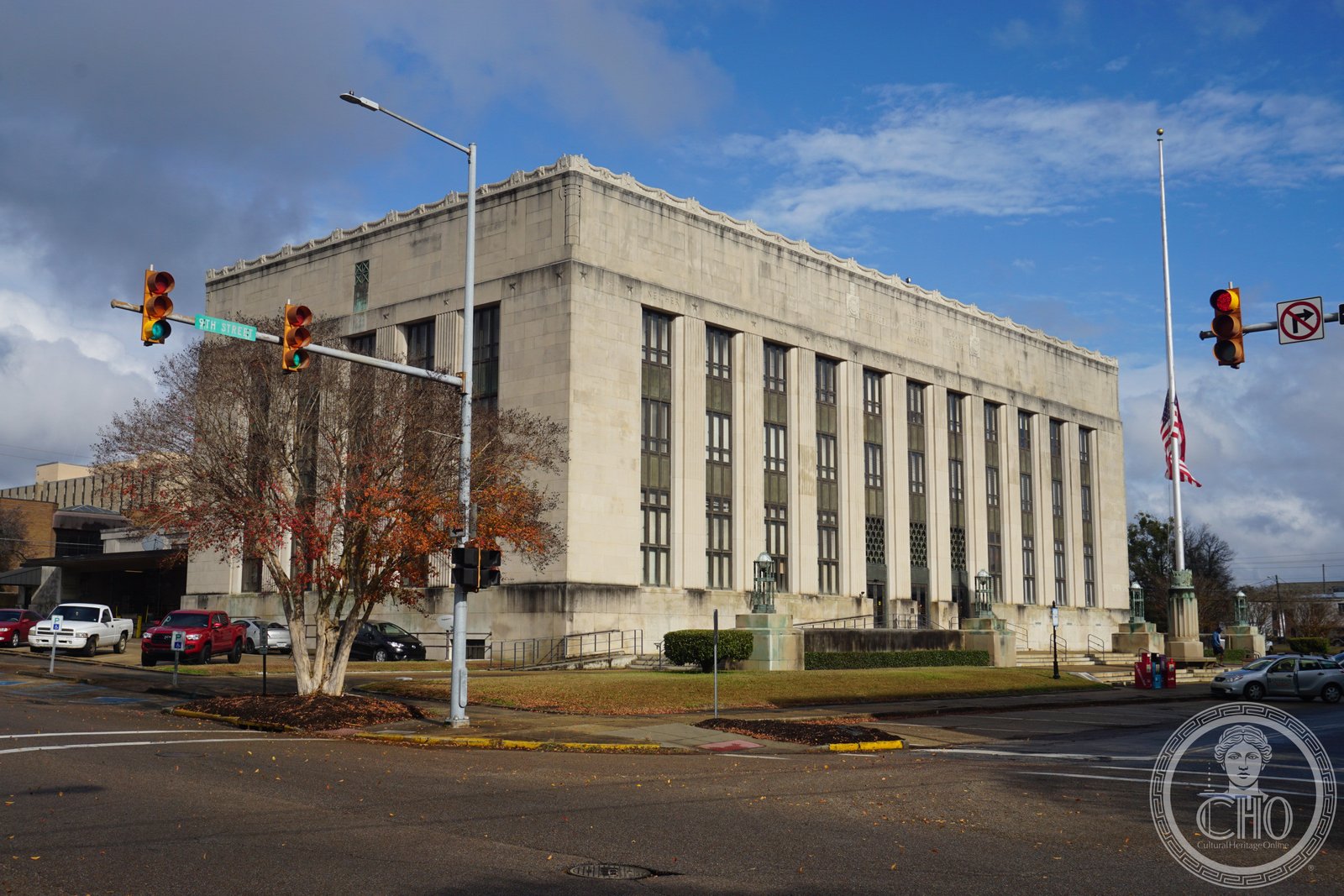
Above the main entrance of the 1933 Meridian federal building, carved in limestone in capital letters, runs the most famous postal motto in the world: “Neither snow nor rain nor gloom of night shall stay these couriers.” Inside, a courtroom that hosted two of the most significant civil rights cases in American legal history stands intact behind its marble columns and mosaic floor.
At a glance
The United States Post Office and Courthouse at 2100 9th Street in Meridian, Mississippi, is a three-story limestone federal building completed in 1933 at a Depression-era cost reflecting the federal government’s commitment to institutional architecture even during economic contraction. Designed by P.J. Krouse & Fort in the Stripped Classical mode — which NRHP documentation describes as “simplified, or stripped, classical” — it features a bronze decorative grill with corn ear motifs at the main entrance, terracotta coping and parapet decorated with eagles, steers, and corn, a foyer with four marble columns and marble mosaic flooring, and a cast bronze building directory in the public lobby. The courthouse hosted the initial filing of James Meredith’s 1961 lawsuit against the University of Mississippi (which would reach the US Supreme Court) and the 1967 prosecution of nineteen individuals for the murders of civil rights workers James Chaney, Michael Schwerner, and Andrew Goodman. Listed on the National Register of Historic Places in 1984, the building continues to operate as an active post office.
Key facts
- Completed: 1933
- Architects: P.J. Krouse & Fort
- Style: Stripped Classical / Art Deco
- Exterior: Limestone three-story main block; granite steps to main entrance; terracotta coping and parapet with eagle, steer, and corn motifs
- Entry: Bronze decorative grill with corn ear design; postal motto engraved above in capital letters; four amber glass globe lamps; marble flagpole base
- Interior foyer: Four marble columns; marble mosaic flooring; cast bronze building directory in public lobby
- Address: 2100 9th Street, Meridian, Mississippi 39301
- NRHP: May 17, 1984 (ref. 84002236)
- Area: 1.4 acres (0.57 hectares)
History
Meridian’s federal postal history begins in 1853, when town founder John T. Ball secured government rental space in his log store on 26th Avenue and 7th Street. Over the following decades the post office relocated five times as the city grew into a significant railroad junction and commercial center in east-central Mississippi — by the late nineteenth century Meridian was one of the largest cities in the state, positioned at the crossing of two major rail lines. The first dedicated Federal Building opened in 1898, designed by architect William Martin Aiken at a cost of $80,000, housing both the post office and the US District Court for the Southern District of Mississippi. That building required an eastern addition as early as 1911 and was ultimately demolished in the 1950s.
The present building was funded during the Great Depression under the federal program that commissioned new public buildings for cities of regional significance. The architects P.J. Krouse & Fort designed a three-story limestone building in the mode that dominated federal architecture in the early 1930s: Stripped Classicism, which retained the axial symmetry and material quality of Beaux Arts federal buildings while eliminating their elaborate applied ornament in favor of simplified geometric enrichment. The agricultural iconography on the parapet — eagles, steers, and corn — was a standard device for federal buildings in Mississippi, rooting the national institution in the local agricultural economy. The postal motto inscribed above the entrance, derived from Herodotus’s description of the Persian postal couriers (and adopted by the US Postal Service as its unofficial motto), gave the building a literary gravitas unusual for a Depression-era civic project.
The courthouse’s significance in American legal history derives from two landmark cases. In 1961, James Meredith filed his initial lawsuit against the University of Mississippi in the Meridian court — Meredith v. University of Mississippi — seeking admission as the first Black student. The case reached the US Supreme Court, which in 1962 ordered the university to admit Meredith; the enrollment on September 30, 1962, was accompanied by riots that killed two people and required federal marshals and military intervention. Six years later, in 1967, the Meridian courthouse hosted United States v. Price, the federal prosecution of nineteen men — including Sheriff Lawrence Rainey and Deputy Cecil Price of Neshoba County — for the 1964 murders of civil rights workers James Chaney, Michael Schwerner, and Andrew Goodman. Seven were convicted; it was the first time in Mississippi that an all-white jury convicted a white person of a civil rights crime.
What you see
The building stands at the corner of 9th Street and 21st Avenue, its limestone mass presenting a three-story front of slightly recessed planes in the Stripped Classical idiom. Granite steps raise the main entrance above street level — a standard federal device to communicate institutional authority — leading to a bronze decorative grill featuring corn ear motifs, a specifically agricultural symbol that ties the building to its Mississippi context. Above the entry, the postal motto is incised in the limestone in evenly spaced capital letters, a text inscription unusually prominent on the facade. The terracotta coping above the parapet carries a program of eagles, steers, and corn that wraps the building’s upper register, combining the national symbol of the American eagle with the livestock and grain crops of the Mississippi economy.
Inside, two granite steps from the front entrance lead to the public lobby, where marble mosaic flooring marks the center of a space framed by four marble columns. The cast bronze building directory in the lobby retains its original character. A 1963 addition extended the basement and first floor rearward without altering the building’s exterior; the original limestone facade, granite steps, bronze entry elements, and marble foyer survive largely intact. The post office continues operations at ground level; the upper courtroom floor, decommissioned as a trial venue in 2012 following budget cuts to the court program, remains accessible for inspection.
Practical information
- Address: 2100 9th Street, Meridian, Mississippi 39301
- Current use: Active US Post Office (ground floor); former federal courthouse (upper floors)
- Post office hours: Standard USPS hours, weekdays; closed federal holidays
- Exterior: Freely viewable from 9th Street and 21st Avenue; postal motto visible without entering
Getting there
The building stands in central Meridian at 9th Street and 21st Avenue, within walking distance of the Meridian Amtrak station (served by the Sunset Limited and Crescent). Meridian Regional Airport (MEI) is approximately 6 miles northeast. Interstate 20 and Interstate 59 cross at Meridian, making it accessible from Jackson (~90 miles west), Birmingham (~90 miles northeast), and Hattiesburg (~80 miles southwest). Downtown parking is available along 22nd and 23rd avenues adjacent to the building.
Nearby
- Mississippi Arts & Entertainment Experience (The MAX) — 0.5 miles northeast on 22nd Avenue; Mississippi music and culture museum celebrating the state’s blues, country, and rock heritage
- Meridian Museum of Art — 0.4 miles south; permanent collection with Mississippi and Southern American art
- Grand Opera House of Mississippi (1890) — 0.3 miles north; Romanesque Revival theater, part of the Meridian downtown historic district
- Jimmie Rodgers Museum — 2 miles northeast at Highland Park; memorial to the “Father of Country Music,” born in Meridian
Sources
- Wikipedia: United States Post Office and Courthouse (Meridian, Mississippi)
- National Register of Historic Places Nomination Form (ref. 84002236, May 17, 1984)
- U.S. General Services Administration, Historic Buildings Program
- Judicial Conference of the United States, court closure documentation (September 2012)
Find it on the map
See this place and what’s around it →Record researched and written by Luigi De Marchi for Cultural Heritage Online, 2026.
📷 Become a Cultural Heritage Online photographer
Share your photos of places: they stay published under your name as the author. The more they're seen, the more you get noticed — and soon a contest will reward the most appreciated photos.
Log in or sign up free to add a photoIs this page about you?
This page is read by travellers and heritage enthusiasts who find it on Google. Tell us how you are connected to this place and we will take it from there.