
One of only two surviving twin-console Wurlitzer theatre organs in the United States — the other is at Radio City Music Hall — lives inside the 1930 Paramount Theatre on Denver’s Glenarm Place: a Rapp and Rapp movie palace that survived the decline of the grand cinema and reinvented itself as the Rocky Mountain region’s premier concert hall.
At a glance
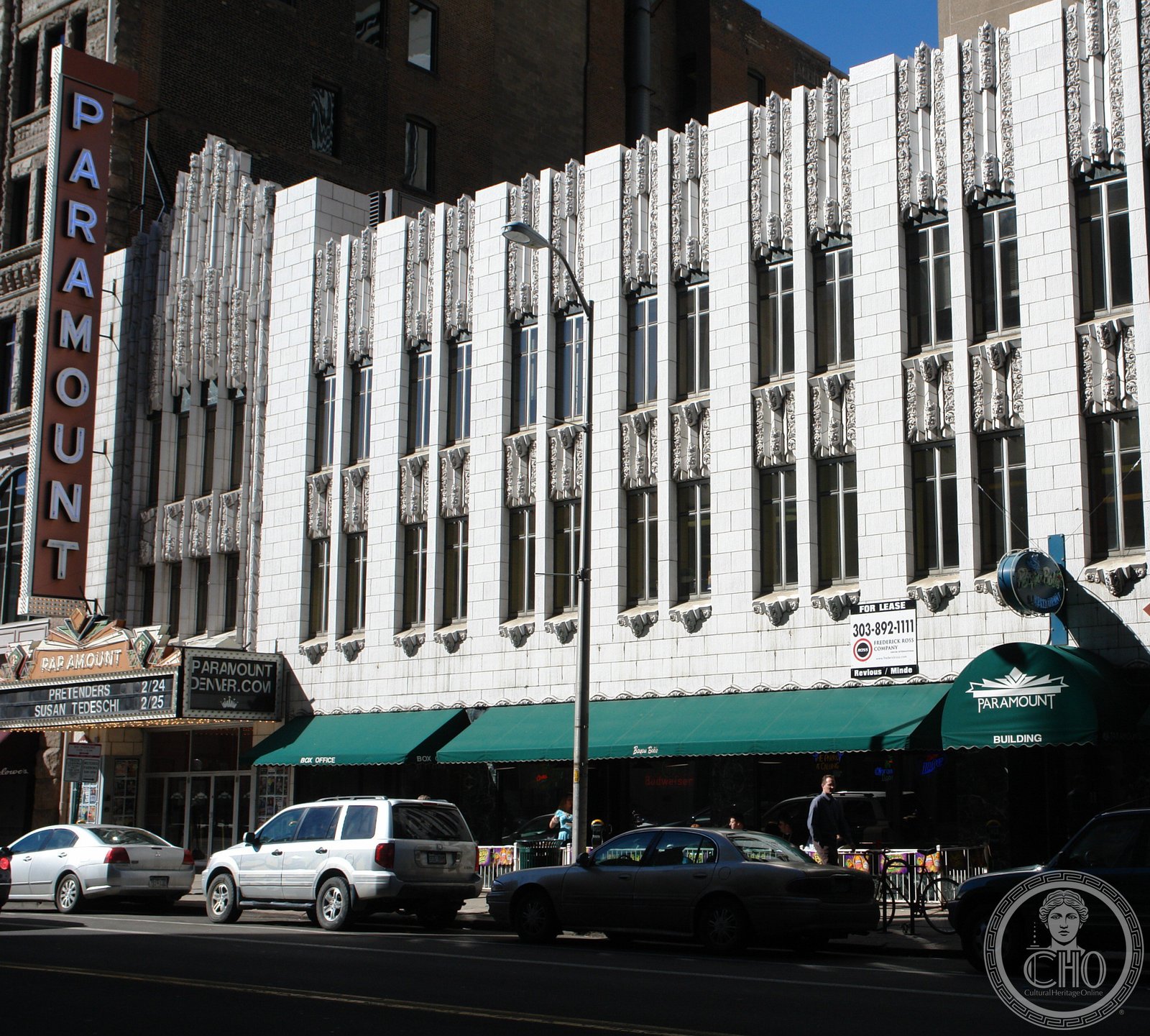
The Paramount Theatre at 1621 Glenarm Place in Denver, Colorado, is a 1,870-seat Art Deco movie palace opened in 1930 by the Paramount-Publix Theatre Circuit, the exhibition arm of Paramount Pictures. The auditorium was designed by the Chicago firm Rapp and Rapp — architects of the Chicago Theatre (1921), the Paramount Theatre in New York (1926), and dozens of other major movie palaces — with interior decorations by Vincent Mondo and murals by Louis Grell. The adjoining three-story commercial building, now providing the main Glenarm Place entrance, was designed by local Denver architect Temple H. Buell in a modernized Art Deco Gothic executed in cast concrete and white terra cotta. The building was placed on the National Register of Historic Places in 1980 and designated a Denver historic landmark in 1988. Its twin-console Wurlitzer organ (Opus 2122, installed July 23, 1930) is one of only two such instruments surviving in the United States; the other is at Radio City Music Hall in New York.
Key facts
- Opened: 1930
- Theatre architect: Rapp and Rapp (Chicago)
- Building architect: Temple H. Buell (Denver, CO); cast concrete + white terra cotta; modernized Art Deco Gothic
- Interior decorations: Vincent Mondo
- Murals: Louis Grell
- Seating capacity: 1,870
- Style: Art Deco
- Wurlitzer organ: Opus 2122, Publix#1 style; 4 manuals, 21 ranks, 1,600+ pipes; designed by Jesse Crawford; installed July 23, 1930; one of only 2 twin-console Wurlitzers remaining in the USA
- Address: 1621 Glenarm Place, Denver, CO 80202
- NRHP: November 21, 1980 (ref. 80000893)
- Denver landmark: 1988
History
The Paramount opened in 1930 as part of the Paramount-Publix Theatre Circuit, the national exhibition network built by Paramount Pictures during the golden age of the movie palace. The choice of Rapp and Rapp as architects placed Denver’s premier new cinema in the same lineage as the Chicago Theatre (1921), the Brooklyn Paramount (1928), and the Paramount New York (1926) — buildings that established the vocabulary of the American movie palace as a species of public architecture. The original main entrance faced 16th Street at number 519; a secondary entry on Glenarm Place later became the primary public access. The adjacent commercial building, designed by Temple H. Buell — a Colorado architect whose later work would include the design of the Denver Bears’ stadium and the Denver Civic Center Auditorium — provided the modern Art Deco Gothic exterior that frames the theatre complex as seen today from Glenarm Place.
For decades the Paramount operated as Denver’s premier movie house. The shift to suburban entertainment, multiplexes, and television eroded the audience for downtown cinema palaces across America; by 1978 the Paramount was Denver’s last remaining movie palace still operating as a cinema. That year the Denver Opera Company staged a production of Puccini’s Madama Butterfly in the space, marking the theatre’s pivot toward live performance. The National Register listing followed in 1980 and the Denver landmark designation in 1988, providing legal protections for the building’s historic fabric. Kroenke Sports & Entertainment acquired the Paramount and an adjacent building in 2002 and has operated it as a major concert venue since. In 1996, before the Kroenke acquisition, comedian Sinbad recorded his HBO special Son of a Preacher Man in the theatre, marking its place in 1990s entertainment culture.
The Wurlitzer organ’s story parallels the theatre’s history. Opus 2122, a Publix#1 model designed by theatre organist Jesse Crawford, was installed on July 23, 1930, just months after the theatre opened. Its two consoles — the primary four-manual and a secondary three-manual shell — were engineered to allow organ preludes, accompaniment to silent film, and live performance across the full theatre. A Vox Humana pipe component was removed at some point; it was restored to operation in 2012 when Bill Brown, founder of Phoenix-area Organ Stop Pizza, donated a pipe chest to the Rocky Mountain chapter of the American Theatre Organ Society, bringing the instrument to its full twenty-one ranks.
What you see
The exterior visible from Glenarm Place is Temple H. Buell’s three-story commercial building with the theatre’s current main entrance at street level. Buell’s design employs cast concrete and white terra cotta in a treatment he described as a “modernized, Art Deco interpretation of the Gothic style” — a characterization that points to the ambivalence typical of American commercial architecture in 1930, when the tension between the Gothic Revival inheritance and the new Deco vocabulary was still being resolved on a building-by-building basis. The vertical emphasis of Gothic detailing — pointed arches, clustered piers, tracery — appears here in a flattened, abstracted form, the stone surfaces smooth rather than carved, the ornament geometrically simplified. The result reads as both contemporary and traditional, which was precisely what the Paramount-Publix circuit wanted for its flagship theatres in major American cities.
The interior auditorium, designed by Rapp and Rapp, follows the established movie palace formula of the late 1920s: a large auditorium of 1,870 seats under an elaborately decorated ceiling, with murals and decorative surfaces by Vincent Mondo and Louis Grell. The twin-console Wurlitzer occupies a prominent position; in current use the primary console is positioned in the pit area, with the secondary console accessible for special presentations. The four-manual organ’s pipes are distributed throughout the theatre in chambers behind decorative grilles, filling the auditorium with sound from multiple directions in the manner the Wurlitzer corporation engineered specifically for large movie palace acoustics.
Practical information
- Address: 1621 Glenarm Place, Denver, CO 80202
- Current use: Active concert venue (Kroenke Sports & Entertainment)
- Tickets: Available online; the venue hosts national touring acts, classical music events, comedy, and private events
- Organ performances: The Wurlitzer is played for selected events; check venue calendar
- Tours: Occasional historic tours are offered; check local preservation organization schedules
Getting there
The Paramount stands on Glenarm Place between 16th and 17th streets, one block east of Denver’s 16th Street Mall, in the heart of downtown. Denver International Airport (DEN) is approximately 25 miles northeast; from the airport, the University of Colorado A Line connects to Union Station (approximately 37 minutes), from which the 16th Street MallRide Free Bus runs the length of the Mall to the theatre’s doorstep. I-25 and I-70 converge in downtown Denver; Speer Boulevard provides a direct approach from the southwest. Parking garages are abundant throughout the downtown core.
Nearby
- Denver Art Museum — 0.7 miles south; collection includes American decorative arts and design; the new Frederic C. Hamilton Building (2006) by Daniel Libeskind
- Denver Center for the Performing Arts — 0.3 miles north; the Buell Theatre (named for Temple H. Buell) and the Ellie Caulkins Opera House
- Brown Palace Hotel (1892) — 0.2 miles east on 17th Street; H.H. Tammen’s Romanesque Revival hotel, Denver’s most historic lodging
- Denver Public Library (Central Branch) — 0.7 miles south; Michael Graves design (1995) with WPA-era research collections
Sources
- Wikipedia: Paramount Theatre (Denver)
- National Register of Historic Places (ref. 80000893, November 21, 1980)
- Denver Landmark Preservation Commission (landmark designation 1988)
- American Theatre Organ Society, Rocky Mountain Chapter: Paramount Wurlitzer documentation
Find it on the map
See this place and what’s around it →Record researched and written by Luigi De Marchi for Cultural Heritage Online, 2026.
📷 Become a Cultural Heritage Online photographer
Share your photos of places: they stay published under your name as the author. The more they're seen, the more you get noticed — and soon a contest will reward the most appreciated photos.
Log in or sign up free to add a photoIs this page about you?
This page is read by travellers and heritage enthusiasts who find it on Google. Tell us how you are connected to this place and we will take it from there.