
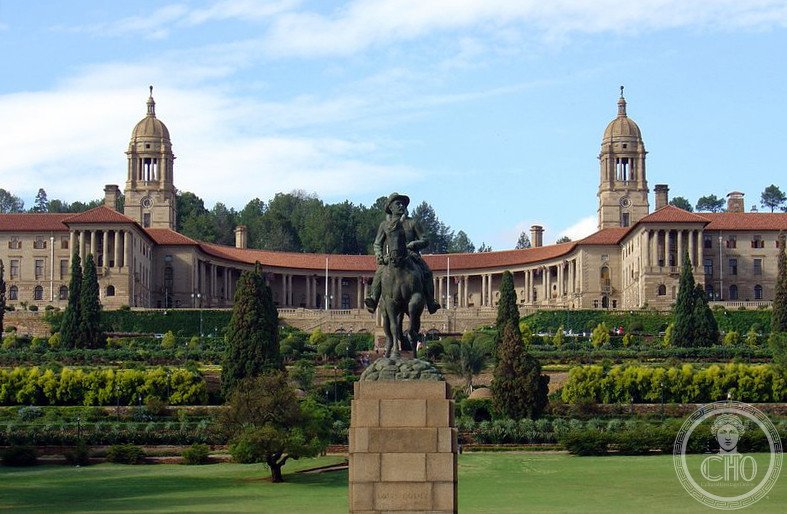
Atop Meintjieskop hill in Pretoria, Herbert Baker’s Union Buildings stretch for 285 metres in two symmetrical sandstone wings, their domed towers framing a great open amphitheatre that faces north across the city. Commissioned to house the administration of the newly unified South Africa, the complex was completed in 1913 and remains the official seat of government and the offices of the President. Baker blended Edwardian Classicism with Cape Dutch memory and local granite and sandstone, insisting that indigenous materials carry the weight of a new national story. Yet the building’s most resonant chapter was unwritten when Baker laid the foundations: on 10 May 1994, Nelson Mandela stood in that amphitheatre before a watching world and was inaugurated as South Africa’s first democratically elected president, transforming the seat of apartheid administration into a symbol of reconciliation that still charges the space today.
At a glance
- Type
- Government headquarters
- Period
- 1910–1913
- Style
- Lutyens / Cape Dutch Classicism
- Location
- Meintjieskop, Arcadia, Pretoria, South Africa
- Coordinates
- 25.7405° S, 28.2120° E
- Architect(s)
- Sir Herbert Baker
Overview
The Union Buildings occupy the highest point in Pretoria, their silhouette visible from much of the city. The building’s two wings, linked by a curved colonnade and central amphitheatre, represent the union of the former Boer republics and British colonies that formed South Africa in 1910. Herbert Baker, already known for his Cape Dutch Revival work in the Cape Colony, here synthesised that tradition with the Edwardian grandeur he would later deploy at New Delhi. The result is a building that feels simultaneously civic and palatial, African and imperial — a tension that maps closely onto the country’s own complicated history.
History
The Act of Union of 1910 created a single South African state from four colonies. The new government required a capital complex worthy of the occasion and in 1908 commissioned Herbert Baker, then based in Johannesburg. Baker won the commission against competitors and began design work immediately. Construction ran from 1910 to 1913, employing around 1,265 workers and costing approximately £1.3 million — making it at the time the largest building project in the Southern Hemisphere. The building was inaugurated in November 1913. Through the twentieth century it housed successive administrations and witnessed the full arc of South African history, from segregation to apartheid to liberation. The Women’s March of 9 August 1956 — when 20,000 women marched to protest pass laws — is commemorated by a memorial in the gardens. The renamed Nelson Mandela Amphitheatre (2013) now seats 9,000 people for state events.
Architecture & Design
Baker’s plan places two identical wings at an angle to one another, joined at the centre by a curved colonnade and the open amphitheatre. Each wing terminates in a domed tower crowned by Atlas sculptures in bronze. The choice of materials was deliberate: locally quarried granite for the base courses, warm Buiskop sandstone for the upper walls, with clock towers whose chime sequence matches Big Ben’s. The overall composition draws on Lutyens’s contemporaneous work in New Delhi — both architects belonged to the same circle and shared the conviction that classical order, adapted to local conditions, could articulate the dignity of new nations. Terraced gardens descend the hill in formal geometry, planted with indigenous South African species, providing the building with a setting that Baker considered as carefully as the stone above.
Cultural significance
Few buildings carry as much historical charge as the Union Buildings. Built to consolidate white minority rule, they became the stage for its dismantling. Mandela’s 1994 inauguration in the amphitheatre was broadcast to a global audience and reprised an older tradition of peaceful mass gathering that the Women’s March of 1956 had established. The complex is a South African National Heritage Site, and its image — twin domes over a wide terraced hill — functions as a national icon comparable to Parliament or the Union Jack in other contexts. The buildings remind visitors that spaces do not have fixed meanings: they are claimed and reclaimed by history.
Visiting today
The Union Buildings and their terraced gardens are open to the public during daylight hours; entry to the gardens is free. The interior offices remain a functioning government headquarters and are not open to visitors without prior arrangement. A bronze statue of Nelson Mandela, arms outstretched, stands on the northern terrace facing the city. The gardens are popular with Pretoria residents for picnics and offer panoramic views across Tshwane.
Getting there
The Union Buildings are approximately 2 km east of Pretoria city centre. By car, follow Church Street east into Arcadia and turn onto Government Avenue; parking is available below the gardens. By public transport, taxis and minibus taxis serve the Arcadia suburb regularly from Church Square. The Gautrain rapid-rail network connects Pretoria to Johannesburg; from Pretoria station, the buildings are a short taxi ride away.
Sources & resources
Find it on the map
See this place and what’s around it →Record researched and written by Luigi De Marchi for Cultural Heritage Online, 2026.
📷 Become a Cultural Heritage Online photographer
Share your photos of places: they stay published under your name as the author. The more they're seen, the more you get noticed — and soon a contest will reward the most appreciated photos.
Log in or sign up free to add a photoIs this page about you?
This page is read by travellers and heritage enthusiasts who find it on Google. Tell us how you are connected to this place and we will take it from there.