
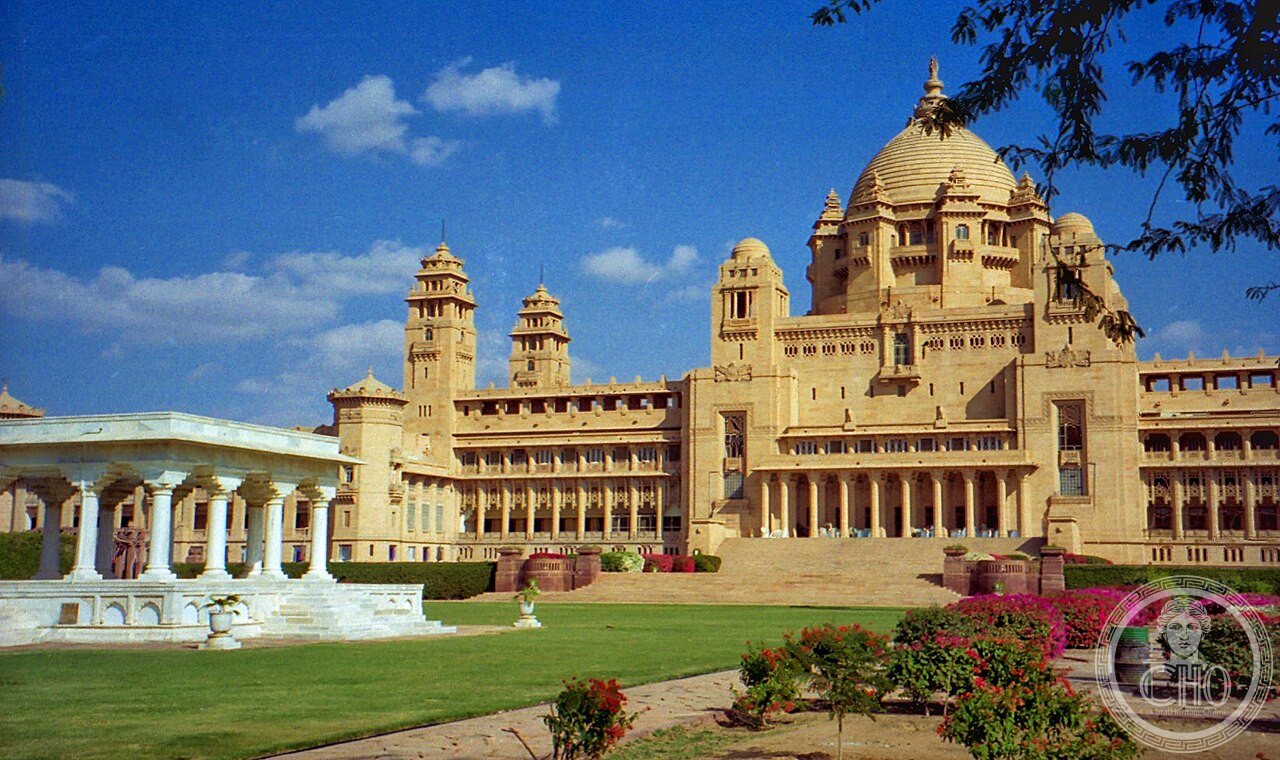
Rising from the Jodhpur plateau in honey-gold Chittar stone, Umaid Bhawan Palace is one of the last great palaces built in India and the largest private residence completed in the twentieth century. Maharaja Umaid Singh commissioned it in 1929 as a famine-relief project — providing employment for some three thousand workers and their families for fifteen years during a devastating drought that had stripped the Thar Desert region bare. British architect Henry Vaughan Lanchester, fresh from designing civic monuments across Britain, fused the Edwardian Baroque grandeur of his homeland with the soaring Rajput towers and curved chattris of Jodhpur tradition. Inside, Polish exile Stefan Norblin painted an extraordinary cycle of Art Deco murals depicting Hindu mythology — a collision of pre-war Warsaw glamour and Sanskrit cosmology found nowhere else on earth. Today the palace serves three lives simultaneously: royal family residence, Taj Hotels luxury hotel, and public museum celebrating the Jodhpur royal heritage.
At a glance
- Type
- Palace / Hotel / Museum
- Period
- 1929–1943
- Style
- Art Deco with Indo-Saracenic and Rajput elements
- Location
- Jodhpur, Rajasthan, India
- Coordinates
- 26.2808° N, 73.0469° E
- Architect(s)
- Henry Vaughan Lanchester; interiors by Stefan Norblin
Overview
Umaid Bhawan Palace comprises 347 rooms spread across a main block, flanking wings, and extensive gardens on a 26-acre hilltop site. The exterior is clad entirely in locally quarried Chittar sandstone — a pale ochre that glows amber at sunset — assembled without mortar in the traditional Jodhpur technique. The central dome rises 56 metres. Three separate functions coexist under one roof: the private apartments of the Jodhpur royal family, the Taj Hotels wing offering some of the most celebrated hotel suites in Asia, and a ground-floor museum displaying royal weapons, vintage cars, clocks, and paintings. The palace anchors Jodhpur’s identity as a heritage tourism destination and remains a working symbol of Rajput continuity into the modern world.
History
When a catastrophic famine struck Rajputana in the late 1920s, Maharaja Umaid Singh faced a crisis of legitimacy: how to feed and employ a population without simply handing out charity, which Rajput honour forbade receiving. His adviser suggested a monumental construction project. Lanchester was commissioned in 1929; the foundation stone was laid that year and the building was inaugurated in 1943 — by which time Umaid Singh had only four years left to live. Construction employed Chittar stone craftsmen, sculptors, tile-setters, and labourers continuously for fifteen years. Stefan Norblin arrived in the early 1940s, having fled Nazi-occupied Warsaw, and spent years painting the sweeping mythological murals in the ballroom, banquet hall, and private apartments. The palace passed to the current Maharaja Gaj Singh II after independence, who negotiated the partial hotel conversion with Taj Hotels in the 1970s.
Architecture & Design
Lanchester composed the palace on a strict axial Beaux-Arts plan — a 195-metre central block with symmetrical wings — but crowned it with a Rajput silhouette of chattris, chhatri-topped towers, and a great hemispherical central dome rising 56 metres. The interiors divide sharply between two registers. The formal state rooms follow a European Art Deco grammar: geometric terrazzo floors, lacquered furniture, ziggurat-profile mouldings, and streamlined metalwork. The Norblin murals introduce a third idiom entirely — large-scale figurative compositions in which Shiva, Vishnu, and scenes from the Mahabharata are rendered in the flat, sinuous line-work and acid palette of 1930s Warsaw poster art. The juxtaposition is startling and completely intentional; Norblin wrote that he sought to find the universal beneath two apparently incompatible visual traditions.
Cultural significance
Umaid Bhawan Palace occupies a singular position in twentieth-century architectural history: it is the only major building where Art Deco interiors were created by a Central European exile working in dialogue with a living Hindu iconographic tradition. The Norblin murals have no parallel anywhere. The palace is also a rare example of colonial-era architecture conceived entirely by its Indian patron — Lanchester executed Maharaja Umaid Singh’s detailed brief rather than imposing a metropolitan template. Designated a heritage hotel under India’s National Tourism Policy, it consistently ranks among the finest hotels in the world and remains in continuous royal use.
Visiting today
The museum wing is open to non-hotel guests daily (small entry fee). Hotel guests access the spa, pool, and dining rooms. The Taj Hotels wing books up months in advance — reserve early. Jodhpur’s old city (the Blue City) and Mehrangarh Fort are 3 km away. Best light for photography of the exterior is late afternoon, when the Chittar stone turns deep amber. Dress modestly for the museum. No photography inside the royal private apartments.
Getting there
Jodhpur Airport (JDH) is 5 km from the palace; direct flights from Delhi, Mumbai, Bangalore, and Jaipur. Jodhpur Junction railway station is 4 km away, connected to Delhi, Jaipur, Mumbai, and Jaisalmer. Taxis and auto-rickshaws are available city-wide. The palace sits on a prominent hill west of the old city and is visible from most of Jodhpur. Uber operates in Jodhpur.
Sources & resources
Find it on the map
See this place and what’s around it →📷 Become a Cultural Heritage Online photographer
Share your photos of places: they stay published under your name as the author. The more they're seen, the more you get noticed — and soon a contest will reward the most appreciated photos.
Log in or sign up free to add a photoIs this page about you?
This page is read by travellers and heritage enthusiasts who find it on Google. Tell us how you are connected to this place and we will take it from there.