
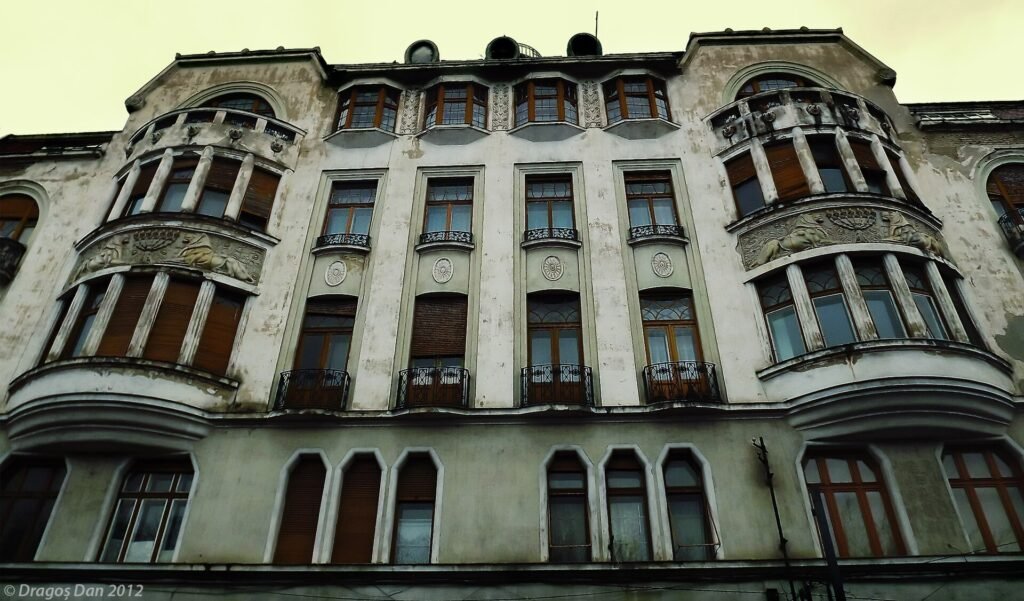
Ullmann Palace
A Viennese Secession palazzo with a Jewish surprise: on a facade otherwise devoted to measured elegance, Zsolnay ceramics in bronze-metallic enamel show a seven-branched Menorah guarded by two lions — among the most quietly extraordinary ornamental details in Oradea’s Art Nouveau heritage.
At a glance
The Ullmann Palace (Palatul Ullmann) stands in Oradea’s historic centre, attributed to architect Ferenc Löbl and completed in 1913. Its style is Viennese Secession — more restrained and geometric than the exuberant Hungarian Art Nouveau of the Vulturul Negru or the Moskovits Palace — but the building earns its place in the city’s heritage through a single detail of exceptional craft: a Zsolnay ceramic panel in bronze-metallic enamel depicting a Menorah flanked by two lions, a symbol of Jewish identity rendered in the most refined industrial ceramics available to early twentieth-century Central Europe.
Key facts
- Architect: Attributed to Ferenc Löbl (Romanian sources describe attribution as presumed)
- Completion: 1913
- Style: Viennese Secession
- Structure: Basement + high ground floor + mezzanine + 3 upper floors, arranged around an internal courtyard
- Roof: Top floor mansard with very high pitched roof
- Signature detail: Zsolnay ceramic Menorah with two lions, bronze-metallic enamel glaze
- Ceramics maker: Zsolnay factory, Pécs, Hungary
- Heritage: National Heritage Monument of Romania
History
By 1913, Oradea’s burst of Art Nouveau building was nearing its end: the First World War would interrupt construction across the region, and by 1918 the city would have passed from Hungary to Romania. The Ullmann Palace belongs to the final years of that creative period — a moment when the Viennese Secession’s more restrained, geometric register was competing with the exuberance of the Hungarian variant.
The Zsolnay Menorah is a detail that would only have been possible in the specific context of early twentieth-century Oradea: a wealthy Jewish commission, a manufacturer in Pécs whose metallic-lustre glazes were among the technical wonders of the era, and an architect willing to place a Jewish religious symbol in the most visible position on a secular commercial facade. The effect is understated and the more powerful for it: the bronze sheen of the enamel draws the eye without announcing itself.
Like all of Oradea’s Secession heritage, the palace has been listed as a National Heritage Monument by Romania. The city is a member of the Réseau Art Nouveau Network and the Art Nouveau European Route.
What you see
The facade is governed by symmetry around a central axis — a more classical compositional logic than the asymmetric explosiveness of the Vulturul Negru, but handled with Secession-era decorative language: stucco medallions, brick-work buttons, ironwork, and stained glass windows. The proportioning of the bays, both horizontal and vertical, is described by the Romanian architectural inventory as particularly well-balanced — a quality that distinguishes Viennese Secession from its Hungarian cousin at its most controlled.
The top floor is a mansard, covered by a very high pitched roof that gives the building a verticality unusual for its period. Inside, the floors are arranged around an internal courtyard — a plan type common in Central European urban palaces, here deployed with the spatial efficiency typical of a mixed residential and commercial programme.
The Zsolnay panel is positioned on the facade at a height that allows it to be read from across the street without overwhelming the composition. The bronze-metallic enamel — a Zsolnay technical speciality — catches the light differently from the surrounding stonework, drawing the eye to the Menorah and its flanking lions.
Practical information
- The Zsolnay ceramic detail is best viewed from across the street in morning or afternoon light, when the metallic enamel catches the sun
- Part of Oradea’s Art Nouveau walking circuit alongside the Vulturul Negru and Moskovits Miksa Palace
- The building is on the edge of the historic centre; the walk from Piața Unirii takes approximately 10–15 minutes
Getting there
Oradea railway station has direct connections to Cluj-Napoca (approx. 2 hours) and to Debrecen in Hungary (under 1 hour). The Ullmann Palace is in the southern part of the historic centre, roughly 20 minutes on foot from the station. Low-cost flights serve Oradea International Airport from several European cities.
Nearby
- Palatul Vulturul Negru — Komor and Jakab, 1907–1908, the city’s most famous Art Nouveau landmark
- Moskovits Miksa Palace — Rimánóczy Kálmán Jr., 1905, circular Secession corner
- Oradea — Romania’s Art Nouveau capital city guide
Sources
- Wikipedia RO, “Palatul Ullmann din Oradea” (attributed architect Ferenc Löbl, 1913, Zsolnay Menorah, Viennese Secession)
- Wikidata Q12737435 (GPS coordinates)
Find it on the map
See this place and what’s around it →📷 Diventa un fotografo di Cultural Heritage Online
Condividi le tue foto dei luoghi: restano pubblicate con la tua firma come autore. Più vengono viste, più ti fai conoscere — e presto un concorso premierà le foto più apprezzate.
Accedi o registrati gratis per aggiungere una foto