
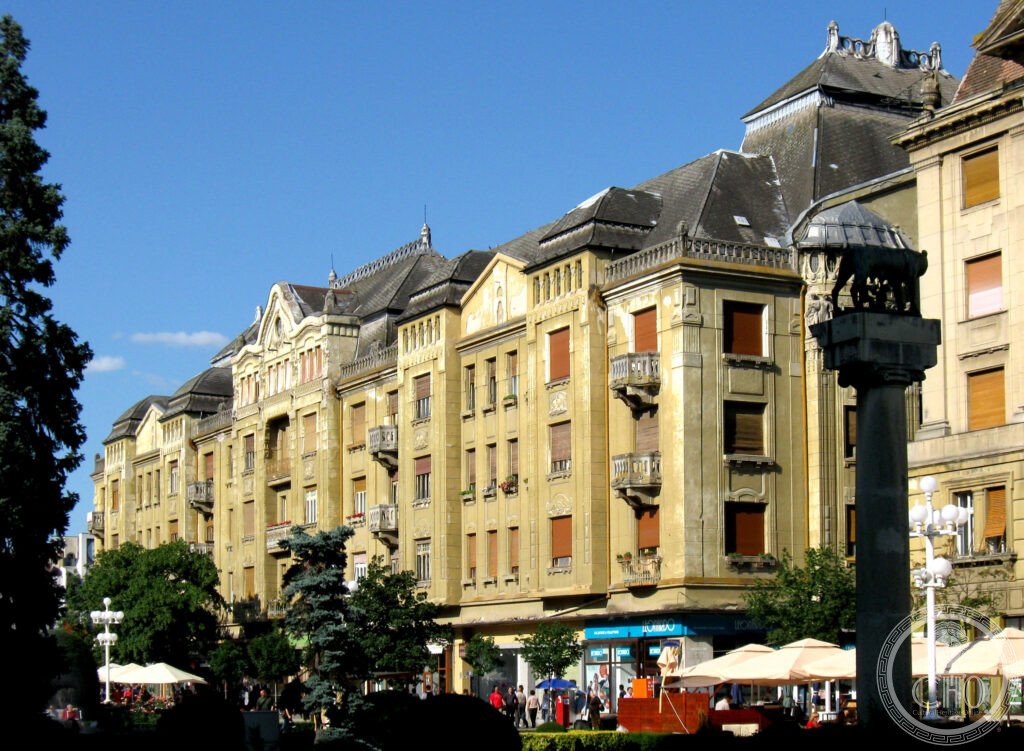
Jacob Löffler commissioned this 46-apartment block on Piața Victoriei for his three sons in 1912 — and insisted that each inherit a dignified entrance of his own, producing a palace with three separate staircases, 142 rooms, and a sculptural programme by Géza Rubletzky.
At a glance
Löffler Palace is one of the largest residential commissions of the Temesvár Secession era. Raised between 1912 and 1913 for a prosperous merchant family, the building occupies a prominent position on the Corso strip of Piața Victoriei — Timișoara’s pedestrian heart — and presents a unified façade that only on closer inspection reveals the three autonomous domestic worlds it encloses. The ornamental sculpture and the quality of the stonework place it among the finest surviving examples of Hungarian Szecesszió residential architecture anywhere in Romania.
Key facts
- Architect: Leopold Löffler (per Wikidata; attributed)
- Client: Jacob Löffler, merchant of Temesvár, for his three sons
- Completed: 1913
- Scale: 46 apartments, 142 rooms
- Sculpture: Géza Rubletzky
- Style: Hungarian National Secession (Szecesszió)
- GPS: 45.7531, 21.2259 — Google Maps
History
In the years before the First World War, Temesvár was one of the wealthiest cities of the Austro-Hungarian empire, and its merchant class commissioned residential architecture that matched the civic ambition of the public buildings rising on Piața Victoriei. Jacob Löffler’s brief was unusual: the building should house three distinct family households — one for each of his sons — while presenting a coherent and prestigious face to the most prominent boulevard in the city.
The solution was structural as much as social. Three separate principal staircases, each with its own formal entrance from the street, divided the building into thirds while sharing party walls, a roof, and a common façade composition. The scale of the resulting structure — 46 apartments across 142 rooms — was unprecedented for a private residential commission in Temesvár.
The building changed hands and use many times during the twentieth century. Today it retains its Secession ornament, a reminder of the extraordinary concentration of architectural talent that the Banat region attracted during the final decades of Austro-Hungarian rule.
What you see
The façade is organised into three vertical bays that correspond to the interior division — a rare case of a building’s domestic logic expressed directly on its public face. Each bay has its own entrance portal with carved floral and figural ornament by Géza Rubletzky, whose sculptural vocabulary moves between the sinuous naturalism of French Art Nouveau and the more geometric abstraction of the Viennese Secession.
The upper floors accumulate ornament progressively toward the roofline, where a continuous frieze of stylised botanical motifs — a trademark of the Hungarian national Secession — runs the full width of the building. Convex bay windows on the upper storeys animate the plane of the wall and catch the afternoon light from the west, transforming the pale stucco into a sequence of warm-toned volumes.
Practical information
- The exterior is freely visible from Piața Victoriei at any hour.
- Look for the three entrance portals at street level — each is individually ornamented.
- Géza Rubletzky’s figurative sculpture is clearest from across the square, in raking morning light.
- Allow 15–20 minutes for the full ornamental programme.
Getting there
Löffler Palace sits on Piața Victoriei in Timișoara’s city centre, immediately adjacent to Lloyd Palace to the north. Tram lines 1 and 8 from Gara de Nord reach Piața Victoriei in under 15 minutes. The building is a 3-minute walk from the National Opera.
Nearby
- Lloyd Palace — directly adjacent, Baumhorn’s 1910–12 Hungarian Secession civic commission
- Merbl Palace — 50 m south on the Corso, 1911 Secession apartment building by Arnold Merbl
- Dauerbach Palace — 80 m south, 1913, home to the historic “Palace” restaurant
Sources
- Wikidata entry Q1520435 — Löffler Palace (architect, GPS, inception data, scale figures)
- Wikipedia: Palatul Loeffler — room count, staircase arrangement, Rubletzky attribution
- Timișoara European Capital of Culture 2023 — Corso architectural ensemble documentation
Find it on the map
See this place and what’s around it →📷 Become a Cultural Heritage Online photographer
Share your photos of places: they stay published under your name as the author. The more they're seen, the more you get noticed — and soon a contest will reward the most appreciated photos.
Log in or sign up free to add a photoIs this page about you?
This page is read by travellers and heritage enthusiasts who find it on Google. Tell us how you are connected to this place and we will take it from there.