
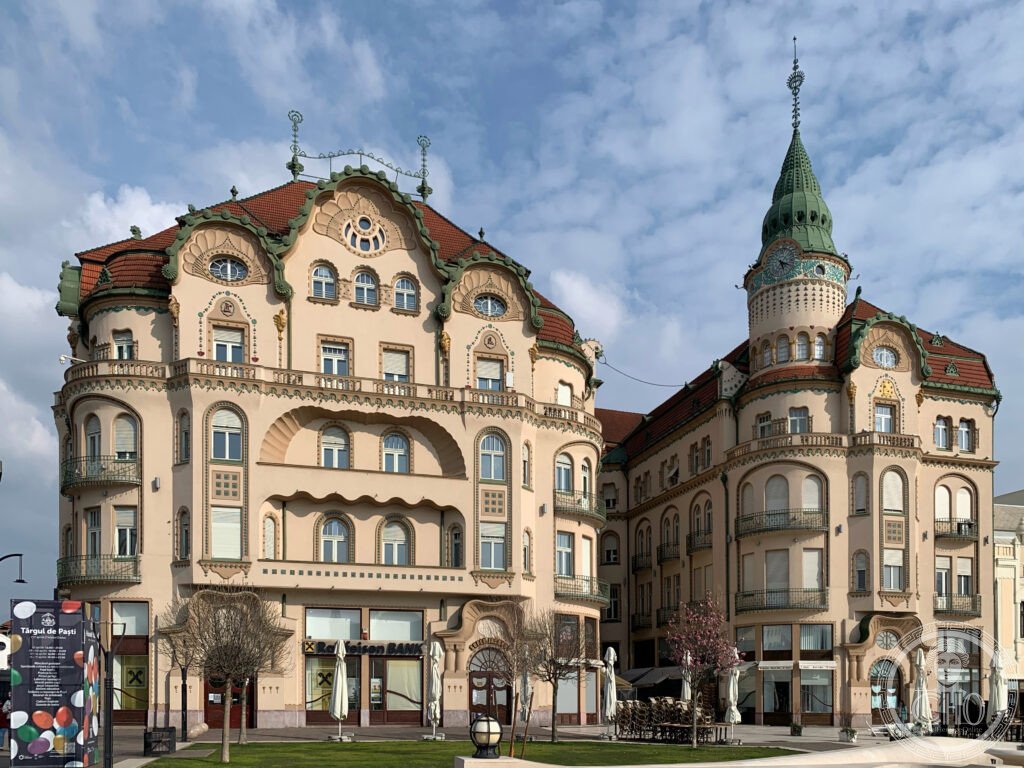
The same architects who built the Subotica synagogue crossed into what is now Romania to leave their most complex civic building: a corner palace with a glass-roofed arcade, three street frontages, and a stained-glass eagle that became the symbol of Oradea’s Art Nouveau quarter.
At a glance
The Palatul Vulturul Negru (Black Eagle Palace) stands at Strada Independenței 1, on the corner facing Piața Unirii, in the heart of Oradea’s historic centre. Built in 1907–1908 by the Budapest architects Marcell Komor and Dezső Jakab — who had already defined the Art Nouveau skyline of nearby Subotica — it is widely considered the most important Secession building in Oradea and one of the finest in the region. The palace replaced an earlier building known as the Green Tree (Palatul Arborele Verde), which had hosted the city’s cultural and political gatherings. The new building expanded that ambition into a multifunctional complex: casino, hotel, offices, and restaurant, arranged around a covered arcade that remains the building’s most celebrated feature.
Key facts
- Architects: Marcell Komor and Dezső Jakab (Budapest)
- Construction: 1907–1908; stained glass arcade completed 1909
- Style: Hungarian Secession (Szecesszió)
- Address: Strada Independenței 1, at Piața Unirii, Oradea
- Arcade: Glass-covered passage connecting Str. Independenței, Piața Unirii, and Str. Vasile Alecsandri
- Signature element: Stained-glass black eagle (vitraliu cu vulturul negru), made in the Neumann K atelier, Oradea, 1909
- Original programme: Casino, hotel, offices, restaurant across three asymmetric wings
- Heritage: National Heritage Monument of Romania
History
Oradea at the turn of the twentieth century was a prosperous Hungarian city, the capital of Bihor County, with a cosmopolitan bourgeoisie that commissioned architecture in the most advanced styles of the day. Komor and Jakab, who had already made their name in Subotica and were at work on civic buildings across Transleithania, received the commission for a new multi-purpose palace on one of the city’s principal squares. The contractor was Ferenc Sztarill.
The building replaced the Green Tree Palace (Arborele Verde), which had been the centre of Oradea’s public cultural life. At inauguration in 1908–1909, the Vulturul Negru contained a casino, a hotel, offices, and a restaurant — a complete programme of urban sociability in a single Secession envelope. The black eagle stained glass that gives the palace its name was made in 1909 by the Oradea atelier of Neumann K and installed in the tympanum of the central arcade body.
After the First World War the building passed from Hungarian to Romanian administration along with the rest of Transylvania. It has continued to serve as a commercial and social hub throughout successive political regimes. Today it houses clubs, cafes, restaurants, and business offices, and remains one of the most important gathering points in Oradea’s social life.
What you see
The palace is a corner building of high ground floor and four upper storeys, formed by two principal wings between which runs the glass-covered arcade. The main facade facing Piața Unirii is deliberately asymmetric — the most expressive Secession surface of the complex, composed of two large unequal bodies whose forms, projections, and ornament reveal the movement’s rejection of classical symmetry. The facade on Strada Independenței is more ordered and restrained, a counterpoint that underlines the theatrical ambition of the square-facing elevation.
The central motif on the main facade is a projecting body divided into two registers, culminating in a trilobate attic with the black eagle stained glass set into its tympanum. The eagle — wings spread, rendered in deep blues and golds — has become the emblem of the building and, by extension, of Oradea’s entire Art Nouveau heritage. Inside, the glass-roofed arcade still serves as a shortcut between three streets, its iron-and-glass canopy admitting daylight into a space that feels simultaneously civic and intimate.
Practical information
- The arcade is open during business hours of the establishments inside (typically 08:00–22:00)
- The main facade and stained-glass eagle are visible from Piața Unirii at any time
- Oradea’s Art Nouveau walking circuit covers the palace, the Moskovits Miksa Palace, the Ullmann Palace, and the Körös Arcade within a compact historic centre
- Tourist information available at the Oradea Promotion and Tourism Centre on Piața Unirii
Getting there
Oradea is well connected by rail: direct trains from Bucharest (approx. 5–6 hours), Cluj-Napoca (approx. 2 hours), and Debrecen in Hungary (under 1 hour across the border). The Vulturul Negru Palace stands on Piața Unirii, roughly 15 minutes’ walk from Oradea railway station. Low-cost flights serve Oradea International Airport from several European cities.
Nearby
- Moskovits Miksa Palace — Rimánóczy Kálmán Jr., 1905, circular corner and female-head keystone
- Ullmann Palace — attributed to Ferenc Löbl, 1913, Zsolnay ceramics with Menorah
- Oradea — Romania’s Art Nouveau capital city guide
Sources
- Wikipedia RO, “Palatul Vulturul Negru din Oradea” (architects, date, arcade, stained glass)
- Wikipedia EN, “Dezső Jakab” (architects’ biography and confirmed Oradea connection)
- Wikidata Q12737440 (GPS coordinates, heritage designation)
Find it on the map
See this place and what’s around it →📷 Become a Cultural Heritage Online photographer
Share your photos of places: they stay published under your name as the author. The more they're seen, the more you get noticed — and soon a contest will reward the most appreciated photos.
Log in or sign up free to add a photoIs this page about you?
This page is read by travellers and heritage enthusiasts who find it on Google. Tell us how you are connected to this place and we will take it from there.