
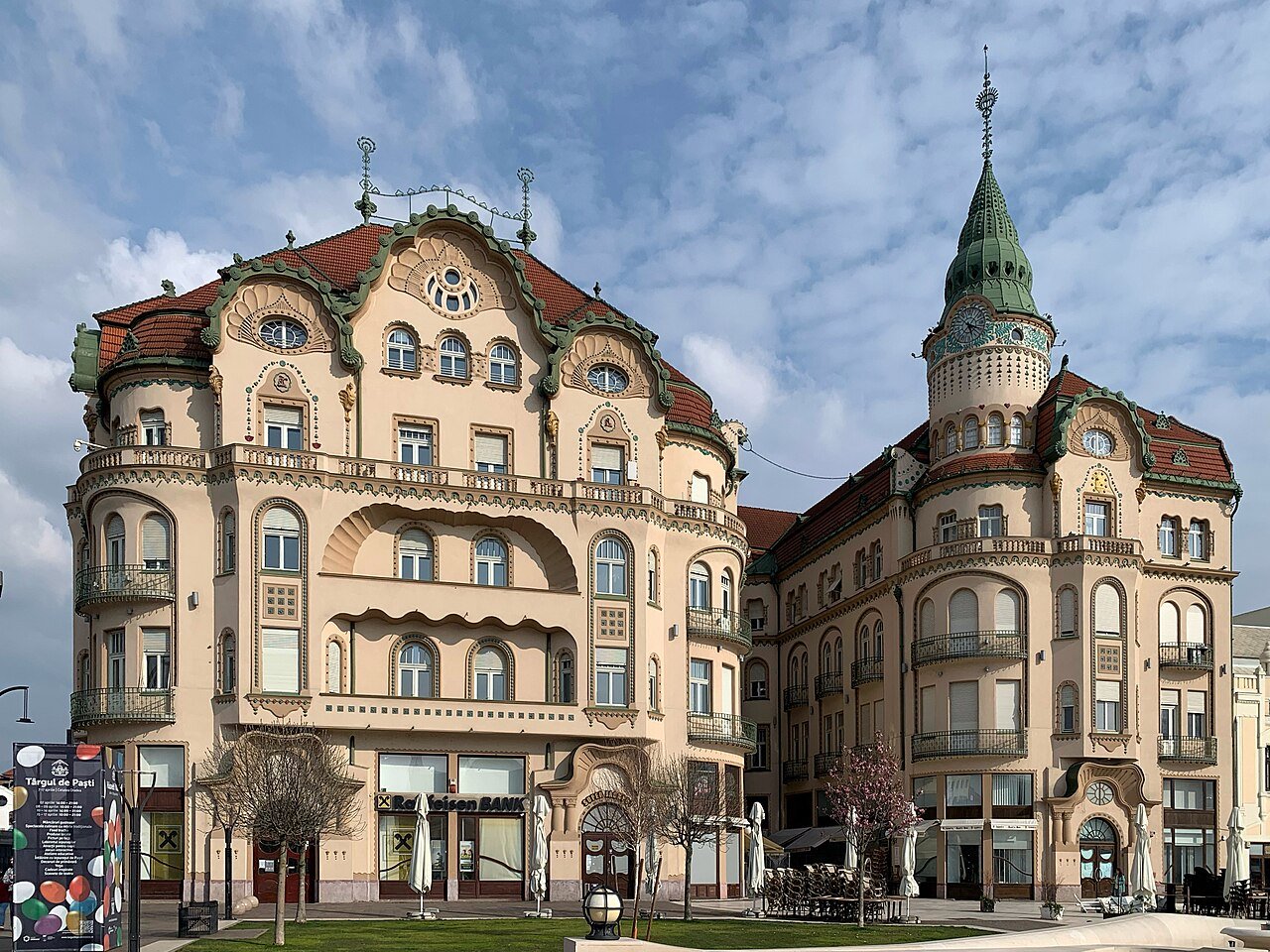
A short distance from the Hungarian border, Oradea preserves one of Central Europe’s densest concentrations of Secession architecture. Its squares and avenues were rebuilt in barely fifteen years before the First World War.
At a glance
Oradea sits in Bihor County, in the historical region of Crișana, about ten kilometres from the Hungarian frontier. During the final decades of Austria-Hungary the city grew quickly, and a generation of architects trained in Budapest and Vienna gave it a coherent early twentieth-century centre. The result is an ensemble of Secession and Art Nouveau facades — curved gables, floral stucco, coloured ceramic, ironwork and stained glass — arranged around Union Square and along the streets that radiate from it. Oradea is a member of the Réseau Art Nouveau Network and lies on the Art Nouveau European Route, which places its heritage alongside that of Brussels, Vienna and Budapest. The centrepiece is the Black Eagle Palace, but the style runs through dozens of buildings across the old town.
Key facts
- Country: Romania (Bihor County, Crișana region)
- Key period: roughly 1900–1914, under Austria-Hungary
- Key buildings: Black Eagle Palace, Moskovits palaces, Apollo Palace, Stern Palace
- Architects: Marcell Komor and Dezső Jakab (Black Eagle Palace, 1907–1908); other names associated with the city’s Secession include Ödön Lechner, the Vágó brothers (László and József), Valér Mende and the Rimanóczy family
- Essential sites: Union Square (Piața Unirii) and the glazed passage of the Black Eagle Palace
History
Oradea’s modern face dates from the long peace of the late Habsburg and Austro-Hungarian period. After the Ottoman occupation ended, the city was rebuilt from the mid-eighteenth century onward, but its decisive transformation came around 1900. A prosperous, mixed population — Hungarian, Romanian, Jewish and German — funded a wave of commercial palaces, apartment houses and public buildings during the two decades before the First World War.
The architects who shaped this boom had absorbed the new vocabularies of their time. Some looked to the Hungarian Secession of Ödön Lechner, with its folk-derived ornament and glazed ceramic; others drew on the Vienna Secession. The two currents met in Oradea and produced a local variant of Art Nouveau that is recognisably its own. The Black Eagle Palace, designed by Marcell Komor and Dezső Jakab and built in 1907–1908, became the emblem of this moment: its stained-glass eagle was executed in 1909 in the Oradea workshop of Neumann K.
Political borders shifted around the buildings rather than through them. The city passed from Austria-Hungary to Romania after 1918, and its name appears in several languages — Oradea in Romanian, Nagyvárad in Hungarian, Großwardein in German. The architecture of the pre-war boom survived these changes, and in recent years a sustained programme of facade restoration has brought much of the centre back to its early twentieth-century appearance.
What you see
The Black Eagle Palace is the building most visitors come for. It is not a single block but three asymmetrical bodies linked by a glazed, glass-roofed passage that runs between Union Square, Vasile Alecsandri Street and Independenței Street, branching so that the covered arcade forms a Y in plan. Overhead, daylight falls through the glass roof; at the junction the famous stained-glass black eagle gives the whole ensemble its name and emblem. The palace originally combined a hotel, casino, offices and a restaurant, and the passage still functions as a public shopping arcade.
Beyond it, the Secession reveals itself building by building. Union Square gathers several of the city’s grandest facades; from there, short walks lead past the Moskovits and Apollo palaces and other ornamented houses whose gables, balconies and tilework reward looking upward. The centre is compact and walkable, and the restored streetscape means the style can be read as a continuous fabric rather than a set of isolated monuments.
Practical information
- The historic centre and Union Square are best explored on foot; most Art Nouveau facades lie within a short radius.
- The Black Eagle Palace passage is publicly accessible and houses shops and cafés.
- Look upward — much of the ornament (gables, stucco, ceramic, ironwork) is above eye level.
- Oradea belongs to the Art Nouveau European Route and the Réseau Art Nouveau Network; the local tourist office publishes a Secession itinerary.
- Allow at least half a day for the centre; a full day if you add the thermal spas nearby.
Getting there
Oradea has its own airport (IATA code OMR), which reopened to scheduled traffic in 2015, and is served by several railway stations on the Romanian network. Because the city lies only about ten kilometres from the Hungarian border, it is also reachable overland from Budapest by road and rail, which makes it a natural extension of a Hungarian Secession itinerary as well as a Romanian destination in its own right.
Related in CHO
- Budapest — Ödön Lechner and the Hungarian Szecesszió
- Vienna — Capital of the Vienna Secession
- Ljubljana — The Secession, the Dragon Bridge and Jože Plečnik
Sources
_-_img_03.jpg)
Find it on the map
See this place and what’s around it →Record researched and written by Luigi De Marchi for Cultural Heritage Online, 2026.
📷 Become a Cultural Heritage Online photographer
Share your photos of places: they stay published under your name as the author. The more they're seen, the more you get noticed — and soon a contest will reward the most appreciated photos.
Log in or sign up free to add a photo