
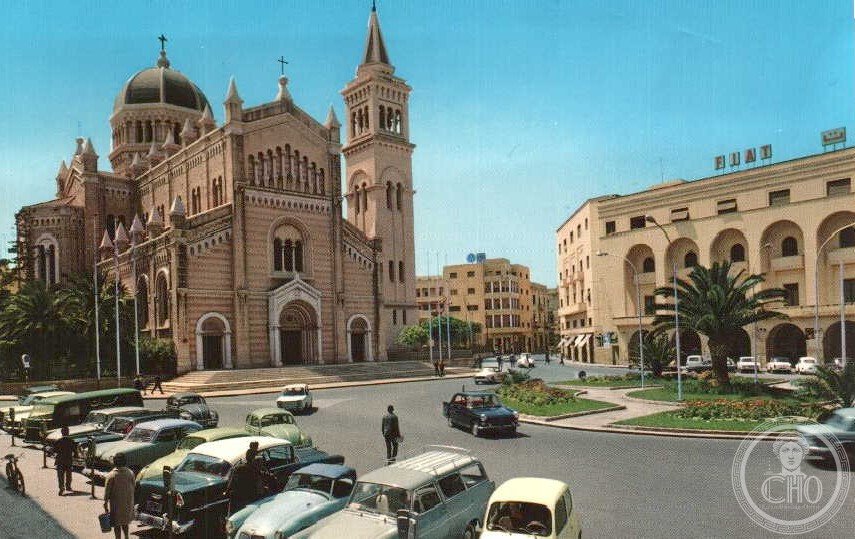
Standing at the heart of Tripoli, this building carries two complete histories within the same walls. Built between 1923 and 1928 as the Roman Catholic Cathedral of Tripolitania under Italian colonial rule, it was designed by architect Carlo Fea in a Romanesque Revival idiom: a wide arched facade, a rose window, twin bell towers, and an interior lined with mosaics depicting the Virgin Mary amid North African landscapes. For forty years it served the Italian community of the Libyan capital. After King Idris proclaimed independence in 1951 the cathedral remained, an ecclesiastical relic of a receding empire. Then in 1969, following Gaddafi's revolution, it was converted into the Gamal Abdul Nasser Mosque: the bell towers became minarets, the mosaics were removed or covered, and the orientations of worship reversed. The building retains its Romanesque exterior structure intact. In no other building in the Mediterranean world are the layered histories of colonialism, decolonisation, and religious transformation so visibly inscribed in stone.
At a glance
- Type
- Former cathedral, now mosque
- Period
- 1923–1928
- Style
- Romanesque Revival / Italian Colonial
- Location
- Central Tripoli, Libya
- Coordinates
- 32.8997° N, 13.1840° E
- Architect(s)
- Carlo Fea
Overview
The building occupies a prominent position on Tripoli's seafront promenade near the old city. Its Romanesque arched facade and twin towers dominate the surrounding cityscape. Now functioning as the Gamal Abdul Nasser Mosque, it is an active place of worship. The exterior is substantially unchanged from its 1928 form, with the addition of crescent finials replacing the original crosses at the tower tops. The building is significant both as a rare intact example of Italian colonial religious architecture in North Africa and as a living document of Libya's post-colonial transformation.
History
Italy occupied Libya in 1911–12 following the Italo-Turkish War. By the 1920s, with Libya firmly under Italian control, the colonial government undertook a programme of monumental construction to express the permanence of its presence. The Cathedral of Tripoli, commissioned from Carlo Fea, was the centrepiece of this programme for the Catholic faith. It was consecrated in 1928. The Italian population of Tripoli swelled to around 110,000 by 1940. After World War II, Italian colonists gradually departed; the cathedral's congregation dwindled. Following Libyan independence (1951) it served the remaining Italian community. After Gaddafi's 1969 coup, the cathedral was formally converted into a mosque, renamed in honour of Egyptian President Gamal Abdul Nasser.
Architecture & Design
Fea designed the building in a restrained Romanesque Revival style — a deliberate choice that referenced early Christian architecture of the Mediterranean basin rather than Gothic or Baroque idioms. The facade has three arched portals, a large central rose window, and twin towers approximately 30 metres high. The interior originally followed a basilica plan with a central nave, side aisles, and an apse. Elaborate mosaic decorations in the apse depicted the Virgin Mary surrounded by North African flora and local figures — a colonial-era effort to root the Christian narrative in Libyan soil. After conversion, the mosaics were removed or plastered over. The mihrab orientation was introduced by partially repurposing the apse. The structural bones of the Romanesque interior remain.
Cultural significance
Few buildings in the world so concisely embody the entire arc of the colonial and post-colonial twentieth century. The cathedral was built as a monument to Italian imperial permanence; within two generations it was repurposed as a monument to Arab nationalism and decolonisation. Today it is an ordinary mosque, used for daily prayer, stripped of its colonial iconography but structurally unchanged. Historians of architecture and of colonialism regard it as an irreplaceable primary source: a building that cannot be misread, because it holds its contradictions in plain sight.
Visiting today
As an active mosque, the building is open to Muslim worshippers for the five daily prayers. Non-Muslim visitors may be permitted to view the exterior and, during non-prayer hours, the interior, subject to local custom and appropriate dress. Given the political situation in Libya, travel advice from your national government should be consulted before any visit to Tripoli.
Getting there
The mosque is located in central Tripoli near the seafront Corniche, close to the Red Castle (Assaraya al-Hamra) museum and the old medina. It is within walking distance of most central hotels. Tripoli is served by Mitiga International Airport, approximately 9 kilometres from the city centre.
Sources & resources
Find it on the map
See this place and what’s around it →📷 Become a Cultural Heritage Online photographer
Share your photos of places: they stay published under your name as the author. The more they're seen, the more you get noticed — and soon a contest will reward the most appreciated photos.
Log in or sign up free to add a photoIs this page about you?
This page is read by travellers and heritage enthusiasts who find it on Google. Tell us how you are connected to this place and we will take it from there.